

3rd Playfulness Workshop: The Importance of Inclusive Education and a Welcoming Environment; Find Out How to Participate
)
At the opening ceremony of the 3rd Workshop on Playfulness: Inclusion in “Times of Welcoming”—an event organized by Sieeesp in partnership with the Celia Godoy Institute and Dislexia TDAH Amor de Mãe—Regina Stefano, coordinator of Sieeesp’s Department of Courses, Prof. Celia Godoy, and Prof. Samantha Oliveira spoke about the importance of discussing playfulness in the context of inclusion. “We—as adults, educators, and mediators—must have the peace, calm, and care necessary to welcome both ourselves and the children,” Celia emphasized.
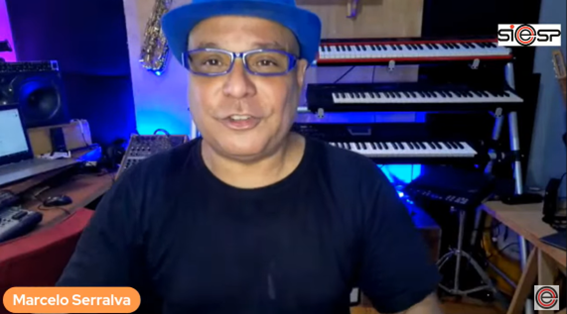
And in the first lecture of the day, Professor Marcelo Serralva addressed the topic “Gamification: Playfulness and Inclusion in Motion”—a subject that has yet to be widely discussed—with the aim of applying all this learning in the classroom with the children. Ludicalization consists of activities involving music and movement, such as games and play, finger and hand games, making instruments from recycled materials, and incorporating singing into our daily routine. All of this brings many benefits to children, such as:
- Creativity;
- Lateralization;
- Group work.
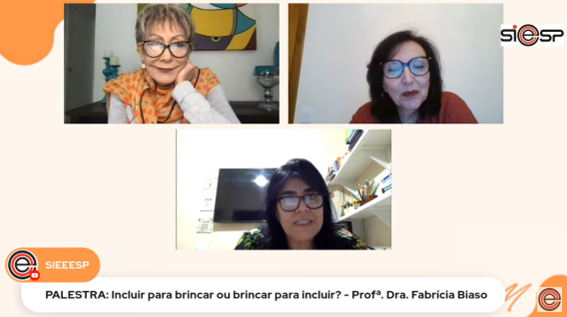
Include to play, or play to include? Professor Fabrícia Biaso, Ph.D., emphasized the importance of creating spaces and activities that are accessible and welcoming to everyone. In addition to adapting environments, games, and ways of playing to include everyone, “it’s also important to pay attention to understanding differences and fostering interaction and bonding among children during play,” she notes.
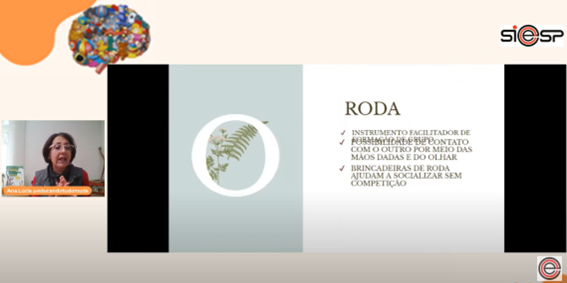
Professor Ana Lúcia Machado, for her part, spoke on the topic“Circles in Motion: Playfulness and Inclusion,” exploring how movement and interaction with the world, combined with activities designed for educational and psychological purposes, utilize the principles of physical education to improve children’s body awareness.
“Regardless of age, interaction is essential to the learning process. Children need to interact with their peers, teachers, and family, and to do so, they must establish communication—both verbal and nonverbal—through gestures. It is essential to work on psychomotor development with children so they can better coordinate their movements and everything related to their surroundings,” the teacher emphasizes.
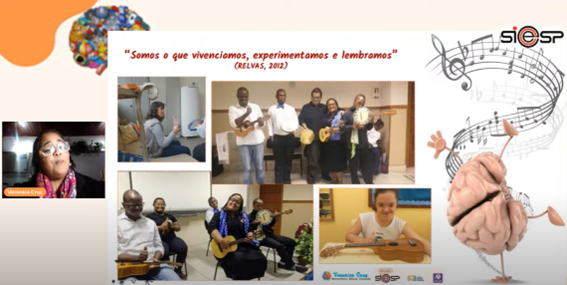
Expert and professor Veronica Cruz, while discussing neuroscience and music as a form of playful expression in education and inclusion, explained that on one hand there is neuroscience, which deals with the objectivity of data and the signals that map brain function. On the other hand, there is music, “which cannot be understood without taking into account the subjectivity, playful engagement, and transitivity that characterize art.” When we listen to music, our heart rate, breathing rate, and brain waves change in accordance with the rhythm and melody. In other words, “they dance to the music.” Music is not only processed in the brain but also affects its functioning. And the potential benefits of the most emotional of the arts do not stop there: music also enhances linguistic abilities.
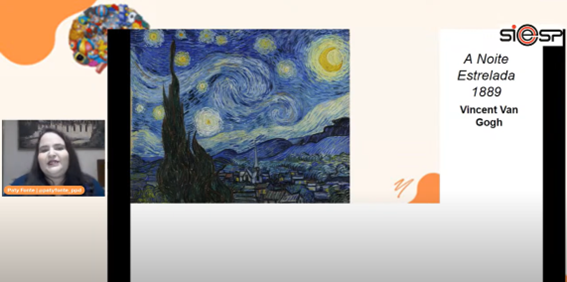
SocioemocionArte: Playful and Emotional Inclusion, in which teacher Paty Fonte spoke about the importance of social-emotional development in early childhood education. Having well-developed social-emotional skills involves recognizing one’s own emotions and learning to manage those feelings as part of the art of living in society—something that should begin from the very first steps. “It is worth noting that, to achieve the goal of fostering social-emotional skills in children, we need to have a targeted approach,” the teacher emphasizes.
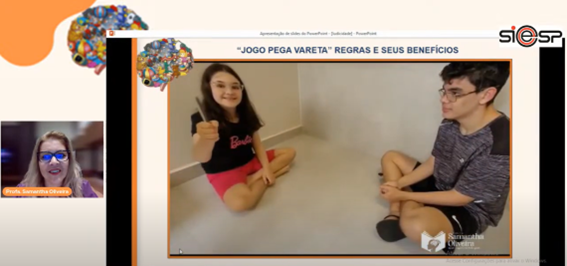
For the final topic of the day, teacher and specialist Samantha Oliveira spoke about ADHD: playing as a family to strengthen bonds and develop skills. To this end, it is essential to encourage children to play—not only for recreation, but because through play they learn skills that are important for their growth. From birth, children interact with the world, and the family is their first social contact. Through family play, children develop various skills: language, motor, cognitive, and emotional. “When a family plays with a child, it is contributing to the child’s full and healthy development. In educational practices, family play serves to strengthen relationships and teaches children to manage and take control of everyday situations,” she notes.
Day 2 of the Ludicidade Workshop will be streamed on the Sieeesp YouTube channel starting at 1:30 p.m. Watch it HERE.
There's still time to register and receive your certificate. Click here.
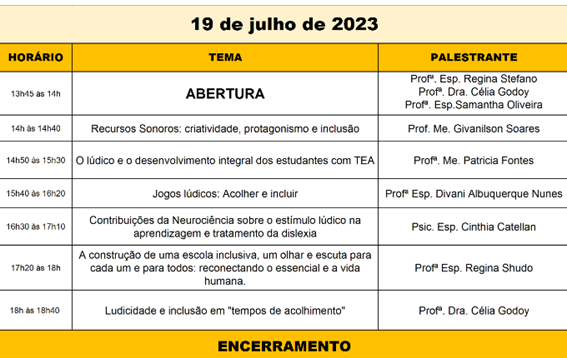
Check out today's schedule:
Share on social media:
Categories
- Diversity, Equity, and Inclusion (DE&I)
- Learning Strategies