

The Science Behind the Use of Immersive Technologies in Education
)
According to the data and research platform Statista, the global virtual and augmented reality market will grow from $10.5 billion to $18.8 billion between 2019 and this year. Most of this growth will come from consumer demand. In other words, more and more people around the world will be using VR and AR. But when it comes to education, is there a scientific basis for using these technologies, or is their use merely a marketing strategy?
Dr. Narendra Kini, CEO of the Miami Children's Health System, discovered while training medical students that, typically, when using more traditional tools such as PowerPoint presentations or textbooks, students were able to retain about 20% of the content after one week.
By incorporating VR into his training sessions, Dr. Narendra found that his students were able to retain up to 80% of the content even a year after the class. In other words: in addition to a 400% increase in knowledge retention, the duration of retention increased exponentially.
But why does this happen?
According to Chris Milk, an immersive artist, producer, entrepreneur, and co-founder of Within, there is what he calls “suspension of disbelief”—the gap between a reality described in words and what our senses would experience if we were to live that reality ourselves. For Chris, there is a space where we cannot believe in or understand reality without experiencing it firsthand.
With virtual reality, we can bridge that gap by understanding what realities are and how they work, and this is essential for increasing students' knowledge retention.
Do you remember Edgard Dale and his pyramid?
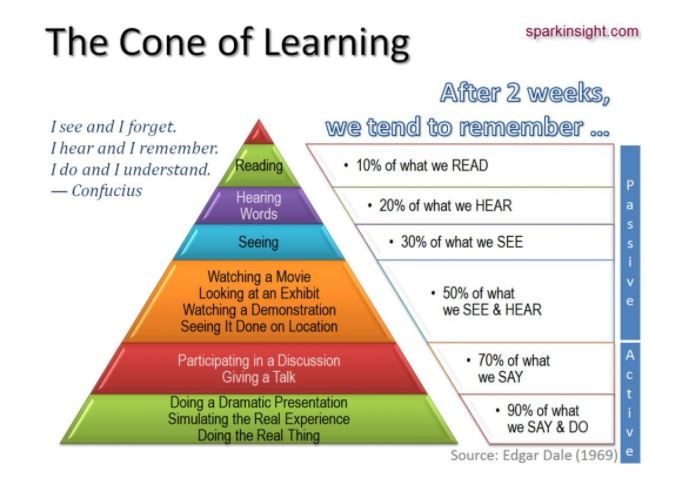
Think of a virtual reality activity. In it, the simulation of environments and experiences engages multiple senses, stimulates our entire body, and brings the whole pyramid to life within a single setting. At Realvi, on top of everything else, students engage in oral communication—they talk with virtual characters. Through our VR and AR experiences, we catalyze student learning so that they consistently achieve maximum retention.
We will continue to explore the science behind immersive technologies here so that we can learn more about them and understand why they will revolutionize education in the coming decades.
Did you like this content? Share it on your social media:
Categories
- The Future of Education
- Innovation