
The Importance of the Unexpected and Social Interaction in Remote Learning
)
It is distressing to begin 2021 without knowing when it will be possible to resume classes and other in-person activities at schools and institutions of higher education. First, because there are millions of students with limited or no access to the Internet and other resources needed to learn and interact remotely. There are also certain limitations to emergency distance learning that were observed by students, teachers, and families throughout 2020, including a reduced capacity to handle the unexpected.
In face-to-face meetings, there are some possibilities that are still difficult to achieve remotely today due to a lack of access to the appropriate resources. Observing body language, physical contact, casual conversations during breaks, and side conversations during class are some of the common experiences that take place in shared physical spaces and shared moments—human aspects that Brazilian culture abundantly teaches us to value. And these are missing, to a greater or lesser extent, in remote interactions, whether synchronous or asynchronous. Those working in the field of education understand the importance of these subjective, unpredictable, and spontaneous factors and how they can influence students’ learning performance.
They help shape what is known as “social presence”—the participants’ ability to identify with the community (for example, their class), communicate purposefully in a trusting environment, and develop interpersonal relationships by expressing their individual personalities.
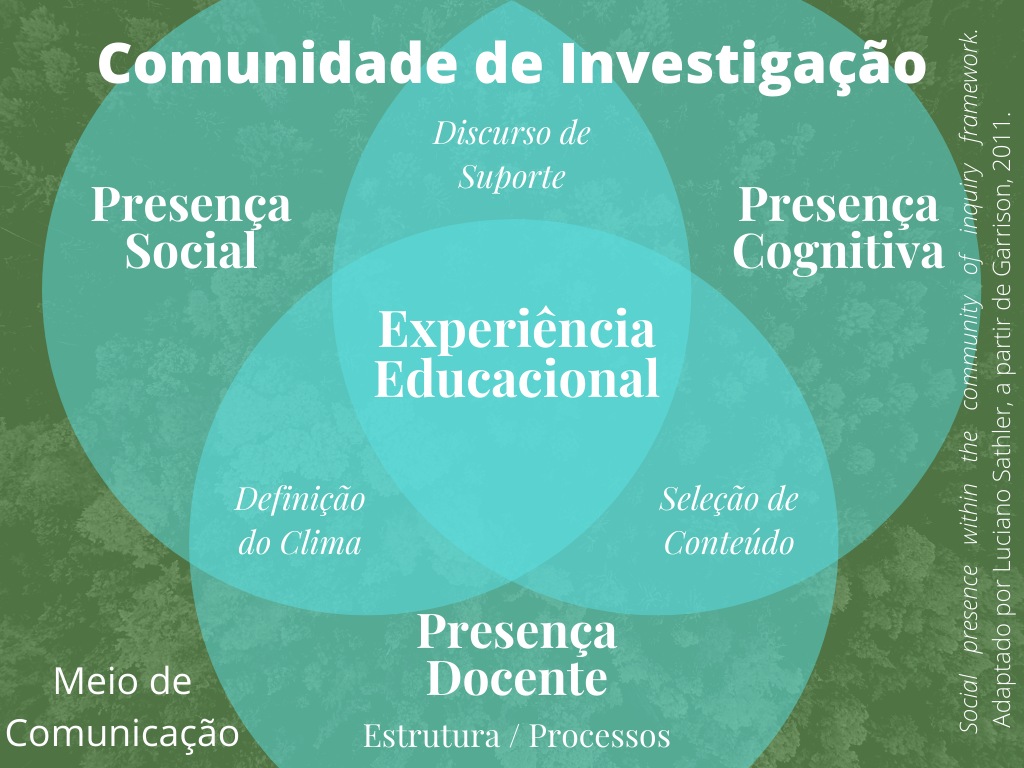
Social presence is one of the components of the proposed* model of a Community of Inquiry—defined as a group of individuals who collaboratively engage in critical and reflective discourse to construct personal meaning and confirm mutual understanding.
The theoretical framework of the Research Community represents a process of creating a deep and meaningful, collaborative-constructivist learning experience through the development of three interdependent elements—social, cognitive, and teaching presence—as shown in the figure below.
Students’ learning outcomes depend on the depth and quality of their engagement in learning, which involves behavioral, cognitive, and emotional components. To help make up for some of the lack of unpredictability, it is recommended to ensure that students have a variety of ways to engage with instructional materials, the teacher, and other students. It is necessary to develop strategies that stimulate students’ interests, strengthen their persistence, and support self-regulation.
In synchronous video conference classes, it is advisable to designate a different student each time to be responsible for providing notes on the material to all classmates. This way, other students can focus on actively engaging with the activity or lecture, knowing that they will be able to supplement their own observations with those of an official note-taker. In addition, the instructor should supplement written notes with audio and video recordings so that students can choose the format they prefer when reviewing the material. In larger classes, the instructor can designate groups of note-takers, ask for volunteers, or involve the class in nominating classmates for the role.
Another recommendation is to offer students a variety of opportunities for physical activity, as well as options to demonstrate their learning and multiple chances to improve their executive function—that is, the strategic planning and execution of the steps involved in a learning task. For example, students might have the option to write a short essay, prepare narrated slides, create a website, or submit an audio recording answering the questions in the assignment.
As with any assignment, it is most beneficial for students when a rubric accompanies any assignment submission option to clarify the instructor’s expectations and ensure consistent grading criteria, regardless of the submission format chosen.
The younger the students are, the greater the difficulties with remote learning—a situation that can only be truly assessed once in-person classes and other activities resume. After all, as Comte-Sponville reminds us: “The child, who knows nothing else but to imitate, spontaneously desires everything he or she imagines to be a source of pleasure for others and thus becomes, for amoral reasons (emulation, imitation, education…), a being for whom all acts customarily called ‘wrong’ will be followed by sadness and the so-called ‘right’ ones by joy—that is, it becomes precisely a moral being.” **.
* GARRISON, D. R. Article review: social presence within the community of inquiry framework. In International Review of Research in Open and Distance Learning, vol. 13, no. 1, pp. 250–252, 2011.
** COMTE-SPONVILLE, A. *To Live*. São Paulo: Martins Fontes, 2000.
Learn more about the author:
)
Did you like this content? Share it on your social media: