

Tax Reform and Schools
)
Last September, the Federal Government submitted its tax reform proposal to Congress. It was expected that, from that point on, the Executive Branch would pressure the Legislative Branch to expedite the bill’s passage so that it could be approved in 2021 and take effect as early as 2022.
That hasn't been the case so far. The government has focused on other priorities in its relationship with Congress, and the truth is that tax reform has been sidelined over the past two months.
It is unclear whether there will be an initiative later this year to fast-track the bill through Congress. In the most likely scenario, the government will not have the political capital to drive this process forward in this manner, and the reform will be postponed to future years. There is, however, still a possibility—one that cannot be ruled out—that an attempt will be made to pass the bill in the month and a half remaining until the end of 2021. It is not uncommon for tax legislation to be passed at the very end of the legislative year, precisely because of the constitutional principle of prior notice regarding tax collection.
When the terms of the government’s proposal were made public, there was a great deal of uproar over the introduction of an income tax on dividends. At first, this new measure was viewed as excessive taxation on the private sector. The numbers, however, do not paint quite that picture.
The introduction of a 15% tax on dividend distributions is offset by a reduction in the corporate income tax and social contribution rates. It is, therefore, a trade-off that reduces the impact on corporations while increasing it for individuals.
This exchange, however, is not necessarily neutral. The larger the proportion of profits a school distributes, the greater the impact of the change will be. The size of the profit margin also plays a role. The table below shows the possible combinations.
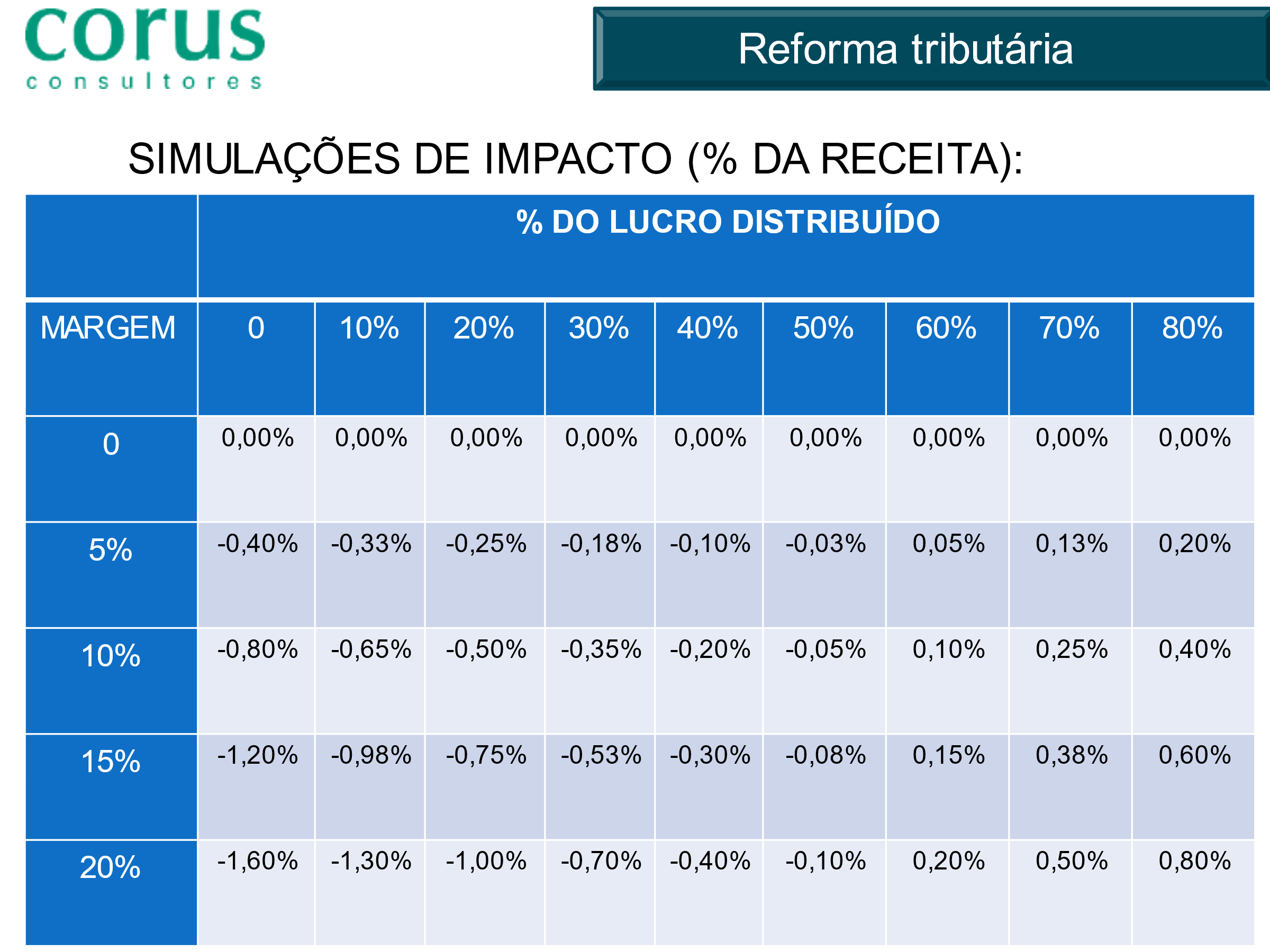
As can be seen, the possible impacts will fall within the range of a 1.6% decrease and a 0.8% increase in the school’s revenue. The intermediate ranges in the table are the most common—given this, the possible impact is even smaller, at less than 0.5% of revenue.
Despite all the fuss, therefore, the approval of the dividend tax does not pose a risk to schools. The impact will be nothing that cannot be managed for a year and then passed on to prices.
Schools should indeed be concerned about another aspect of the tax reform that has not yet been submitted to Congress: the creation of the Contribution on Goods and Services (CBS). Depending on the proposal, this item could account for between 4% and 8% of schools’ revenue. To guard against this, it is essential that every school include the following clause in its service agreement with parents:
“If any legislative or regulatory change enacted by the government results in a proven increase in the School’s costs or a reduction in its revenues, the amounts of the annual installment payments will be revised in order to maintain the economic and financial balance resulting from this contract.”
It is highly recommended that schools monitor the progress of the discussions on tax reform as the year comes to a close. Depending on the outcome, school administrators will need to make calculations and decisions.
Learn more about the author:
With a degree in Economics from the School of Economics and Business Administration at USP and an MBA in Business Economics from USP, Barão served as director of Sieeesp (Union of Educational Institutions of the State of São Paulo) and managed private schools for nine years. He serves on the board of several educational institutions. He has been working as a business consultant since 1994.
Share this content on your social media!