
The official opening of Bett Brasil 2025 highlights education as a tool for addressing crises and building regenerative futures
)
Bett Brasil 2025, the largest event for innovation and technology in education in Latin America, officially opened this Monday (28) at 10 a.m. in São Paulo. Now in its 30th edition, the event expects to draw more than 46,000 visitors over four days, fostering essential discussions about the future of education. The opening ceremony addressed this edition’s central theme, “Education to Tackle Crises and Build Regenerative Futures, ” and was attended by educators and industry leaders.
Claudia Valério, the executive director of Bett Brasil, welcomed the attendees and highlighted the event’s key discussions, which focused on strategies to bring together the various stakeholders in the educational ecosystem.
In addition, Claudia noted that this edition is even more special, as the event is celebrating its Pearl Anniversary. “30 years, 30 editions, and today of all days—World Education Day—we’re opening Bett Brasil 2025. We’re very proud to hold the opening ceremony for this event on a date like this.”
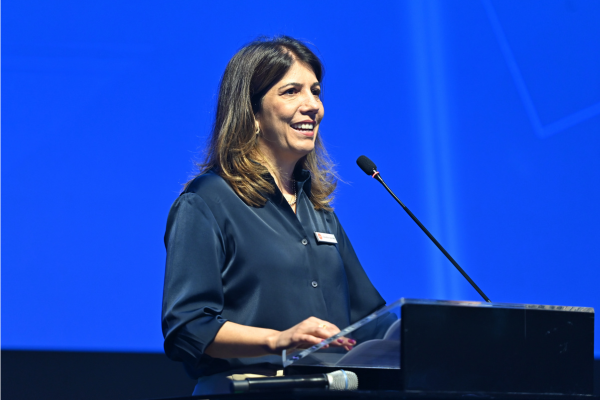
The director emphasized that this year’s event will address current issues that are part of everyday life in society and schools—and that, in some way, have implications for the future. “We’ll discuss topics of extreme social relevance, such as climate change, mental health, and artificial intelligence. There will be four days of extensive learning, exchanges, and relationships that should last throughout the year,” emphasized the general director of Bett Brasil.
The president of the National Education Council (CNE), César Callegari, emphasized that the future is already here and presents constant challenges to education. “The world is moving forward and challenging us to seek new solutions. To do this, it is essential to understand that learning is not limited to the reproduction of content, but requires processes of experimentation. We create knowledge when we experiment—and even more so when we do so collaboratively and collectively,” he said.
Callegari highlighted the main challenges and projects currently being led by the CNE, such as the development of the new National Education Plan; the implementation of new curriculum guidelines and high school pathways; the standardization of screen use in classrooms; and guidance on new regulations for teacher training in both elementary and high school.
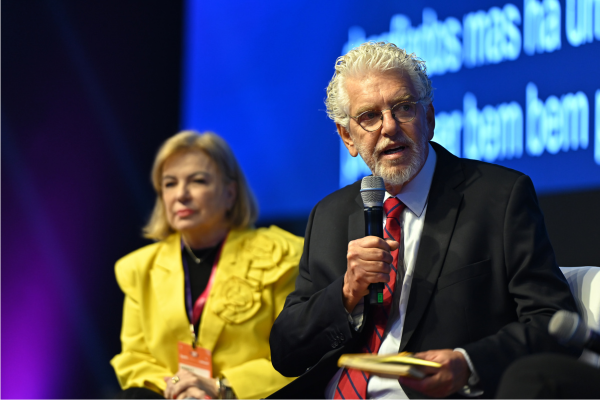
“We are ushering in a new era for another 2 million teachers. We will train a new generation focused on holistic education and on both practical and theoretical experimentation. We firmly believe that the use of technology cannot replace in-person, collaborative teaching, and this belief guides our efforts,” he concludes.
For Amábile Pacios , vice president of the National Federation of Private Schools (FENEP), teacher training is essential for educational progress. “The private sector currently trains 67% of teachers, which places a great deal of responsibility on us. We need support to advance this training. This is a joint and fundamental effort.”
Amábile offered food for thought to those in attendance at the opening ceremony. According to her, fewer young people today want to become teachers than in decades past. “Based on the school we run, we haven’t seen a significant number of young people wanting to become teachers in the last 10 years. This is largely a reflection of society’s lack of recognition of the role of teachers. We need to change this cultural aspect, and that is a responsibility we all share.”
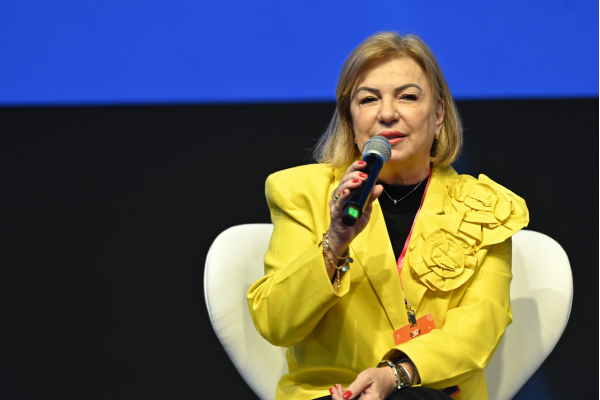
The expert also cited the need for improvements to the regulatory framework for distance learning, as the document directly affects national educational policy. “We need an empathetic dialogue on this issue within the sector; it directly affects our school curriculum and teacher training.”
The director of the Federal Government’s Secretariat of Basic Education (SEB), Anita Gea Martinez Stefani, emphasized that the Ministry of Education (MEC) has been working intensively to integrate technology into Brazilian education, while respecting Brazil’s unique characteristics and challenges. “Our main goal is to prevent technology from becoming yet another factor contributing to inequality. We still have nearly 4,000 schools without electricity, while others are equipped with cutting-edge technology. We approach this from a systemic perspective, ranging from basic to advanced use of innovations without excluding anyone,” she states.
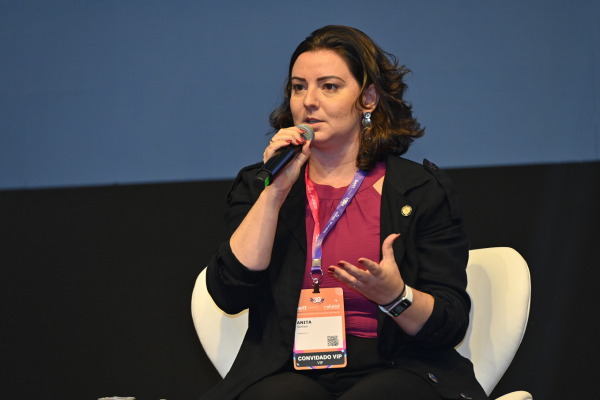
Continuing education for teachers that includes training in technology was another topic raised by the Federal Government representative. “We need to incorporate technology into the curriculum and the in-person learning model, strengthening the teacher’s role as a facilitator and instructor in the ethical and consistent use of these tools.”
Vinicius Neiva, executive secretary of the São Paulo State Department of Education, noted that the state government has been prioritizing age-appropriate literacy in public schools. According to Neiva, the administration has been using new technologies—some of which were even presented to the government at previous editions of Bett Brasil—and has achieved positive results with the implementation of this method.
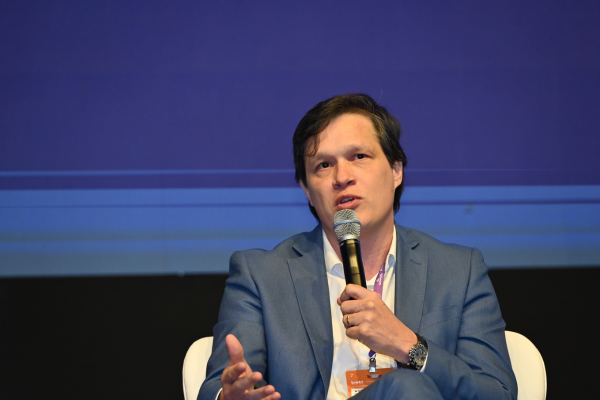
The secretary also cited data showing that vocational education is growing exponentially in the state of São Paulo, which is prompting the government to expand the technical curriculum. “We need to define the choices we will make for Brazilian education. We need to determine what content will be covered in the classroom and how to connect that to young people’s future in the job market. We’re seeing a huge increase in demand for technical courses, which we view very favorably,” he said.
Another point raised by Vinicius is the need for discussions on education funding to address current crises. “It’s a topic that’s rarely discussed, but we need to talk about education funding. For example, to address the climate crisis, we have to retrofit schools to accommodate air conditioning and make that financially sustainable. It’s a discussion that should take place across various levels of government and sectors.”
The opening ceremony was moderated by Adriana de Barros, a journalist and TV Cultura host.
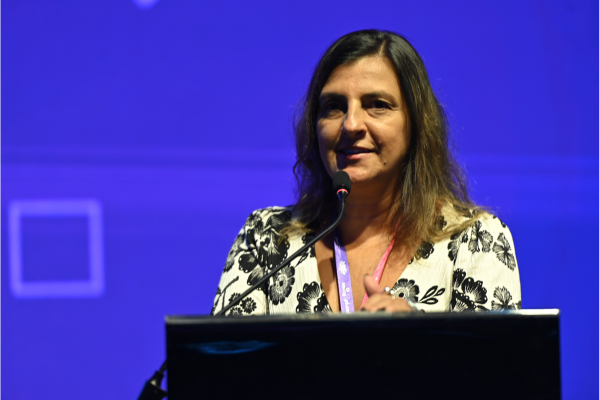
Bett Brasil features a robust program that includes more than 450 national and international speakers, spread across 12 concurrent auditoriums. The activities include conferences, forums, and thematic arenas, featuring innovative interactive formats such as the Aquarium, Roundtable, and Flipped Classroom. Highlights include topics such as the climate crisis, artificial intelligence, mental health, equity in education, and human development.
The event runs through Thursday (May 1) at Expo Center Norte in São Paulo and features more than 330 exhibiting brands, offering cutting-edge solutions for K-12, higher education, and vocational education. Admission is free.
Share on social media:
Categories
- The Future of Education