
School Meals: How to Optimize the Overall Management of the PNAE
)
School meals are much more than just a right of public school students that must be protected. There is a consensus that this is a fundamental issue, since it affects not only students’ quality of life but also their academic performance.
To manage school meals, education officials must carry out various steps of the National School Meals Program (PNAE).
Most of the time, these tasks are performed manually, but the good news is that many of them can be streamlined by implementing efficient measures.
Success Story
In Mato Grosso do Sul, the State Department of Education has invested in technology to streamline administrative processes and ensure consistent, real-time information on school meals across all participating schools.
The chosen technological solution was Cheff Escolar, the only software in Brazil that covers all stages of the PNAE and provides greater agility, efficiency, and transparency in its operations.
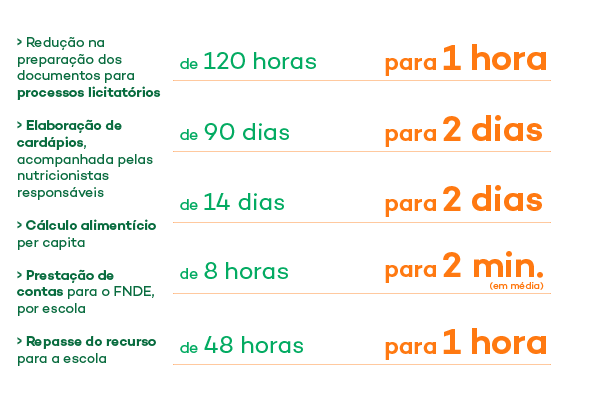
Check out the top 5 results achieved by SED-MS:
Real-time information
Another benefit of Cheff Escolar is its integration with Business Intelligence (BI), a service that provides monitoring dashboards with strategic indicators, enabling more efficient analysis and monitoring of the PNAE.
With the BI, it is possible to monitor schools' consumption in real time. This enables administrators to make adjustments to ensure that school meals are provided as effectively as possible.
In Mato Grosso do Sul, food quality is monitored through the BI. School meals consist of 82.5% fresh or minimally processed foods and only 13.9% processed or ultra-processed foods.
Figures that exceed the program's requirements: at least 75% of the resources must be allocated to fresh or minimally processed foods, and no more than 20% to processed and ultra-processed foods.
It is a fact that technological solutions make management more modern, streamlined, and transparent; and by helping ensure compliance with the law, they also guarantee that public school students have access to nutritionally adequate meals.
By using these solutions, school teams have also gained more time to focus on what really matters: teaching and improving student performance.
Before this system was implemented, schools spent a great deal of time organizing school meals. Today, those efforts can be focused primarily on educational matters—a benefit for students, parents, staff, and educational institutions.
To manage all stages of the school meal program in a practical, integrated way that complies with PNAE standards, visit the Cheff Escolar website and learn about the software that will revolutionize your Department of Education.
Share on social media:
*Content is the sole responsibility of the advertiser.
**This text does not necessarily reflect the opinion of Bett Brasil.
Categories
- Educational Management