

Synchronous online classes aren't always the best option
)
In 2020, 99.3% of Brazilian schools suspended in-person classes, keeping their doors closed for an average of 279 days during the school year. *
Inevitably, reactions to the public health emergency have brought to the forefront practices and discussions that have been part of the distance education (DE) scientific community for decades. Some educators and administrators, who had previously refused to discuss topics related to DE, were forced to broaden their perspective in an effort to address the unforeseen situation.
Remote learning has become a euphemism for distance education carried out without planning, with little or no prior training, a lack of equipment, software, and virtual learning environments, and unreliable internet access. The heroic improvisations of those who tried to cope with social distancing have become a double-edged sword. On the one hand, the conviction has spread that Digital Information and Communication Technologies (DICT) should be incorporated into teaching and learning practices. However, the mixed results achieved have shown that the ability to respond varied greatly between the public and private sectors, as well as from one location to another.
As society recognizes the urgent need to resume in-person activities in schools, there is concern about making up for learning that did not take place as it would have under normal circumstances.
“The hope is to rely on remote education as an ally in supporting teaching strategies within a hybrid model—combining in-person and remote learning, preferably facilitated by technology—which can make it possible to extend study time for children and young people and help them catch up on their learning. There is a generation at risk of having their cognitive and social-emotional development compromised, but this challenge must be faced, and it is possible to overcome it.” **
In schools that chose to maintain the same number of synchronous online classes as they had in-person, reactions such as increased stress and low effectiveness were evident. The students’ silent and indignant protest manifested itself in the “camera-off” crisis. It was common to hear the complaint: “What was already boring got even worse.”
I was reminded of a very informative, albeit introductory, article*** that discusses the different possibilities of synchronous and asynchronous activities, from which I have drawn the following information.
Asynchronous activities support teaching and learning relationships even when participants cannot be online at the same time. They are, therefore, key components for fostering flexibility and personalization in distance learning.
Synchronous meetings facilitated by TDIC have the potential to strengthen the development of learning communities. They offer a more social experience, enabling real-time interaction and helping to reduce feelings of isolation.
It is important to understand when, why, and how to use the different types of distance learning components, especially synchronous and asynchronous activities. Even in schools that have chosen to—and have succeeded in—matching the course load with synchronous classes via videoconferencing, it is possible to observe shortfalls in expected learning outcomes.
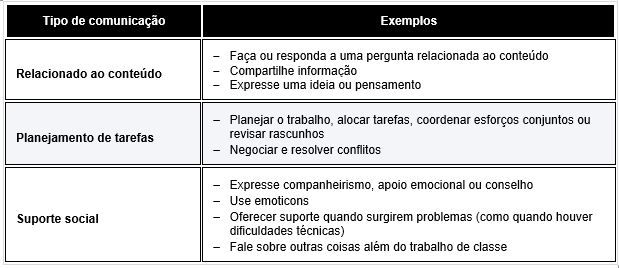
There are three types of communication that are important for building and sustaining online learning communities—see Table 1.
First, communication related to course content is essential for learning. Students need to be able to ask questions and share information and ideas. Second, support for task planning is essential, especially when students are creating some kind of product, such as an assignment, in collaboration with their peers. Finally, supportive social relationships are desirable for creating an atmosphere that promotes collaborative learning.
Table 1. Three Types of Communication in Online Learning Communities
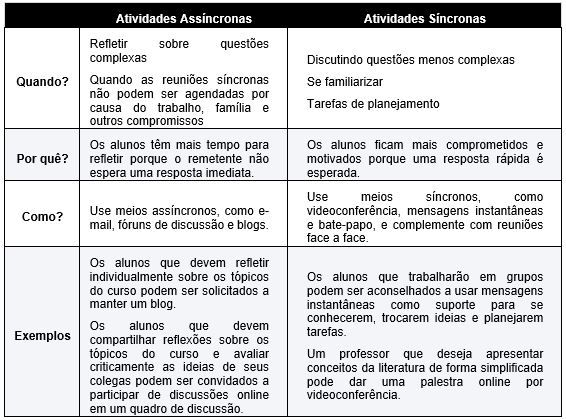
Synchronous communication allows you to monitor the recipient’s reaction to a message, making the participant feel more engaged and motivated to read it. When communicating asynchronously, however, the student has more time to understand the message, since the sender does not expect an immediate response. Thus, synchronous activities increase excitement and motivation, while asynchronous activities enhance the ability to process information.
Synchronous activities lead to a more engaging form of participation, suitable for less complex exchanges of information, including task planning and social support. Asynchronous activities should focus on more reflective tasks, especially for discussions of complex issues.
The combination of synchronous and asynchronous learning offers several ways for students and teachers to exchange information, collaborate on assignments, and get to know one another. Table 2 summarizes when, why, and how to propose asynchronous or synchronous activities.
Table 2. When, Why, and How to Use Asynchronous or Synchronous Activities
References
* INEP. Educational Response to the COVID-19 Pandemic in Brazil. Brasília, DF: Anísio Teixeira National Institute for Educational Studies and Research (INEP), 2021.
** CNE. National Guidelines for the Return to In-Person Classes and the Reorganization of the School Calendar: Proposed Opinion and Draft Resolution. Brasília, DF: National Education Council (CNE), 2021.
*** HRASTINKI, Stefan. Asynchronous and synchronous e-learning. In Educause Quarterly, vol. 31, no. 4, Oct.–Dec. 2008.
Learn more about the author:
Did you like this content? Share it on your social media:
Categories
- Learning Strategies