

Bett Brasil 2026 Shows Why the Future of Education Is Still Human
)
The second day of Bett Brasil 2026, Latin America’s largest event on innovation and technology in education, sent a clear message to educators, administrators, and experts: amid the rapid advancement of artificial intelligence, the human factor has never been more crucial to the future of education.
One of the highlights of the program was the release of the report by the OECD—the Organization for Economic Cooperation and Development. Brazil now has free access, in Portuguese, to the leading international document on generative artificial intelligence in education. During the AI in Education Summit, the Salto Institute presented the complete translation of the OECD’s *Digital Education Outlook 2026: Exploring Effective Uses of Generative AI in Education*. The report comprises 13 chapters featuring comparative evidence, case studies, and interviews with researchers and administrators from different countries on the use of generative AI in education.
The presentation was led by Rafael Parente, Executive Director of the Salto Institute, and Lucia Dellagnelo, Deputy Director for Education and Skills at the OECD and a Harvard Ph.D.
“Artificial intelligence is already deeply embedded in Brazilian schools. What was missing was a public, rigorous, and accessible resource in Portuguese to guide responsible decision-making by educational administrators and leaders,” Parente points out.

Rafael Parente during the launch of a report on AI in education. Photo: Bett Brasil.
Lucia Dellagnelo emphasized that the use of generative AI tools, in and of itself, does not guarantee learning—and may even hinder understanding when used without a pedagogical purpose. “Using generative AI to perform tasks is not the same as learning from it. Educational gains occur when there is qualified guidance and an appropriate pedagogical design, led by the teacher,” she explains.
According to her, general-purpose tools can offer significant opportunities, such as more conversational, flexible, and adaptable approaches across different disciplines. However, they still present significant challenges, such as occasional errors (so-called “hallucinations”) and the need to make experiences more engaging to promote real learning.
Among the key lessons highlighted by the report is the importance of keeping teachers at the center of the educational process. “Algorithms can suggest paths, but it is educators who must make the decisions. No AI-generated lesson plan can replace a teacher’s professional judgment,” Lúcia emphasizes.
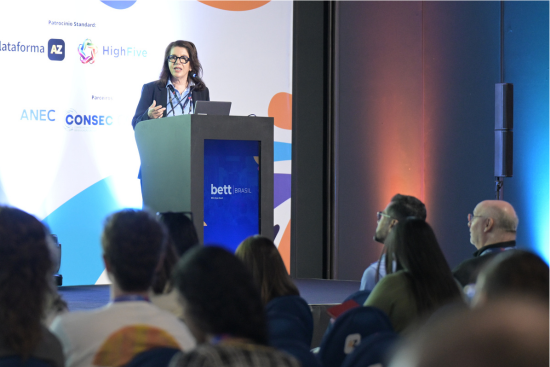
Lucia Dellagnelo emphasized the importance of teachers as the cornerstone of the educational process. Photo: Bett Brasil.
The work is available under the CC BY 4.0 open license and can be downloaded via this link. The aim of the study is to use its findings to develop public policies for the responsible use of AI, invest in teacher training, advance data protection regulations, and encourage research on the impacts of technology on learning.
“We are entering a phase of ‘AI-enhanced education.’ This means that technology is no longer merely an accessory but has become an integral part of the educational framework, requiring a review of the curriculum, assessment, and teaching practices,” added Rafael Parente.
Meanwhile, during the main plenary session of the Basic Education Congress, historian Leandro Karnal and Leo Chaves, founder of EAI Educa, shifted the focus to another essential aspect: social-emotional skills. In a landscape of constant transformation, the future will belong to people who are able to communicate, adapt, and learn.
“When I reject technology, I reject the tool. To reject AI is to reject a powerful tool for assistance and intelligence. We need to reinvent ourselves. That is the challenge right now. It’s not AI that will save us—it will be the teachers. They are the greatest educational technology we have,” said Leandro Karnal.
“The power of leadership and influence that teachers have in society is irreplaceable,” added Leo Chaves.

Karnal and Leo Chaves addressed social-emotional issues during a panel discussion at Bett Brasil. Photo: Bett Brasil.
At the Managers’ Forum, the talk “Between Likes and Laws” brought to light one of today’s most sensitive issues: the impacts of hyperconnectivity on adolescents. Participants included Caio Lo Bianco, CEO of LIV, and Judge Vanessa Cavalieri, who discussed excessive screen time, digital citizenship, legislation, and the effects of digital platforms on young people’s mental health, including the new guidelines set forth in Law No. 15,211/2025, which establishes limits on how digital platforms may interact with minors.
“We are facing a concerning situation, in which digital exposure is beginning at an increasingly early age and carries real risks. Today, we are already seeing an increase in sensitive content, such as the sharing of intimate images and even the generation of fake nudes using artificial intelligence—a UNICEF study estimates that 1.2 million children will be affected by this type of situation by 2025. This underscores the importance of parents and guardians being vigilant and closely monitoring what their children consume and post,” said Caio Lo Bianco.
Vanessa Cavalieri highlighted the need to combine regulation with education. “The legislation represents important progress by restricting practices such as advertising targeted at minors, emotionally charged notifications, and unrestricted access to social media. But that doesn’t solve everything. We’re talking about a phenomenon that also needs to be addressed within schools, through education, dialogue, and the development of a more mindful digital culture that involves students, families, and the government itself,” she noted.

Caio Lo Bianco and Vanessa Cavalieri discussed the impacts of hyperconnectivity on adolescents. Photo: Bett Brasil.
The discussion also turned to an issue that has been concerning educators, families, and policymakers: the rise of online gambling among young people, known as “Bets.” Experts pointed out that the gamification of these platforms, combined with the sensation of immediate reward, has increased the risk of addiction—a behavior already classified by the World Health Organization (WHO) as a gaming disorder.
“There is an element of playfulness in these environments that masks the risk. For many young people, betting starts as entertainment, but it can quickly turn into compulsive behavior, with direct impacts on their personal, academic, and financial lives,” warned Vanessa Cavalieri.
Recent data underscores the scale of the problem. According to a survey by the Brazilian Association of Higher Education Institutions (ABMES), 34% of young people between the ages of 18 and 35 who had planned to enroll in higher education in 2025 postponed their enrollment due to gambling expenses —which means nearly 1 million people are not attending college.
Wrapping up the day’s highlights, businessman Walter Longo offered a thought-provoking reflection on the advancement of artificial intelligence during a roundtable discussion. Taking a more humanistic and less alarmist approach, he invited the audience to view technology not as a threat, but as an extension of human capabilities.
“Artificial intelligence is not the end of human intelligence; it is the beginning of an expanded version of ourselves. The challenge is not to compete with machines, but to understand how they can enhance what makes us human—through our creativity, our ethics, and our ability to ask better questions,” he said.
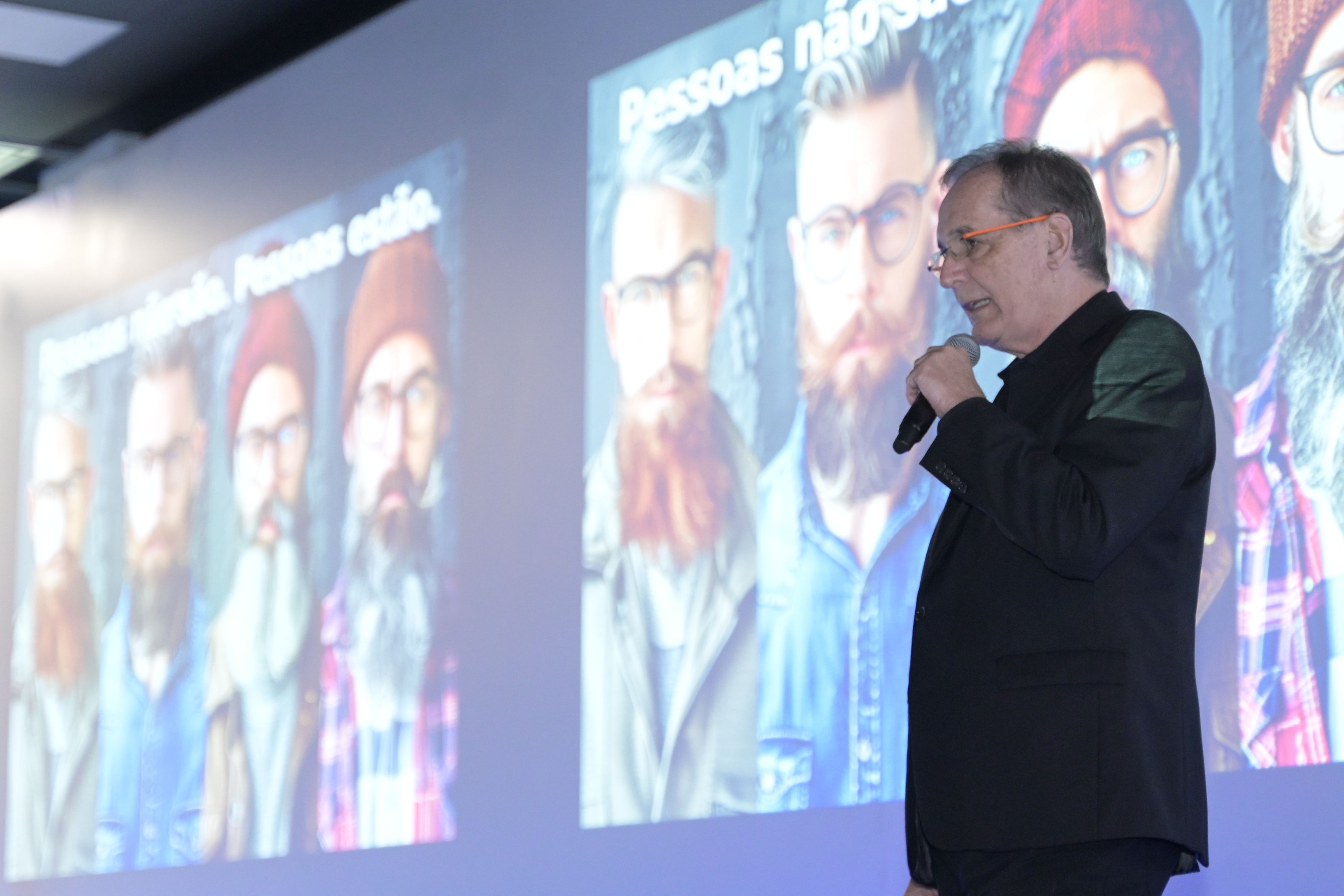
Walter Longo reflected on the advancements in AI in the current context. Photo: Bett Brasil.
For Longo, the current moment calls for less fear and more clarity. According to him, the role of education is precisely to prepare individuals for this new landscape, in which technology and critical thinking go hand in hand. “The revolution has already begun, and it calls for a shift in mindset. It’s not about replacing people, but about expanding possibilities—which necessarily depends on the way we educate and think,” he concluded.
In addition to a program expected to feature more than 144 hours of content, Bett Brasil 2026 is currently bringing together more than 330 national and international brands in its exhibition area, showcasing solutions, technologies, and services for all levels of education.
Share on social media:
Categories
- The Future of Education
- Educational Management