

Bett Brasil Sets New Trends in Education
)
Have you ever heard of edutainment? It’s a new concept in which entertainment is used as a tool to enhance the learning experience. The trend made its debut at the 29th edition of Bett Brasil, Latin America’s largest event for innovation and technology in education, which is taking place at Expo Center Norte through tomorrow (26).
Edutainment is new in Brazil, but the approach has already been introduced in other countries. According to a Mordor Intelligence report on the topic, the segment is projected to grow 17% annually through 2025, driven primarily by edutainment (education + entertainment) centers such as nature parks and science and technology museums, as well as demand for other venues and experiences that combine educational and recreational elements.
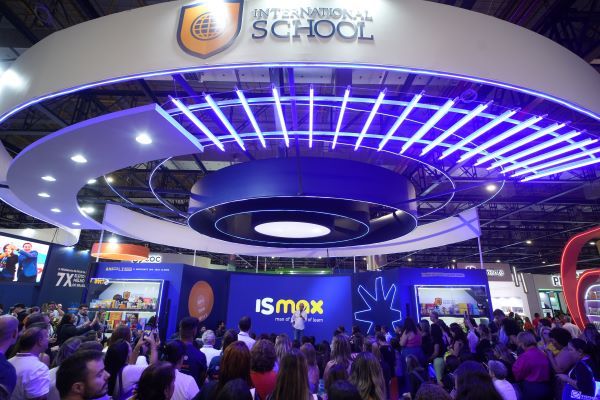
At Bett Brasil, which features more than 300 brands from the educational ecosystem, International School—the leading program in Brazil’s bilingual education sector—unveiled its new IS Max platform, which incorporates the concept of edutainment and provides students, teachers, and families with access to national and international content and productions from renowned studios such as BBC Learning, Deutsche Welle, Lionsgate, Lego, The Smurfs, TV Pinguim, and the Motion Pictures Association, among others.
“We decided to launch the platform during Bett Brasil because it is the largest education and technology event for our sector in Latin America, with an extremely qualified audience. And, just as we expected, the response has been very positive. Everyone who visits our booth says that IS Max is an innovative product that will combine education and entertainment in a surprising way. And, of course, we’re very happy about that,” says Ulisses Cardinot, CEO of International School.
Forma Turismo, the largest student travel operator in Brazil and Latin America, also featured this concept as a highlight of its booth at Bett Brasil. The company is responsible for organizing visits to the Mauricio de Sousa Produções studios, an attraction that offers an immersive experience into the world of Turma da Mônica and Sítio do Pica Pau Amarelo. The facility is currently under construction and is scheduled to open in the second half of 2024 in Atibaia, São Paulo.
“We bring playfulness and entertainment to support schools’ teaching approaches—a true extension of knowledge. The Sítio do Pica Pau Amarelo project is entirely based on edutainment; for example, everything is truly immersive so that the students’ experience is truly enriching. Students are ‘encouraged’ to interact in a way that allows them to learn through hands-on experience what was taught in the classroom,” says César Leonel, director of Forma.
Another exhibitor at the event that has also embraced the concept of edutainment is Grupo CI, Brazil’s largest educational tourism company. “We are excited to participate in Bett Brasil for the first time and look forward to connecting with key players in the education and technology markets. Over the past 10 years, we have recognized the need for experiences outside the classroom. In an increasingly connected and digital world, the activities offered by Grupo CI foster real interactions and connections with the world and society, helping young people absorb the content taught in classrooms and online, while broadening their horizons and perspectives on the subjects they study,” says Celso Garcia, managing partner of Grupo CI.
The CI Group brings together companies that offer exchange programs (CI Intercâmbio), travel, and graduation parties (Amaze Travel), as well as educational trips. Trilha Educação focuses on educational trips with educational itineraries, such as visits to Petar Tourist Park, the Amazon, the historic cities of Minas Gerais, and hundreds of other destinations.
Affection in the Service of Education
As longtime partners of Bett Brasil, the LED Movement—Light in Education—brought the discussion “Learning Through Affection: How Welcoming and More Humane Attitudes Can Change Students’ Paths” to the event. The roundtable discussion took place on the stage dedicated to public education and was moderated by journalist and actress Sandra Annenberg.
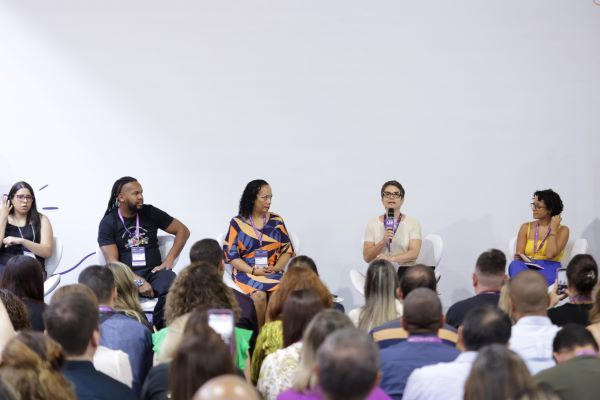
Recently, elementary school teacher Allan Pevirguladez, who was on the panel, went viral on social media with a video showing an anti-racist song he developed with his students. The song “My Hair Is Beautiful” is part of the MPBIA project—Anti-Racist Brazilian Popular Music for Children. “I was invited to create an educational project along these lines, and I found that music was the best way to do it. MPBIA is a way to welcome and educate, and today it’s available on digital audio platforms so that it can reach the entire country. It’s very rewarding,” the teacher revealed during the meeting.
“Welcoming” is also the motto of teacher Dione Fonseca, who teaches immigrant and refugee children. Noticing that her students were fearful and reluctant to enter the school because of memories of conflict and war in their homeland, Dione decided to implement a special “welcome” teaching method: the African song “Barima tuwe.” “We did some research and found that this song is a symbol of welcome and acceptance, so we decided to sing it whenever a new student arrives at school. It has a pleasant rhythm that soothes and calms. It’s a way to show warmth and safety to these children who have already suffered so much,” she explained.
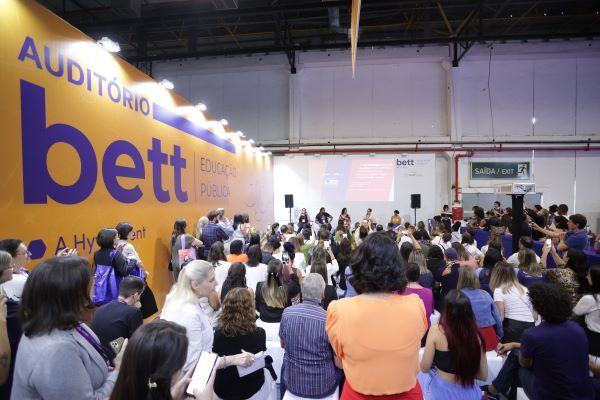
Understanding diversity is also part of this process of inclusion. Midria—a poet, social scientist, and student—highlighted to conference attendees the importance of recognizing non-binary identity and using gender-neutral language in educational settings. “The Portuguese language favors the universal masculine form, but there are many cultures around the world that recognize a third gender, which is non-binary identity. We must understand that gender is a social construct, which is why we need to be inclusive, and the use of gender-neutral pronouns is a step toward that,” she explained.
The panel moderator, Sandra Annenberg, took the opportunity to pose a question to the audience. “Even though women are the majority in Brazil and around the world, we continue to favor the masculine pronoun. Why?”
At the end of the debate, the participants agreed that to achieve an inclusive and equitable education system, we must regionalize education, value teachers, and raise awareness about the exercise of citizenship. “We can only change the world through empathy and education,” Annenberg emphasized.
BNCC and Early Childhood Education
Childhood is a critical period for children’s cognitive, physical, and emotional development; for this reason, early childhood education is a fundamental stage of schooling for the social development of us all.
At Bett Brasil, the largest event on Innovation and Technology in Education in Latin America, the topic was discussed during a panel featuring Professor Márcia Bernardes, state coordinator of the São Paulo State Literacy Program, and Professor Geraldo Peçanha de Almeida, director of the Pólen project. The discussion focused on the effective implementation of the BNCC (National Common Core Curriculum).
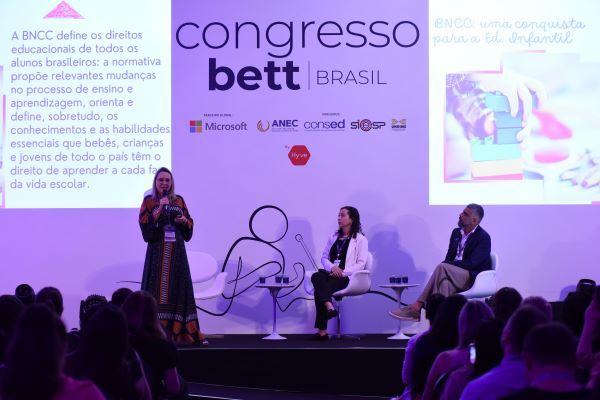
Professor Márcia spoke about the history of early childhood education in Brazil, from its legal recognition in 1998 to its inclusion in the BNCC in 2017. “The BNCC is an important milestone because, for the first time, early childhood education was included in a document that covers all segments of basic education,” she said.
She emphasized that despite the progress made, there are gaps in the implementation of the BNCC that need to be addressed. One of the key issues is continuing professional development for teachers, which is essential to ensuring that all children have their right to learn. “It is very important for teachers to take an interest in furthering their studies, going beyond the BNCC, which serves as a guide,” she said, adding data that serves as a warning sign: “36% of students in São Paulo’s municipal and state school systems who moved from the 2nd to the 3rd year of early childhood education cannot read or write. That’s a total of 120,000 illiterate students. These are students who have been severely disadvantaged by the pandemic.”
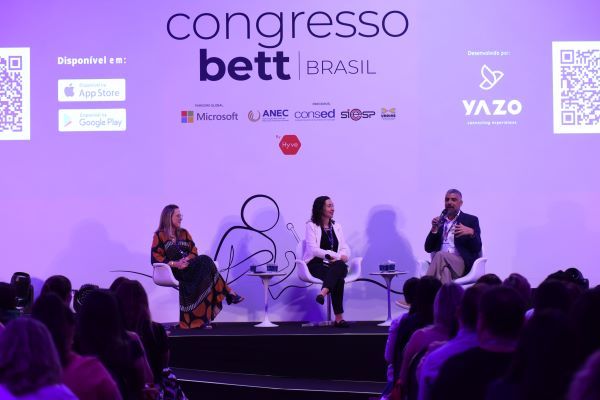
Professor Geraldo Peçanha also highlighted continuing education for teachers as one of the current challenges in early childhood education. “Where do we draw our inspiration from to be early childhood educators? We can’t stop studying, because everything I’ve learned has come from continuous study. Some of the BNCC’s areas of experience include lines, sounds, colors, and shapes. But if you ask a teacher to name three Brazilian visual artists, musicians, or musical styles geared toward children, they won’t be able to answer,” he emphasized.
Peçanha also commented on other shortcomings in early childhood education, such as the difficulty educators face in encouraging children to take the lead and allowing them to experience the full range of childhood; and the need to reflect on the representation of male educators in early childhood education—a situation he says he continues to experience to this day.
Share on social media:
Categories
- The Future of Education