

How is artificial intelligence redefining the role of the professor in higher education?
)
The rapid expansion of artificial intelligence (AI) has brought about profound changes in higher education, requiring institutions and faculty to rethink teaching practices, assessment models, and the very role of the professor.
For Luciano Sathler, a member of the Minas Gerais State Board of Education and Brazil’s first vice-rector for Distance Education, the widespread adoption of Generative Artificial Intelligence—driven by tools released to the public in recent years—has brought about a true “existential conflict” in formal education.
According to him, the intensive use of these technologies can encourage what is known as “cognitive offloading, ” when part of the intellectual effort is delegated to machines. “The answer is always ready, which gradually reduces the ability to think for those who become complacent, ” he says. In this context, learning and teaching become even more challenging tasks.
According to the expert, the future of university education depends on the ability to integrate technology and human thought in a balanced way. The use of artificial intelligence, he says, should be a collaborative effort: students must be able to engage with digital tools without sacrificing their intellectual autonomy and creativity.
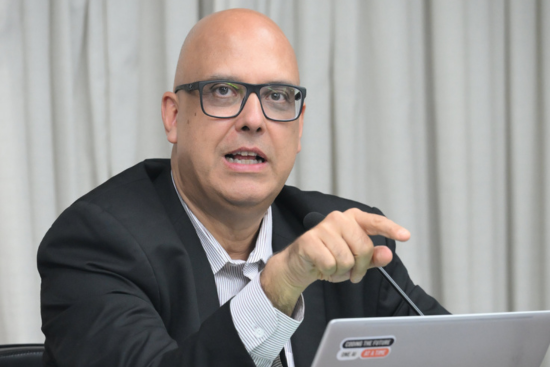
Luciano Sathler is one of the speakers at Bett Brasil 2026. Photo: Personal archive.
“Only those who know how to use AI as a co-creator—without losing the human touch and by adding something that technology has not been able to capture—will continue to learn and embark on a genuine journey of personal development,” he notes.
According to Dr. Aldo Henrique, a senior systems analyst at the National Confederation of Industry (CNI) and a university professor in the field of computer science, the transformation of teaching is already evident in practice. In his view, artificial intelligence has shifted the teacher’s role from that of a content deliverer to that of a “learning ecosystem architect.”
“In the computer science courses I teach, the focus is no longer on basic syntax or writing code, since AI already performs these operational tasks with precision. Today, my work is focused on teaching students to think in architectural and systemic terms, preparing them to solve complex problems that go beyond what a command can generate without critical oversight, ”he explains.
Dr. Aldo reports that, in his classes, the integration of language models helps raise the standard of the projects developed by students, encouraging more sophisticated solutions that more closely mirror real-world market challenges. The technology also functions as a “virtual monitor,” tracking students’ progress and freeing up more time for individualized mentoring.
“This change requires teachers to be the first to master these tools, serving as an example of how theory is translated into practice in an ethical and efficient manner,” he says.
Assessment of Learning
The impact of AI also extends directly to academic assessment models. “Teachers who have kept the same learning assessment plan in place since 2023 are grading assignments prepared entirely or partially using generative AI, without really knowing whether the student has learned the material or not,” Sathler points out.
To address this challenge, it is necessary to rethink the assessment of learning; he argues that educational institutions should adopt active methodologies and continuous assessment processes that prioritize meaningful learning and empower students.
“It is essential to maintain an ongoing training program at universities—one that is based on learning communities and effectively supports faculty in their day-to-day work. This can be achieved with minimal investment in content and requires leadership that focuses on fostering more human relationships and creating environments characterized by care and trust,” he says.
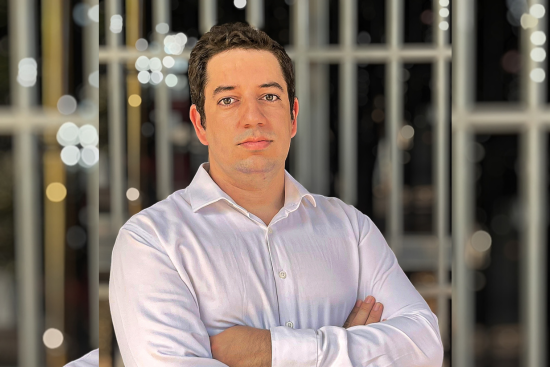
Dr. Aldo Henrique is confirmed to attend Bett Brasil 2026. Photo: Personal archive.
Based on his own experience in the field of assessment, Dr. Aldo advocates a model centered on the learning process. One of the strategies he employs in his courses is the use of a Socratic chatbot, programmed to stimulate students’ reasoning through questions rather than providing ready-made answers.
In addition, knowledge is assessed through project presentations and technical interviews. “The greatest weight in the grade is placed on the student’s ability to justify architectural decisions and the logic behind the solution, making it irrelevant whether AI was used in the writing, as long as intellectual mastery is demonstrated,” he says. To reinforce fundamental concepts, traditional written exams also continue to be used.
Is Brazilian higher education ready?
Despite these advances, experts believe that Brazilian higher education is still in the early stages of adaptation. According to Sathler, the country is currently engaged in regulatory debates, with ongoing discussions about standards and legislation related to the use of generative artificial intelligence.
Among the issues of concern to administrators and educators are intellectual property, data privacy, academic integrity, and the impact of technology on the world of work. In this context, he argues that universities should establish institutional policies to guide the use of these tools, creating governance systems capable of monitoring the various applications of artificial intelligence in everyday academic life.
Dr. Aldo, on the other hand, points out that the greatest challenge lies not in the technology itself, but in the cultural shift needed to integrate it into the educational process. “Until there is widespread AI literacy—which allows us to view these tools as productivity accelerators rather than merely as a threat—the educational system will continue to operate below its transformative potential,” he concludes.
The discussion on the future of teaching and higher education will be the focus of the debate during the Ahead CIEE Forum—Higher Education, held at Bett Brasil from May 5 to 8 at Expo Center Norte. Luciano Sathler and Dr. Aldo Henrique will participate in the panel “AI, Teaching, and the Future: Higher Education in the Era of Integrated Intelligences” on May 6 at 1:00 p.m. To register, click here.
Share on social media:
Categories
- The Future of Education