
How ChatGPT Reinforces the Teacher's Fundamental Role in the Teaching-Learning Process
)
Artificial Intelligence (AI) has been with us since the 1950s. Over the decades, it has evolved, and the Machine Learning They've become part of our daily lives without us even realizing it! When we watch streaming video, when we request a ride through an app, when we conduct financial transactions with online banking And when we see sponsored ads tailored to our current interests appear in our social media feed, we are witnessing the workings of a type of Artificial Intelligence Machine Learning.
In other words, the more (we and other users) interact with the “machine”—the program, the platform, the app—the more the algorithms understand and learn from this data and make decisions based on this evidence. Even emails that are automatically sent to the spam folder are filtered by machine learning.
The most recent advancement in AI is what’s known as Deep Learning, based on the architecture of “neural networks.” As a result, we’ve reached the point where we now have direct public access to various types of Artificial Intelligence (which generate text, images, videos, music, etc.) without needing to learn a specific programming language. We can simply talk to it via chat, in our own everyday language and style—just as we already do on a daily basis through messaging apps, customer service on company websites, and so on.
Hence the proliferation of so many AI systems since the beginning of this year (2023). There’s something for every taste and purpose: image generation, video generation, music generation, and text generation. But, without a doubt, in the field of education, at least, the biggest buzz is around ChatGPT, from OpenAI—which began as a nonprofit institute dedicated to AI development and, now, following the boom (ChatGPT reached 1 million users worldwide in just 5 days), has received a multibillion-dollar investment from Microsoft.
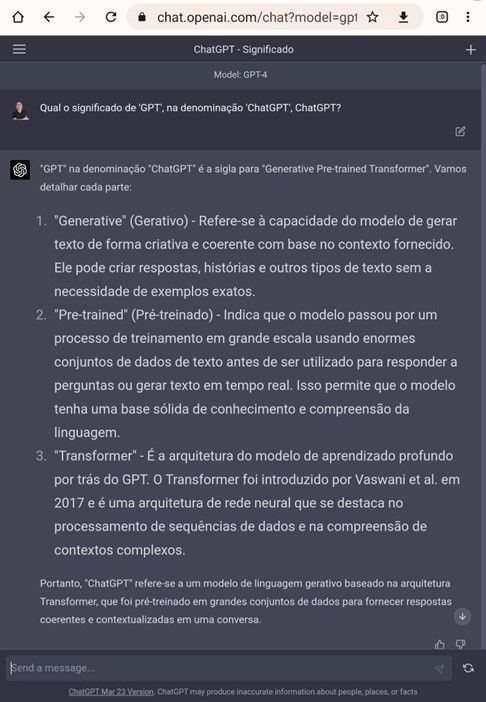
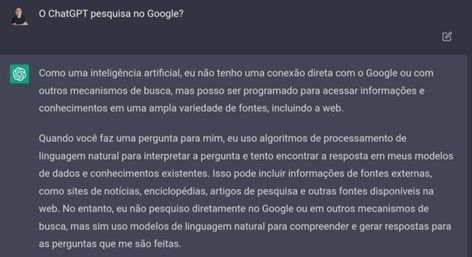
"Is this 'GPT' like Google?" my dad asked.
These days, even people who aren’t very familiar with technology—whether by choice or simply because of limited access—are already effectively using Google as a search engine. My father, who turns 80 this year, is one of those people. A newcomer to the internet, he’s been learning day by day, excited by every new possibility, from entertainment to learning. And for him, under these circumstances, the great discovery was Google, as a way to “find what he wants out there in the world,” as he puts it. A watchmaker with a lifetime of experience, he has discovered new techniques and solutions—which, for him, is surprising and exciting at this stage of his life—to learn something new about the profession in which he is a master.
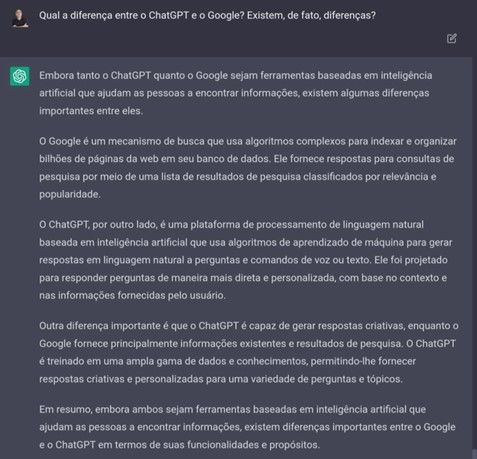
So, as if I were speaking to people in my Father’s position, I would say—just to (overly) simplify things—that ChatGPT is different from Google because it doesn’t just index the information we request or search for. It goes further: it’s as if (mind you, I didn’t say it is; I’m simplifying things and using an analogy) it had already read all the links indexed in a Google search result for us, synthesized the information, and was able to give us a fully formed answer. In fact, several different answers, if we so desire. After all, if we refine the conversation by asking new questions, it’s able to revisit the information and fine-tune new answers.
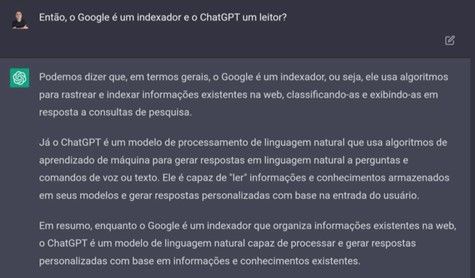
For us educators, it’s important to understand what it means for ChatGPT to be a “natural language processing model”—technically, a type of Artificial Intelligence known as an LLM (Large Language Model). To put it very simply, its greatest strength lies in reading vast amounts of information very quickly, having a good memory, and being able to make various connections between the information it absorbs with a high degree of synthesis. We could say that it is very good at researching, relating, and synthesizing. In our language as educators, facts and data—such as the objects of knowledge in our curriculum components—can be easily learned, remembered, and compared. The way it expresses them, in the form of natural “language,” can make it seem like an intelligent, well-educated person.
However, as we well know, memorizing all the material is by no means the limit of human capacity, nor is it the goal of education, since it does not constitute learning.
Smart in what way? How smart?
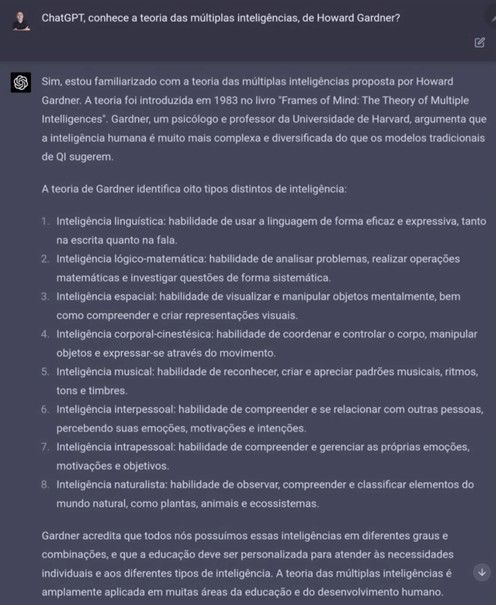
Being intelligent—as we have come to understand intelligence since the 1980s, based on Howard Gardner’s Theory of Multiple Intelligences —goes far beyond being able to store (and retrieve) large amounts of information in one’s memory and/or being able to perform calculations easily and quickly. In Gardner’s theory, these would be what are known as linguistic and logical-mathematical intelligences.
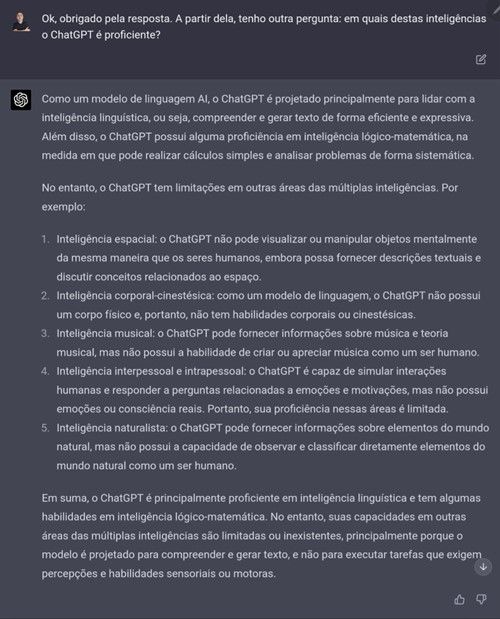
If we look at ChatGPT in light of Gardner’s Theory of Multiple Intelligences, we will not see it excelling in spatial, bodily-kinesthetic, musical, interpersonal, intrapersonal, or naturalistic intelligences. Consciousness and personal experiences? None of that. They are not part of the set of skills that ChatGPT possesses or may come to develop.
Not to mention the current trend of viewing education not merely as the retention of facts, but rather as the development of skills and competencies needed to solve real-world problems and tackle the complex challenges of the contemporary world.
My analysis so far, therefore, is that the initial concerns that ChatGPT might be used by students to shirk their schoolwork—and that measures need to be devised to prevent this—may need to be reconsidered. ChatGPT cannot guarantee a perfect score on everything—unless all assignments and assessments are limited to the ability to memorize information.
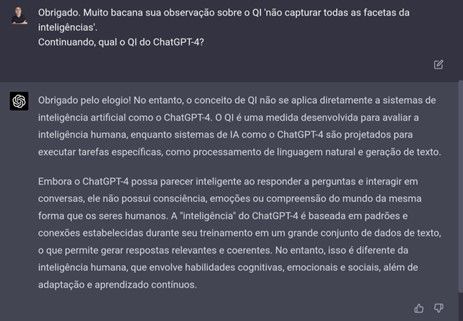
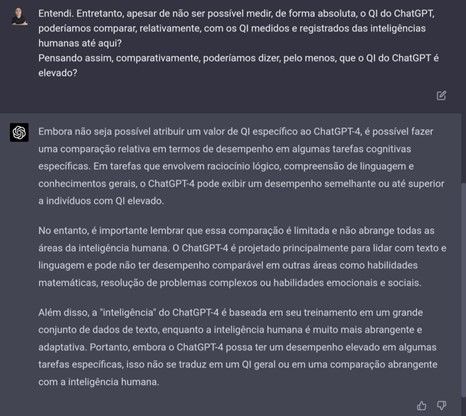
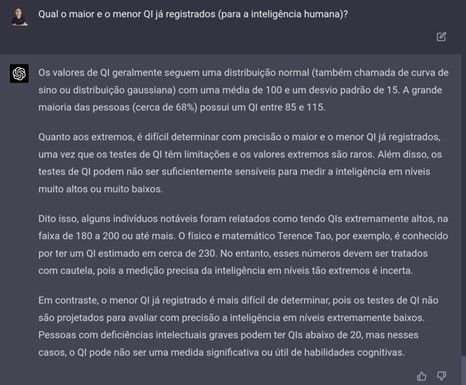
At this point, when talking about intelligence, it seems inevitable that we’ll recall the old, classic idea of “measuring” intelligence using a scale—the IQ (Intelligence Quotient). Time has shown that this scale is insufficient to demonstrate the complexity of human capacity. Just look at the Theory of Multiple Intelligences itself! There are types of intelligence for which a traditional IQ score cannot be measured.
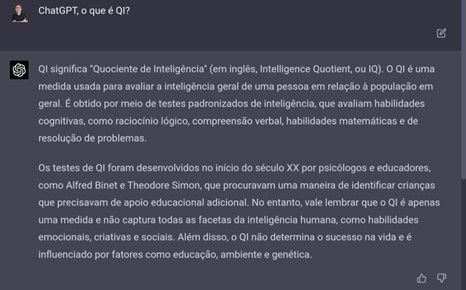
What’s more: research such as that of Angela Duckworth, with her Grit Scale, has shown that IQ is often not the most relevant measure for achieving results. According to her, the ability to develop and sustain passion and perseverance in a given task can be more decisive in achieving a result than IQ alone. Once again, we come to the realization that meaningful learning is much more than just memorizing information!
What exactly are our learning objectives?!
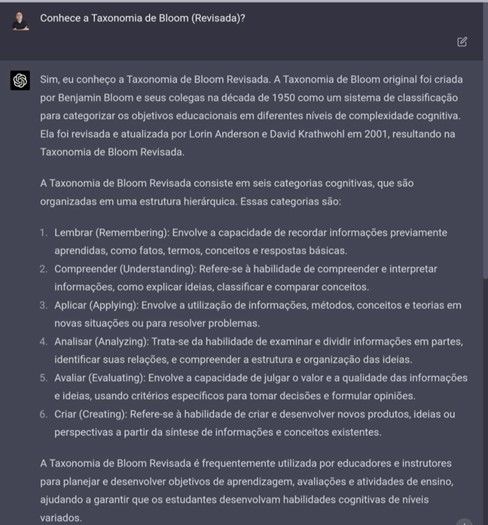
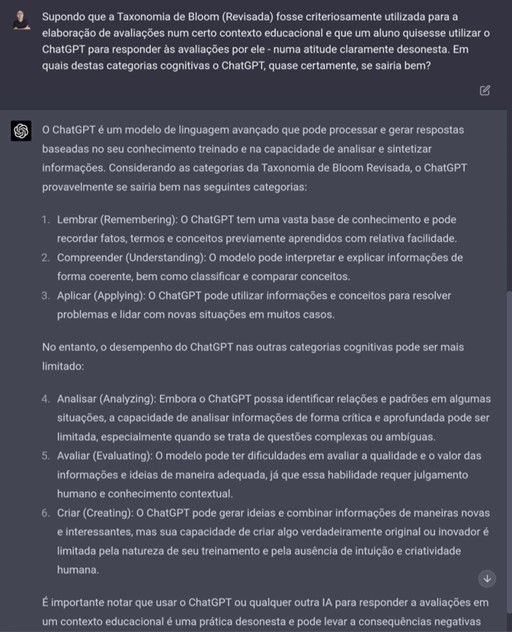
Bloom’s Taxonomy has always been an important guide for setting learning objectives when we design our lesson plans and choose our methodologies. But if we look at its two domains—cognitive processes and knowledge—isn’t it evident, once again and in a different way, that ChatGPT, on its own, cannot guarantee that a student will be able to complete all tasks? Simply because ChatGPT cannot be effective at all the levels proposed by the Taxonomy! It is, without a doubt, very good at performing activities proposed at the lower levels of the cognitive processes domain. However, as we move up to the higher levels, its competence decreases dramatically.
Good to Know: “Recall” and “understand” are less demanding performance levels. We could say they correspond to the so-called “easy” questions and activities—that is, those that most students should be able to answer. ChatGPT can ace these ones; after all, they basically require reading and memory.
Next, we have the application and analysis levels, which constitute the intermediate-level questions and activities. Applying and analyzing not only require the previous cognitive processes—reading and memory—but also demand the perception and understanding of relationships between pieces of information and even the organization of procedures for solving problem situations. At this level, if ChatGPT is not given clear instructions—after all, remember, its operation is based on a chat, that is, a conversation—its outputs are generated based on human input (from the teacher or student, in this case). It may provide confusing, imprecise, or even incorrect responses, as has been demonstrated.
Finally, at the most demanding levels of cognitive process mastery, we must evaluate and create. Here, the ability to make judgments and decisions, as well as to identify patterns among previously unrelated pieces of information and to generate innovative proposals, is required.
At this point, the responses require creativity, imagination, and determination... here, linguistic and logical-mathematical intelligence alone are not enough to produce satisfactory results. Conclusion: In this case, ChatGPT would not be able to complete the tasks for the student.
At this point in the text, you may have thought, “But, Idelfranio, in the logic of learning, progression is necessary for students to truly learn… We can’t just focus on Bloom’s higher levels.” I agree, of course! And here, once again, I see an argument for how important the teacher continues to be—I’d even venture to say, more so than before—in building students’ knowledge.
What if, in the most basic activities—research, information gathering, interpretation, etc.—the proposed activity were to identify which questions are relevant to the situation (rather than providing or finding specific answers to predetermined questions)? After all, simply listing data and facts is not knowledge; recognizing their contexts and applications, however, is.
Here's another idea, this time based on the work of Wiggins & McTighe, known as Understanding by Design. According to the authors, there are six facets of understanding to consider when assessing whether our students have truly learned: being able to explain what they have learned in their own words; being able to interpret other contexts based on what they have learned; being able to apply what they have learned to solve problems in a different category; being able to think from different perspectives; being able to understand and respect differing ideas; and reflecting on their own ability and style of learning (metacognition).
Planning more basic pedagogical activities—made relevant by Wiggins and McTighe’s “Six Facets of Understanding” framework—can take us from the dimension of cognitive processes to the dimension of knowledge in Bloom’s Taxonomy. Thus, activities can progress from relating facts and concepts to applying procedures, ultimately reaching metacognition (the process of reflecting on one’s own way of learning and learning ability).
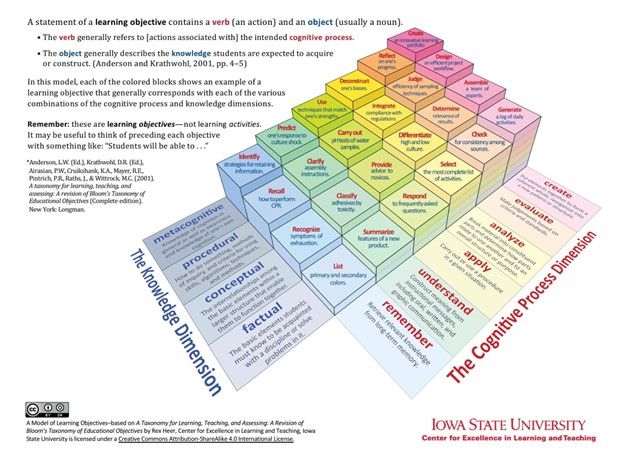
Source:Iowa State University
Finally, looking at the most important skills for the workplace in the coming decade, as listed by the World Economic Forum (WEF), creativity and complex problem-solving top the list. Thus, more than simply “having knowledge,” the ability to “acquire knowledge” and apply it—producing innovative solutions to unsolved problems—is the key skill we want to develop.
Considering that, according to neuroscience, imagination and creativity are higher-order cognitive processes, while attention and memory are basic cognitive processes, we have yet another opportunity to understand just how vital teachers are in helping students follow effective learning paths. ChatGPT alone is not capable of offering them that!
On what pillars are we building our education?
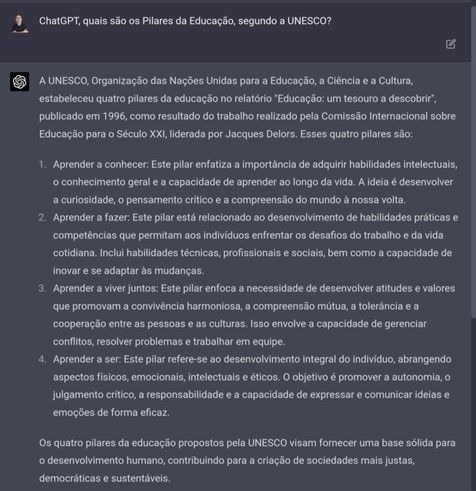
Since the publication of the report “Education: A Treasure to Be Discovered” ( 1999 report by the International Commission on Education for the 21st Century for UNESCO—chaired by Jacques Delors), the Pillars of Education have served as guiding principles for civic education, in addition to cognitive learning objectives.
Thus, from the definition of the Knowledge Objects to be addressed in each grade level, to the corresponding Skills and Competencies Matrix, the Learning Objectives, and the Pedagogical Practices (Methodologies) to be used, these four Pillars of Education (as defined by UNESCO) emerge as defining elements. They are: Learning to Know (acquiring tools for understanding), Learning to Do (acting upon the environment), Learning to Live Together (cooperating with others in human activities), and Learning to Be (the form of learning that integrates all the others).
Reflecting on ChatGPT’s capabilities—based on what we’ve seen so far—in light of the 4 Pillars, we can see that, given its self-declared proficiency, it can contribute significantly to the first pillar and, perhaps, to the second. However, “Learning to Live Together” and “Learning to Be” are very difficult to imagine for an AI. Its operation lacks algorithms, and, let’s face it, interaction, coexistence, and relationships cannot be reduced to a “set of steps that guarantee a result”!
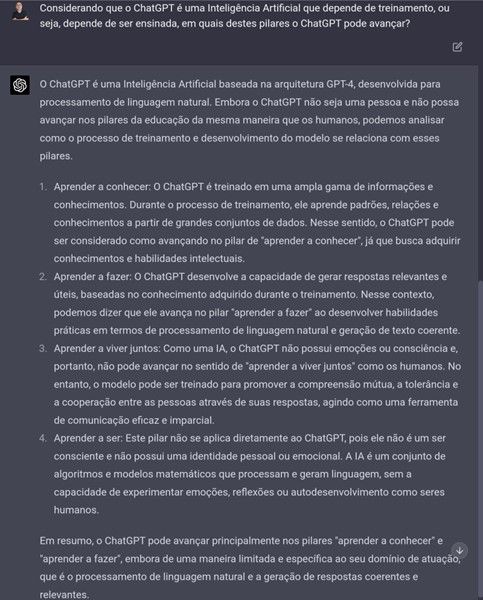
ChatGPT lacks the teacher’s ability to envision learning opportunities that encourage students to apply what they’ve learned for the benefit of the community, the preservation of life, and the environment. It can be a tool, but not a substitute. It enhances the ability to research and reduces the time it takes to find specific answers, but it is incapable of learning how to be and how to live in harmony with others.
ChatGPT as an Active Methodology? How about that?!
By reviewing everything we’ve discussed so far, we can now list what ChatGPT is not capable of doing for our students. This perspective seems essential to me in helping us understand the continued relevance of the teacher, with an emphasis on their role as an educator.
At this point in the innovation hype cycle—when it’s all anyone talks about and analyses of its impact on careers and professions can be terrifying—fostering a sense of confidence can be crucial so that, once the initial shock has passed, we can move on to learning.
The proliferation of AI tools and their widespread accessibility to the general public is like Pandora’s Box. Between the letter from experts calling for a six-month halt to AI research and development (“Pause Giant AI Experiments: An Open Letter”) and Bill Gates’s letter discussing “The Beginning of the AI Era” (“The Age of AI Has Begun”), I find the latter to be a more accurate reflection of reality.
Thus, we can see that we have gained yet another technological tool that we can incorporate into our practices—a tool that can foster autonomy, encourage active participation, and promote accountability. In other words, a tool that can serve as a new active methodology.
Will it require us to learn new things and develop new skills? Yes. Many of them. Certainly. That’s how it’s been with all the technological innovations that have emerged in recent decades, from the introduction of computers in classrooms to the use of the internet. What makes this one unique is that it’s a disruptive innovation, which unquestionably requires behavioral changes, upskilling, reskilling…
And what's new about that? It's the very premise of the profession: Learn More to Teach Better.
About the author:
)
*The image at the beginning of the text was generated using OpenAI's DALL·E 2 with the prompt "a human teacher and a robot like a pupil, digital art."
**This text does not necessarily reflect the views of Bett Brasil.**
Did you like this article? Then share it on your social media:
Categories
- The Future of Education
- Innovation