
Daycare as a Stage of Learning: The Impact of Early Childhood Education on the First Years of Life
)
Literacy begins long before a child officially learns to read and write. According to experts, the development of language, attention, concentration, and social-emotional skills in the early years of life is one of the most important foundations for academic performance throughout a child’s educational career.
To explore this topic further, Bett Brasil invited Fernanda King, the educational director of King Consultoria Educacional and Petit Kids Cultural Center, and Márcia Bernardes, a member of the São Paulo State Board of Education, to speak in the Public Education auditorium.
The speakers discussed the impact of early childhood education—particularly public early childhood education—on children’s development and advocated for daycare as an essential stage for cognitive and emotional development and for laying the foundation for literacy.
Fernanda King shared part of her personal and professional journey, noting that she came from public school and technical education. In her view, the transformation of Brazilian education necessarily involves strengthening public education starting in the early years of childhood. “If we really want to do something for Brazilian education, it must be through public education,” she said.
The director of education presented data from the Functional Literacy Indicator (Inaf), which show that approximately 29% of the Brazilian population between the ages of 15 and 64 is considered functionally illiterate. According to her, learning challenges have become even more complex in light of behavioral changes caused by excessive screen time, anxiety, and increasing difficulty concentrating.
Fernanda drew attention to habits that are becoming increasingly common in the digital world, such as the superficial consumption of information and reading only headlines without delving deeper into the content. “We are living in a time when it is extremely difficult to pay attention and concentrate. This is evident in schools, on social media, in disjointed comments, and even in the way people consume information,” she noted.

Fernanda King during a lecture in the Public Education auditorium. Photo: Bett Brasil.
When discussing the role of daycare centers, the expert emphasized that early childhood education has ceased to be exclusively welfare-oriented since the 1988 Constitution, when it officially took on the role of an educational institution. Despite this, she noted that a large part of society still does not fully recognize the pedagogical importance of this stage.
“People think that children go to school just to play, but that’s only the tip of the iceberg. Countless cognitive, social-emotional, and self-regulation skills are being developed in this process,” he said.
Fernanda also advocated for a more integrated approach between health, education, and social services, especially during a child’s early years. In addition, family involvement in school is another key factor. As an example, she cited initiatives carried out in Ceará, which showed significant improvements in educational outcomes in settings with greater family involvement in the school environment.
Next, Márcia Bernardes shared her professional experience in early childhood education, which began when she was still young. According to her, her career path changed completely after she became the director of a daycare center at age 21 and came to understand the impact of early childhood on a child’s educational development.
“The staff at the center where I started said I wouldn’t last a year, because no one wanted to be a daycare director—it was a position that didn’t look good on a résumé. But when I saw the day-to-day operations and the work involved in early childhood education, I understood the importance of daycare’s role in education and decided to dedicate my career to it,” she said.
Márcia cited data from a study conducted with first-grade elementary school students in Atibaia, which analyzed the relationship between academic performance and attendance at daycare. According to the expert, the study showed that children who attended early childhood education achieved better academic results later on.
“We’ve noticed that the better prepared a child is when entering first grade, the better their results will be throughout their school years,” she noted.
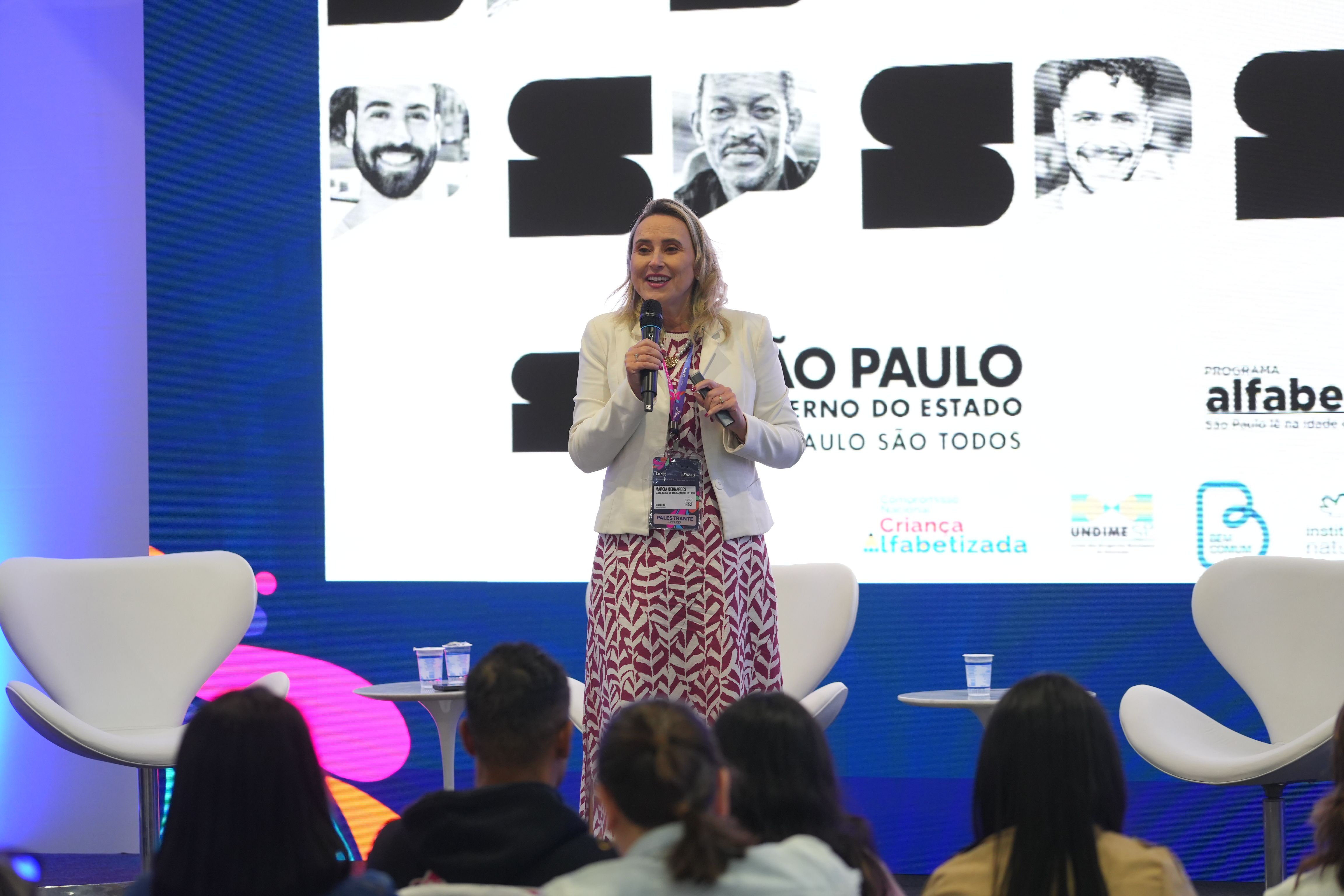
Márcia Bernardes advocated for fostering a culture of reading and writing starting in the early years. Photo: Bett Brasil.
The director explained that the data helped expand public policies aimed at early childhood literacy in the state of São Paulo, including the expansion of the “Alfabetiza Juntos” program to early childhood education.
Márcia also advocated for fostering a culture of reading and writing from an early age, as well as for the active involvement of families in the school environment. “We brought parents into the school because the learning process needs to be a collective effort,” she said.
In addressing the structural challenges facing education in São Paulo, she pointed out that about 80% of the state’s municipalities are small, which underscores the need for ongoing support from the government. “The state needs to be present and provide support to ensure quality in early childhood education,” she said.
During the presentation, Márcia highlighted improvements in reading fluency indicators between 2023 and 2025, including an increase in the rate of fluent reading among students in early childhood education and elementary school, which rose from 7.4% to 11.8%.
In closing the debate, the expert emphasized the importance of cooperation among municipalities, the state, schools, and families to ensure a quality public education. “Everyone needs to work together. The student belongs to the public school, not to the municipality or the state. It is our duty to ensure access to a quality education, regardless of where the student is,” she concluded.
Share on social media:
Categories
- Learning Strategies