

Day 2 of the Bett Northeast Conference Brings Together Experts to Discuss the Relationship Between AI and IE in Education
)
After two days of extensive discussion on the future of basic education in the country, the 2024 edition of the Bett Nordeste Conference, a traveling event organized by Bett Brasil, the organizer of the largest event on Innovation and Technology for Education in Latin America. Held in Recife, the conference featured more than 16 hours of content, included over 50 guest speakers—among them educators and experts in the field—and also featured an exhibition space with brands related to the education market.
The main theme of the event, “AI and IE in Education: What Should We Learn?”, was the theme of a panel discussion that brought together leading figures in the field of education from the Northeast region: Luciano Meira, Science and Innovation Coordinator at Proz Educação and professor at the Federal University of Pernambuco (UFPE) ; Marina Pinheiro , professor in the Department of Psychology at UFPE ; and Pierre Lucena, CEO of Porto Digital.
"When discussing what we can learn from AI, it is essential to remember that learning is, above all, a process of dialogue, not of entrenchment," Marina said. In her view, technological innovations, such as artificial intelligence, often generate a certain amount of resistance in education, especially when they involve issues of authorship and autonomy of thought. “There is a concern about the emancipation of the individual as an agent who shapes culture,” she said.
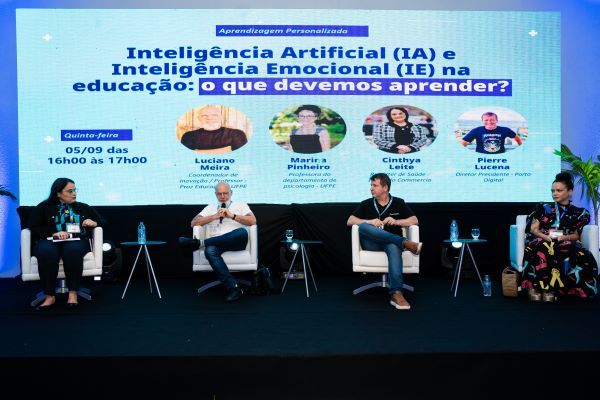
The professor pointed out that AI poses significant challenges, since it was once believed that machines merely translated information without producing meaning, but that view has changed. “The question now is how we can maximize the use of this technology and remember that we bring objects to life. Whether it’s a child at play or technological innovations, everything becomes an extension of those who use it,” she emphasized.
Still on the topic of “what should we learn?”, Meira emphasized that the first and most important point is to place teachers and school administrators at the center of the process. “Any implementation of technology—especially something as sophisticated as AI—must place teachers and school administrators at the center of institutional decisions, ensuring that everything makes sense in the local context,” Meira said.
For him, another key point is recognizing the importance of the teacher’s role. AI should be viewed as a tool that integrates with teaching activities—not merely to complement them, but to expand the possibilities of teaching. “AI is not only meant to enhance the teacher’s work, but also to expand their ability to carry out the teaching process itself,” he said.
The professor emphasized that the current situation calls for more experimentation and dialogue regarding digital technologies in education. “We still know very little about the impact of AI, and we are only beginning to explore these possibilities. We are far from an effective digital transformation in schools, and it is essential that this process be accompanied by more experimentation,” he said.
Emotional Intelligence for Life
On the topic of emotional intelligence, psychologist and professor Rossandro Klinjey—ambassador and co-founder of Educa—participated in the Bett Nordeste Conference to discuss the importance of developing emotional intelligence skills in schools.
"School is a fundamental setting for the development of identities," said Rossandro Klinjey. "This process begins in the family but continues at school, where students spend a significant part of their lives. It is there that they test how effective—or ineffective—the emotional intelligence they developed at home really is," he said.
For Klinjey, school is not just a place for cognitive development, but also for developing social-emotional skills. “This includes self-love, which I consider to be the core skill of the individual—as if it were the operating system of the soul. With self-love, you develop all other skills; without it, it becomes difficult to determine what is most important to you,” he said.

He points out that by strengthening self-love and self-esteem, students are better able to cope with challenging situations. “When you work on these skills, you learn how to ask for help, set boundaries, and avoid toxic relationships that can lead to bullying, for example. This emotional resilience acts as a shield against many issues,” he said.
According to Klinjey, there is a growing awareness of the importance of working on people’s inner selves. He noted that we experience the world collectively through our personal filters, and that these filters are often distorted by a lack of self-love and self-understanding, which compromises the way we engage with the world.
The psychologist also highlighted the importance of events such as the Bett Nordeste Conference, which provide opportunities for discussion and the sharing of experiences. “These events are essential because they allow people to connect, share their challenges, and seek solutions together. Bett Brasil grows every year because it serves as a premier forum for discussing education and reshaping standards. It’s a meeting place where we can build a path of development for everyone who is part of the educational ecosystem,” he concluded.
AI as a Management Tool
Another highlight of the second day of the Bett Nordeste Conference was the discussion on how AI can contribute to the management of educational institutions. The session was led by André Neves, a full professor at the Federal University of Pernambuco (UFPE), and Luis Henrique Martins Junqueira, a professor and co-founder of Letrus.
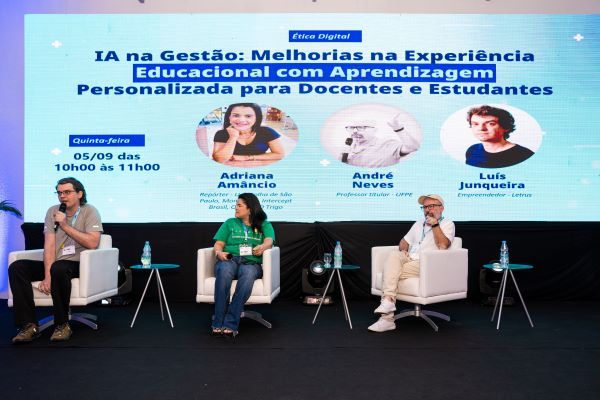
André Neves, a full professor at the Federal University of Pernambuco (UFPE), believes that, although generative AI—based on Large Language Models (LLMs)—has had a major impact since November 2022, we are still in the early stages of this technology. “Beyond the fascination of seeing how these systems can communicate with humans in natural language, we need to remember that they are not one-size-fits-all solutions to every problem. These systems have limitations and are not capable of handling every type of processing,” said the professor.
Neves sees significant potential in generative AI to improve the management of schools, school districts, and departments of education. “In my view, the main benefit is that it acts as an assistant, complementing people’s work. It can help them handle large volumes of information more efficiently, interact with users, and facilitate decision-making,” he said.
However, he emphasizes that there are challenges associated with this technology that must be addressed to ensure the tool is used responsibly, ethically, and in a truly positive way. “We need to avoid the illusion that we are dealing with a magical oracle, as well as the fear that AI is a great villain for humanity. We are facing a technology with disruptive potential comparable to major historical milestones, such as writing, the printing press, and the industrial revolution, but one that is evolving at a much faster pace,” he stressed.
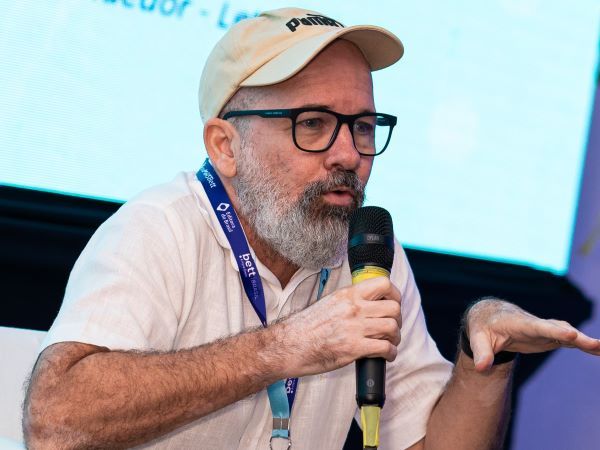
Neves states that schools play a key role in this adaptation process. “Schools must take the lead in this transition. From the administration to the classroom, it is in schools that we learn to deal with the new. Administrators, teachers, and students must be mindful of the impacts—both positive and negative—of this new world that is unfolding before us,” he concluded.
Junqueira emphasized the importance of discussions on this topic to reduce mistrust regarding the use of artificial intelligence and to stimulate debate on practical applications for solving specific problems. “Our students are generating data all the time, and organizing these results through technology sheds light on both best practices and areas for improvement, informing educational policy decisions at the school, regional, and state education department levels,” he commented.
Technical Visit to Porto Digital
The second day of the Bett Nordeste Conference also featured a technical tour of Porto Digital, one of Brazil’s leading technology parks and innovation hubs. This new initiative was organized for this edition with the goal of offering conference attendees the opportunity to visit, in person, leading educational institutions in the city of Recife.
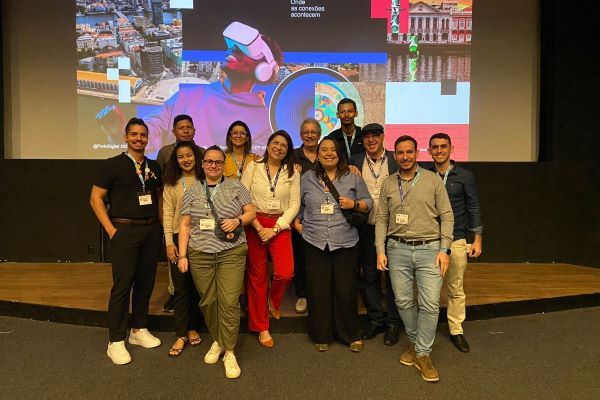
“I thought the technical visit was incredible, especially the insight into programs and partnerships for young people focused on education,” said Rafael Cunha, a participant in the Bett Brasil Conference who took part in the initiative. Similarly, teacher Evelyn Nascimento remarked: “I hadn’t been to Porto Digital before. And as an English teacher who uses many technology tools in the classroom, the technical visit provided inspiration that will enrich my professional life.”
For Henrique Steinberg, the Porto Digital representative in charge of leading the technical tour, the experience with the attendees of the Bett Nordeste Conference at Porto Digital highlighted the importance of connections in the world of education. “Connections speed up the process of getting things done, catalyze results, and amplify the positive. That’s what allows positive experiences to multiply and negative ones to be avoided. Connections, transparency, and solid civic and social values are the foundation of everything. At Porto Digital, this is exactly what we strive for, building on our founders’ values and applying them to our work.”
Share on social media:
Categories
- The Future of Education