
Hybrid Education and the New Quadrants of Teaching and Learning
)
Also as part of the celebrations marking ABMES’s 39th anniversary, in August the Association hosted avirtual seminaron hybrid education and what the new paradigms for teaching and learning should look like in the post-pandemic era. This is a political-pedagogical approach that, we believe, is better aligned with the demands of the present day, in addition to highlighting the investments in technology made by institutions of higher education in recent semesters.
In his opening remarks at the event, Education Minister Milton Ribeiro emphasized the importance of recognizing the essential nature of in-person education, which depends on the passage ofBill 5595/2020, currently under consideration in the Federal Senate—an initiative that also enjoys strong support from ABMES. Subsequently, both the president of the National Education Council (CNE), Maria Helena Guimarães de Castro, and the council member and rapporteur for the hybrid education agenda in the CNE’s Chamber of Higher Education, Luiz Roberto Liza Curi, endorsed the Association’s proposal regarding hybrid quadrants as a way to express the variety of technology-mediated learning experiences.
As Maria Helena pointed out, hybrid education consists of “an innovative approach to developing competencies and skills in which hybrid activities can complement in-person activities through various means, always keeping in mind that all of our students are digital natives.” For Liza Curi, “hybrid education is not a new teaching model, but a new pedagogical approach—a necessary, comprehensive, and far-reaching use of technology to enhance the learning process.”
Also present at the event was João Vianney, a consultant with Hoper Educação—an ABMES partner in organizing the seminar—who emphasized that hybrid education is already a reality, partly due to the new profile of today’s students. “Students are arriving at school younger and younger, more connected, and equipped with a range of digital learning skills. They want a new kind of education.”
But what exactly are these quadrants, and how can they help us understand the hybrid model? As I explain inanother article, there are several possible scenarios for hybrid education, but we believe that this model presented by ABMES encapsulates how hybrid learning plays out in classrooms and helps higher education institutions develop new pedagogical projects that engage with this new reality.
From an educational perspective, the hybrid model we propose is based on two dimensions: space (in-person or virtual) and time (synchronous or asynchronous). These two axes result in four quadrants of didactic and pedagogical possibilities: in-person and synchronous activities (PS), virtual and synchronous activities (VS), in-person and asynchronous activities (PA), and virtual and asynchronous activities (VA).
QUADRANTS OF HYBRID EDUCATION: A PROPOSED MODEL
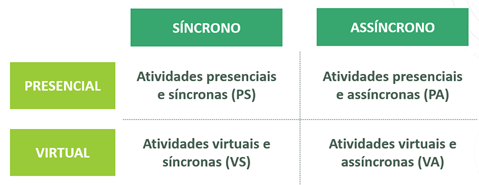
Based on each of the quadrants, it is possible to plan a variety of educational activities that engage with that reality, such as lectures (in-person or remote), science projects, in-person and virtual labs, simulations, and digital libraries.
DIDACTIC AND PEDAGOGICAL POSSIBILITIES
.png)
In practice, this means an unprecedented expansion of opportunities for innovation in teaching, offering students a program that is better aligned with their expectations, a broader perspective on their educational journey, and outcomes that are more closely aligned with the demands of the job market.
REAL-LIFE EXAMPLE FOR A HEALTH COURSE
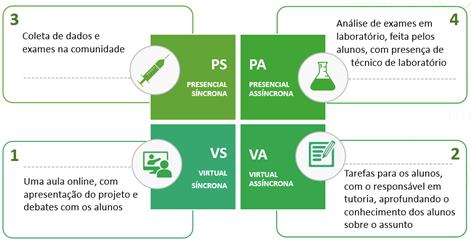
A real-life scenario for a health outreach activity suggested by Professor Max Damas, an advisor to the ABMES presidency.
Before the pandemic, we referred to an educational model that combined in-person activities with distance learning as “hybrid”; today, we realize just how limited our understanding was. The urgent need to ensure the educational development of millions of undergraduate students in the midst of the greatest crisis of the century has led us to rethink all our structures in search of solutions to the imposed social distancing. As a result, new horizons have opened up before us.
Although we already knew that academic education isn’t confined to the four walls of the classroom, we hadn’t fully grasped just how far we could go with new educational methodologies. It’s true that even before the pandemic, we suspected that the future of education would be hybrid, but today we’re convinced of it. We just didn’t expect that future to arrive so soon. It’s here, and it’s already knocking on the doors of our institutions of higher education.
Learn more about the author:
Did you like this content? Share it on your social media: