
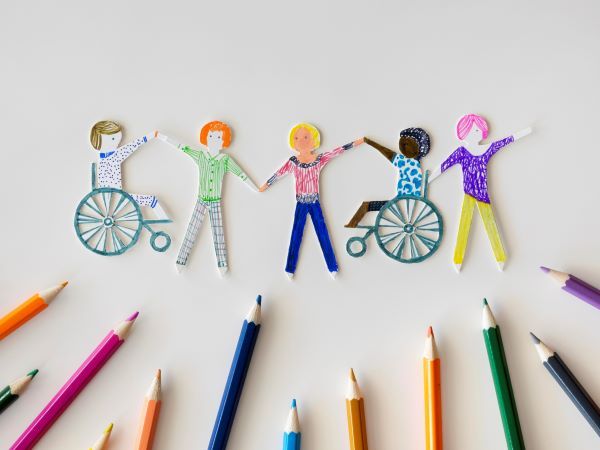
Inclusive education means valuing the differences among students
)
Inclusive education remains a challenge for Brazilian educational systems. The challenges of making schools a more inclusive environment for everyone are felt in both public and private education and can cause numerous setbacks for a country’s socioeconomic progress.
The exclusion of people with disabilities from education and the labor market can result in a loss of approximately 3% to 7% of a country’s GDP, according to the World Bank report “The Inclusion of People with Disabilities in Latin America and the Caribbean: A Path to Sustainable Development,” released in 2021.
The study indicates that approximately 85 million people in Latin America and the Caribbean have some form of disability, representing 14.7% of the total population. In terms of education, the World Bank report shows that 15% of children with disabilities are not enrolled in school, and one in two people with disabilities does not participate in the labor market.
Marta Gil, executive director of the Amankay Institute for Studies and Research, warns that without the skills and knowledge acquired in school, people with disabilities may face profound and long-lasting economic consequences, especially when they try to enter and remain in the labor market.
“This condition affects a significant number of people, regardless of race/color, economic status, gender, place of residence, or other identity markers, all of which are interconnected. In other words, we can conclude that exclusion is multifaceted and affects socially vulnerable groups,” Marta explains.
And what are the current barriers to achieving the goal of a truly inclusive school? According to Klaus Schlünzen Junior, a professor and researcher at São Paulo State University (Unesp), teacher training is one of the main obstacles.
“We need to train teachers who understand what inclusion is—not only from a conceptual standpoint, but especially in practice. Unfortunately, most teacher-training institutions, at best, advocate this perspective but continue to follow an approach that tells students what teachers should be like. Yet, paradoxically, their own training practices remain traditional, rooted in an instructionist perspective,” says Klaus.
He believes that a truly inclusive education is one based on the principle of valuing differences. “Educational settings (schools, universities, institutions) seek to standardize the teaching and learning process. To think about inclusive education is to understand that every day, every semester, every school year is unique; we have different teaching practices, new resources, and students with diverse expectations and needs—and that is where the richness lies,” says the Unesp researcher.
Professor Doug Alvoroçado, who works in public schools in Rio de Janeiro and specializes in Specialized Educational Services (AEE), also follows this line of reasoning and believes that among the best examples of inclusion in schools he has observed are those where the guidelines include an individualized educational plan for each student, with proper documentation of activities, aligned with universal design for learning.
“I see the current landscape as one of positive progress in inclusive education, with this topic becoming more widely accepted and less of a ‘taboo’ in society. However, we still see many common misconceptions, such as the idea that inclusion simply means placing a student with a disability in a regular classroom and calling it a day, or merely offering that student a scaled-back curriculum,” says Alvoroçado.
Another point emphasized by Professor Klaus is the development of school projects designed with the participation of teachers, administrators, students, families, and the community to transform the overall state of education, which is still far from being an inclusive school system.
“Successful schools around the world are those that have developed their own programs, conceived from within with the participation of everyone. Although public policies and government support are important, it is essential that schools develop their own guidelines based on their specific context and that they be able to give meaning and purpose to their actions. I believe this is the best path to follow, and to that end, we need to train our teachers in this perspective,” he explains.
Initial and Continuing Teacher Education for Inclusive Education
For Professors Klaus and Doug, proper teacher training for inclusive education is key to the evolution of the current situation we are experiencing, where inclusion is still far from ideal. In Doug’s view, career advancement is essential to motivating interested educators and teachers to invest more in training focused on inclusive education.
“Teachers need training that shows them how to carry out all their work in an inclusive manner—not just in specific situations, such as when working with a student with a visual or physical disability. They need to understand what universal design for learning is and tailor their work to be as adapted and appropriate as possible to accommodate as many students as possible. That makes all the difference,” Alvoroçado emphasizes.
The professor from Rio de Janeiro also emphasizes that modernizing continuing education through innovation is a key focus. “We have a wealth of assistive and accessible technology at our disposal. We can use it as an ally in literacy, numeracy, and media literacy. Today’s students are born as digital natives, and that cannot be overlooked,” he says.
The Unesp researcher, on the other hand, sees the importance of continuing education for special and inclusive education teachers as equally important for the general education classroom.
“Special education teachers must be trained not only from a theoretical perspective, in the use of assistive technology and other resources to promote inclusion. Their training must be more systemic—encompassing an understanding of collaborative work with classroom teachers, a focus on exchange and collective learning, the ability to observe and recognize students’ demands and needs, and a mutual willingness to listen to teachers and their students in order to explore new approaches to teaching. To this end, training these teachers is no easy task: we need to fully understand what kind of inclusion we want and establish in school projects how to coordinate the work of these teachers,” concludes Klaus.
Did you like it? Share it on social media:
*Article originally published in the special Bett Brasil issue of *Revista Escola Particular*.
Categories
- Diversity, Equity, and Inclusion (DE&I)