
Public Education in the Spotlight: The 30th edition of Bett Brasil dedicates a special section to strengthening the public school system
)
Of the 178,500 schools in Brazil, nearly 80% are part of the public school system, which highlights the need for ongoing investment in infrastructure, teacher training, and educational innovation. Against this backdrop, the 30th edition of Bett Brasil reinforces its role in fostering dialogue across the entire educational community by featuring a dedicated space for public education at the event.
The Public Education area will be open free of charge to all visitors to Bett Brasil, providing opportunities for reflection, the exchange of experiences, and discussions on public policies, innovative practices, and solutions that can strengthen the public school system.Admission is free, and you can register HERE.
The venue will feature an “ ” exhibition area for impactful projects developed by non-governmental organizations and an auditorium hosting lectures throughout the four-day event. There will also be a lounge for public officials to exchange experiences, with support from Ecossistema Square, Editora do Brasil, Start by Alura, and ODILO.
One of the highlights of the program will be the panel discussion on the School Partnership Program, implemented in the state of Paraná. The model has stood out for promoting collaboration between the public and private sectors to improve school management, learning outcomes, and educational infrastructure. The discussion, scheduled for April 28 at 10:30 a.m., will feature João Luiz Giona Junior, Director-General of the Paraná State Department of Education; Antonio Cesar Pinto da Cunha, Director-General of Tom Educação; and Vinicius Klein, State Attorney General of Paraná.
Continuing the discussion on innovation in public education, on April 29 at 3:30 p.m., the session “Transformative Literacy for Public Education” will take place, featuring Adoniran Leite, a consultant at Editora do Brasil; Natália Mota, chief scientist and founding partner of Mobile Brain; and moderated by Renata Sanches, manager of Educational Services at Editora do Brasil.
Also in the realm of public sector initiatives, on April 30 at 12:00 p.m., there will be a panel discussion titled “Digital Libraries and Public Education: Discover Leia Paraná, a Success Story in Promoting Reading, ” featuring Frederico Faria, director of ODILO in Brazil; Lorena Pantaleão, coordinator of Digital Education at the Paraná State Department of Education; and Ane Carolina Chimanski, head of the Department of Curriculum Development at the Paraná State Department of Education.
Continuing the discussion on the factors that influence the educational environment, the panel on parenting, scheduled for May 1 at 10:30 a.m., will feature Juliana Nogueira, coordinator of the STJ’s Early Childhood Commission, and Guilianna Felizola, a pediatrician at the STJ, with Dirce Takano serving as moderator. The discussion will address how family engagement in the educational process, combined with knowledge of neuroscience and the science of trauma, can contribute to healthier school environments, disease prevention, and a reduction in violence against children.
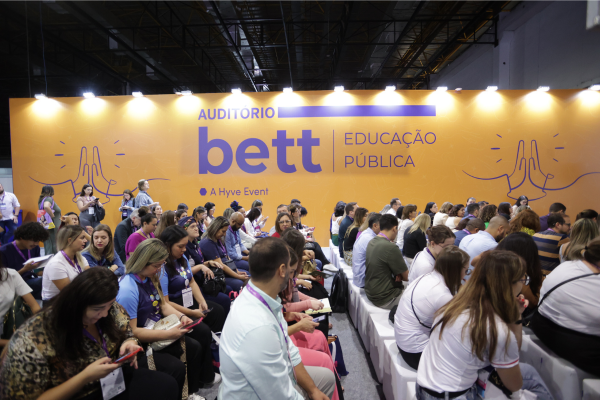
Over the course of four days, case studies, projects, and solutions for Brazilian public education will be discussed. Photo: Bett Brasil.
With a focus on expanding access to different pedagogical approaches, on April 29 at 10:30 a.m., the panel discussion “From Dream to Reality: High-Impact Bilingual Education in the Public School System” will take place, featuring Renato Rezende Filho, former mayor of the municipality of Pilar; Clewerton Cavalcante, Municipal Secretary of Education and Culture for the municipality of Pilar; Gabriela Lotta, professor at FGV; and moderated by Vanessa Tenório, CEO of Systemic Bilingual.
To complement the topics related to curriculum innovation, on April 30 at 2:00 p.m., the program features a discussion on the implementation of the National Common Core Standards (BNCC) for Computer Science, which made computer science instruction mandatory in K-12 education starting in 2022.
Chapecó’s Secretary of Education, Astrit Maria Savaris Tozzo; the Director of Pedagogy for the Chapecó municipal school system, Sueli Suttili; the Director of Educational Technologies at SEDUC-SP, Rafael Cunha; the Manager of Educational Technologies and Platforms — São Paulo State Department of Education, Rodolfo Encinas Pinelli, and the CEO of Start by Alura, Thais Pianucci, will share the experiences of the city in Santa Catarina and the state of São Paulo and demonstrate how the alignment between the curriculum and teacher training has enhanced learning and promoted digital inclusion.
As part of the series of panels focused on public education policy, on April 28 at 2:00 p.m., the panel “Assessment as a Tool for Remediating Learning” will present case studies from two municipalities that are innovating in the use of assessments as a tool to support the remediation of learning in a targeted and evidence-based manner.
Participants in the debate will include Alessandro Gomes Soares, Municipal Secretary of Education for the City of Curvelo; Antônio Cláudio Flores Patrícia, Secretary of Education at the Osasco Department of Education; and Alessandra Bianca Cornaglia, Executive Secretary for Pedagogical Management at the City of Osasco. The discussion will be moderated by Ricardo Scheneider, a partner at Ecossistema SQUARE.
Innovation will also be the focus of the panel discussion on the IT professional training program for high school students and those in the Youth and Adult Education system within the Pernambuco state school system. In just six months, more than 5,000 students received certification in areas such as web systems development and data visualization, through a partnership with CESAR School. On April 28, at 5:00 p.m., Carla Alexandre Souza, Educational Solutions Manager at CESAR School, and Paulo Fernando de Vasconcelos Dutra, Executive Secretary for High School and Vocational Education at the Pernambuco Department of Education, will participate in the discussion, moderated by Leo Gmeiner, founder of School Guardian.
Also on the lecture agenda is the case of the city of Bertioga (SP), which highlights technology as an ally in creating a more inclusive and accessible public education system. Featuring Samuel Xavier Santana Guedes, director of Educational Technology Management for the city government, and Jucinéia Maria de Oliveira, executive and training director at Calriz Sistemas, the panel will demonstrate how the integration of digital platforms and the active role of teachers are revolutionizing education in the municipality.
The free Public Education area at Bett Brasil is a space for recognition, listening, and innovation. After all, ensuring a high-quality and accessible public education means guaranteeing an essential right for millions of Brazilians.
Share on social media:
Categories
- The Future of Education
- Educational Management