
Municipal Elections: How Can We Ensure (Truly) Inclusive Education?
)
This October, Brazil went to the polls to elect new mayors and city council members in the 26 state capitals and in more than 5,500 other cities across the country. Voting is a means for the public to make their voices heard, with the hope of fostering a better future for everyone. In this context, education is always a top priority among the most urgent demands the public makes of their representatives on city councils and the mayor.
The Bett Blog spoke with civil society organizations and educational institutions to learn about their priorities for improving the quality and equity of education, particularly with regard to inclusive education—a recurring topic of concern among educators.
Below are the opinions on the Inclusive Education agenda from the “Rodrigo Mendes Institute,” “Todos Pela Educação,” and the “Lemann Center for Leadership in Educational Equity.”
Karolyne Ferreira, an advocacy specialist at the Rodrigo Mendes Institute (IRM), identifies two priorities in inclusive education for municipal administrators in Brazil. “The first is to ensure that people with disabilities are enrolled in mainstream schools and classrooms, since all students have the right to learn together. An environment that embraces diversity is beneficial for everyone,” she says.
According to the 2023 School Census, the number of students enrolled in special education (which includes students with intellectual and physical disabilities, those on the autism spectrum, and those with high abilities and giftedness) reached 1.8 million, representing 3.7% of all enrollments in Basic Education. Fifteen years ago, this proportion was significantly lower: just 1.2%, totaling approximately 640,000 enrollments.
Karolyne states that the second priority is investing in continuing education for teachers in Inclusive Special Education. “It is essential that teachers improve their practices, develop a variety of teaching strategies, and eliminate barriers so that students with disabilities can fully participate in school activities and daily life,” emphasizes the advocacy specialist at the Rodrigo Mendes Institute.
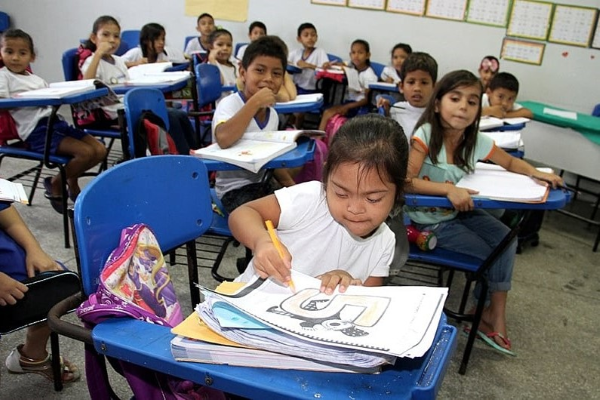
A student with Down syndrome during class at a public school. Photo: Rodemarques Abreu/Manaus City Hall
According to the report released by the Special Education Indicators Panel from the IRM, in 2012, only 4.2% of classroom teachers in Basic Education had completed an 80-hour specialized continuing education program certified by the MEC in Special Education. In 2023, according to the School Census, that figure rose to 6.1%. When analyzing state capitals, some show more significant progress. For example, in 2023, 19.3% of teachers in Vitória (public and private schools) had received continuing education in Special Education, while in Fortaleza, the proportion was only 1.5%.
The Rodrigo Mendes Instituteisa nonprofit organization whose mission is to help ensure that every person with a disability receives a quality education in an inclusive school.
Bernardo Baião, the Educational Policy Coordinator at Todos Pela Educação, emphasizes that inclusive education must encompass three dimensions: access, retention, and learning. “This triad ensures educational quality not only for children with special needs, but in general,” he says.
Regarding access, Baião emphasizes the importance of ensuring that all students with disabilities are enrolled primarily in mainstream schools. “It is essential for a student with a disability to be in the classroom with the other students. That is the first step toward inclusion,” he stresses.
However, he warns that ensuring access is not enough without also ensuring that students can remain in school. “The second element involves accessibility in schools in general, both in terms of transportation and the use of spaces,” he explains.
See also:
- Teacher training is essential for inclusive education
- Anti-racism is something you learn from an early age
- The Importance of the Family and Its Collaboration in the Inclusion Process
In addition, Baião emphasizes the importance of multifunctional resource rooms, where students with disabilities can participate in specific activities outside of regular class hours, under the supervision of trained professionals. “The student remains in the regular classroom during the school day and participates in specific activities in the afternoon. This is the second crucial element,” he says
Finally, the Educational Policy Coordinator at Todos Pela Educação highlights the third dimension, which focuses on learning and involves a set of pedagogical elements that are personalized and adapted to each disability. “This includes appropriate materials, tailored curricula, and trained teachers. If necessary, we must rely on specialized professionals to support these students,” he says. He concludes by emphasizing that, without these coordinated measures, “inclusion is not possible.”
The Todos Pela Educação is a civil society organization with a single goal: to bring about real change in the quality of basic education in Brazil. We are a nonprofit, nongovernmental organization with no ties to political parties, and we are funded by private donations.
The Eduardo Marino, Applied Knowledge Manager at the Lemann Center for Leadership in Educational Equity, points out that, due to the complex nature of the Brazilian educational landscape, schools often reinforce inequalities rather than leveling them out, especially for students who face greater obstacles.
He points out that leadership training at the Lemann Center is guided by reflections based on indicators of educational inequality, such as skin color or race, gender, location, socioeconomic status, and disability. “These factors overlap in everyday school life, intensifying the negative effects on students’ educational trajectories; therefore, intersectionality must be a central focus in discussions about how to ensure quality education with equity,” he says.
Marino points out that the Equitable Education Policies formulated by the Lemann Center, with support from Porticus, provide guidance and recommendations to educational leaders for the design and implementation of policies that promote equity in school systems and schools, with strategies and actions that embrace, recognize, and value the characteristics and contexts of each student, especially those from marginalized groups who are impacted by the indicators of educational inequality mentioned above.
The Lemann Center for Leadership in Educational Equity is an independent, nonpartisan, and global organization founded by the Lemann Foundation and inspired by the city of Sobral, in Ceará.
Share on social media:
Categories
- Diversity, Equity, and Inclusion (DE&I)