
Hybrid Learning and Large-Scale Change in Schools
)
The learning crisis is a global phenomenon that was identified several years ago and is likely to worsen due to the impact of the pandemic. In Brazil, the situation is even more serious because there is a greater disparity in educational outcomes compared to other nations with per capita income and Human Development Index (HDI) levels similar to ours.
Although more children and adolescents than ever before are enrolled in school, for many, schooling does not result in the expected learning outcomes. One thing is certain: doing more of the same will not produce the results needed to address the urgent challenges at hand. We need to promote large-scale change in schools, including the adoption of new procedures, tools, and methodologies; the intensive pedagogical use of technology; changes in management; and improvements in the design of school spaces.
It is estimated that, in 2016, more than 600 million¹ children and adolescents worldwide did not meet minimum proficiency levels in reading and math. To highlight the global learning crisis, the World Bank introduced the concept of “Learning Poverty”—the inability to read and understand a simple text by age 10. It is estimated that 53% of children in low- and middle-income countries are unable to read proficiently by age 10.
The near-universal access to schooling is one of the great global achievements of the past 50 years. But going through school without learning fundamental skills and completing the expected levels of education as a functional illiterate is a tragedy in a world that is rapidly changing under the impacts of globalization and automation. The digital economy carries the risk of marginalizing those who are unable to develop the appropriate skills, with a high likelihood that they will suffer the effects of structural unemployment and greater income concentration.
For millions of children and young people, this failure to learn means a future in which they will be unable to find a job or engage in productive work, exercise their rights as citizens, or shape a better future for themselves, their families, and their communities.
There are still issues with funding inequality, with fewer resources being allocated to the impoverished families who need them most—a problem that Brazil hopes to address through the new Fund for the Maintenance and Development of Basic Education and the Valorization of Education Professionals (Fundeb). Food security, sanitary conditions, and adequate infrastructure remain unresolved challenges in many schools across the country.
There is a need for large-scale change in Brazilian schools to align educational offerings with the profile of students from the Internet Generation, the demands of society, and the fundamentals of the Information Society.
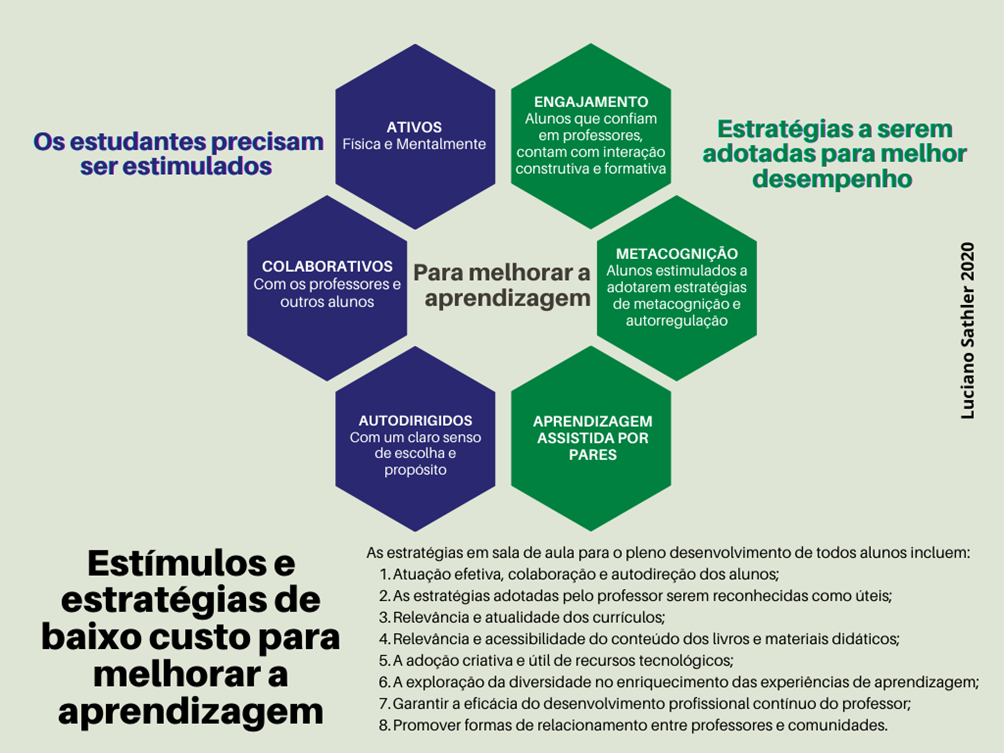
The classroom is a microcosm of the outside world, where children learn their values, attitudes, skills, and knowledge. This classroom experience can be transformative and, therefore, offers the greatest opportunity to address the issue of quality. Recent extensive international research² suggests some low-cost strategies that can be adopted to achieve more meaningful learning, as shown in Figure 1.
The adoption of hybrid learning is a strategic part of this change, which has now become an urgent necessity in light of the challenges posed by the need to safely resume in-person classes and other activities for everyone.
Hybrid learning is a formal educational program in which students engage in learning that is partly based on online content, interactions, and guidance. Students have some flexibility regarding the time, location, and pace of their studies, as well as the learning tracks they choose to follow. Some of the activities take place synchronously at school or in another setting, under the supervision of a teacher.
Hybrid learning has the potential to increase schools’ flexibility in serving students and teachers who are expected to return to in-person classes on alternate days and at alternate times. It can reduce infrastructure needs and offers economically sustainable alternatives for developing catch-up programs and reorganizing the school calendar.
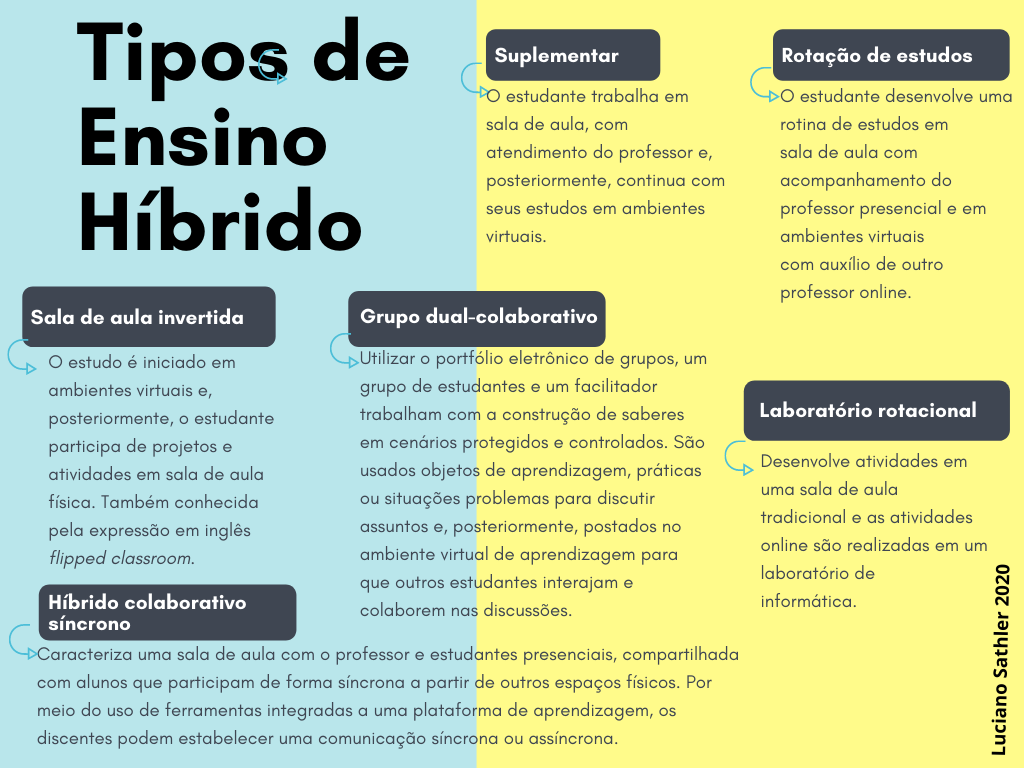
This approach makes it easier to tailor learning paths for students who are struggling. There are several types of hybrid instruction, which can be implemented on an alternating basis with the same class, depending on the intended learning objectives and the students’ profiles, as shown in Figure 2.
Therefore, it is essential that educational institutions include strategies for implementing hybrid learning in their contingency plans for the prevention, monitoring, and control of COVID-19 transmission.
When conducting diagnostic assessments, this planning must be incorporated into the design of remedial activity programs—with a focus on skills and competencies—to ensure that learning gaps are addressed and the educational process is monitored in a cost-effective and high-quality manner.
Hybrid learning must take into account various factors to ensure its successful implementation, such as policies on the allocation of class hours, technological infrastructure, academic management systems, training for all stakeholders, virtual learning environments, and active teaching methods that will help shift the paradigm from “teaching” to “learning” and autonomy.
The goal of personalizing learning must be an integral part of implementing hybrid education, as it is clear that “one-size-fits-all” approaches to knowledge and school organization are ill-suited to the needs of individuals and the Information Society.
A growing view is that systems capable of achieving universally high standards are those that can tailor the learning and progression program to the needs and motivations of each student.
- UNICEF. Addressing the Learning Crisis: An Urgent Need to Better Finance Education for the Poorest Children. New York: UNICEF, 2020.
- UNESCO. The Global Learning Crisis: Why Every Child Deserves a Quality Education. Paris: UNESCO, 2013.
Learn more about the author:
Did you like this content? Share it on your social media:
Categories
- Teaching Methodologies