
Hybrid Learning: Models That Can Support the Reopening of Schools
)
The reopening of schools requires educators and institutions to analyze different scenarios. These scenarios can be explored in greater depth through studies conducted by various organizations, such asUNESCO, and through the excellent document published bythe Unibanco Institute, which compiles guidelines from various international organizations.
In this text, I share some possibilities based on hybrid teaching models—which I explored in the bookI co-edited on the topic, though they were not covered in great depth at the time. Our reflections on hybrid learning focused more on sustained models—those that are possible when all students are present in the classroom—rather than on disruptive models, which assume that not all students will be at school, such as Enhanced Virtual Learning and À La Carte, as shown in the image below.
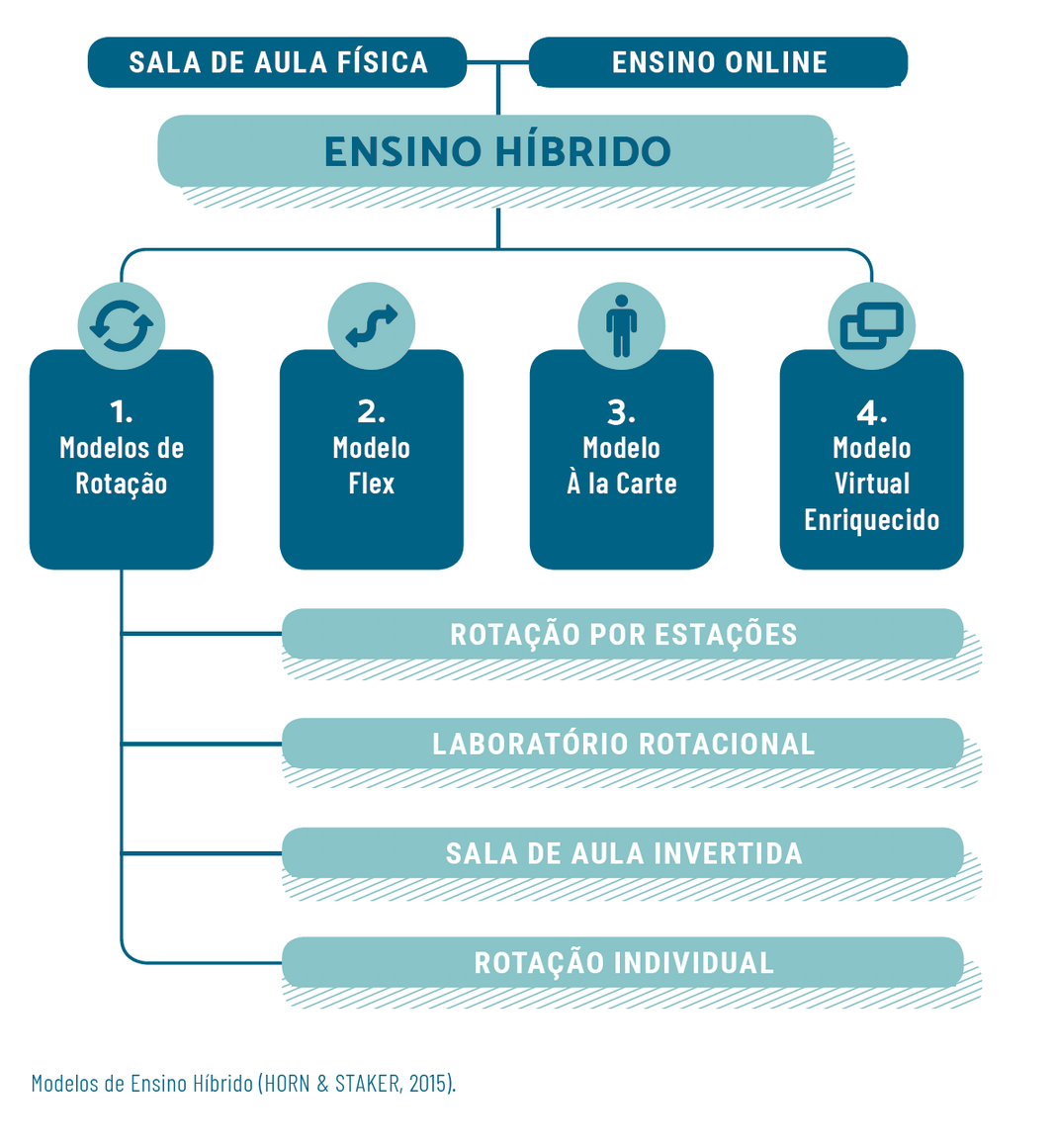 As I always like to point out, our vision of hybrid teaching is based on the relationship that Dewey establishes between teaching and learning. For the author, the two concepts are closely related, and choosing the term “teaching” implies that its counterpart is learning, since the student is at the center of the process, and classes are planned to facilitate that student’s learning.
As we develop our courses, we have been considering a number of issues, and I invite you to examine, below, how some of these models might contribute to a scenario involving the partial reopening of classes.
Rotation Through Stations and Project-Based Learning
In this model, students rotate through stations to engage in activities that develop skills and competencies that can be enhanced by the presence of peers in the school environment. One suggestion for planning these activities is to use project-based learning, which allows students to apply the knowledge they acquired during the online period, taking into account more complex cognitive processes.
Project-Based Learning (PBL) is an active methodology that uses projects as the central focus of instruction, often integrating two or more subjects. Projects may arise from a problem or a guiding question stemming from an authentic context, involving research, hypothesis testing, group work, and other skills until a solution or final product is reached. In this context, students must address interdisciplinary issues, make decisions, and work as a team. Critical thinking, creativity, and collaboration are essential to this process.
Enhanced virtual learning: school attendance for specific purposes
In this model, students complete all aspects of the curriculum online and attend school for mandatory in-person sessions with a teacher once or more per week. During these meetings with the teacher, they engage in in-depth discussions on topics that require further exploration, have their questions answered, or receive guidance to help them with the next steps—much like personalized mentoring.
The difference between what most of our schools have offered during this period of remote learning and the “enhanced virtual” model is the possibility of personalizing the learning experience. In other words, online resources—such as videos explaining concepts and reading materials that explore different perspectives on each concept—allow students to delve deeper into the aspects that, for each individual, generate the greatest engagement. Expanding the range of data-collection tools, therefore, becomes essential, especially to enable this personalized monitoring.
In a more restrictive scenario, this model would involve teachers dedicating part of their schedules to smaller groups of students, who would meet—in compliance with all health guidelines—to share essential learning outcomes, those selected as indispensable for this school year (see the curriculum matrices cited in the references, which outline this process of selecting learning outcomes).
In a less restrictive setting, this model would work for the group of students who would meet to engage in collaborative activities in larger groups, such as debates or problem-solving exercises that apply what they have previously learned in the individual format. We see in this model a connection to the hybrid teaching model known as the “flipped classroom.” For this model to make sense as a form of personalized learning, data collection is essential, and in-person sessions are informed by this information.
À La Carte: Hybrid Curriculum
In the à la carte model, as defined by the authors (Horn and Staker, 2015), a course is taught entirely online; furthermore, according to the authors, this model is most effective in high school for elective courses. This model could therefore be suitable for the educational pathways (for which I had the honor of collaborating on the drafting of thecurriculum guidelines).
In a more restrictive scenario—specifically for high school—elective courses could shift entirely to an online format, allowing for teacher-led guidance, with tutoring taking place online via videoconferencing. Assessments would also be conducted in this format.
In a less restrictive scenario, some of the previously selected courses would transition to an online format for the remainder of the year, closely monitored by instructors through video conferences for discussion and in-depth analysis, but with course materials delivered online. Assessments could be conducted in groups during in-person sessions.
Considerations and Reflections
In the various scenarios I have presented in this text, it is important to reflect on the role of online learning in planning. Rather than simply assuming that both in-person and online classes will take the form of “lectures,” it is important to define the purpose of each session.
Online learning offers an excellent platform for “instructional” content, particularly in the form of recorded lessons, or video lessons. Recorded lessons can serve as a repository of explanations of concepts and can be reused to help students fill in any gaps in their understanding that may arise.
Whether synchronous (in remote learning) or in-person (in hybrid learning), these settings should not be spaces for mere presentation, but rather for human connection and interaction among people—highlighting such relevant issues as empathy, reasoning, and critical thinking. “Delivering” content should not be the focus at this time; rather, the ability to solve problems and put into practice the learning that has been built upon through prior exposure gives greater meaning to what we call hybrid teaching—which is more than just the combination of in-person and online learning—but rather the possibility of personalizing learning. As Cesar Coll (2018) notes:
The personalization of learning is conceived as a set of pedagogical and instructional strategies aimed at promoting and reinforcing the meaning of academic learning for students. […] The question is not whether or not we should move toward personalization, but how to do so.
Perhaps this is the time for us to think about how to do this, revisiting the idea that innovation will be increasingly methodological rather than technological.
References
BACICH, Lilian; TANZI NETO, Adolfo; and TREVISANI, Fernando. Hybrid Teaching: Personalization and Technology in Education. Porto Alegre: Penso, 2015.
BACICH, Lilian, and HOLANDA, Leandro. STEAM in the Classroom: Project-Based Learning Integrating Knowledge in K-12 Education. Porto Alegre: Penso, 2020.
COLL, Cesar. The Personalization of School Learning, 2018. Available at: http://www.eduforics.com/br/personalizacao-da-aprendizagem-escolar-uma-exigencia-da-nova-ecologia-da-aprendizagem/
HORN, M. B.; STAKER, H. Blended: Using Disruptive Innovation to Improve Education. Porto Alegre: Penso, 2015.
To learn more about the courses we offer on these topics, visit: www.triade.me/cursos
Learn more about the author:
Did you like this content? Share it on your social media:
Categories
- Teaching Methods