
Experts Discuss the Progress and Challenges of the New National Education Plan
)
During the 31st edition of Bett Brasil, Editora do Brasil discussed the recently approved National Education Plan (PNE) 2024–2034, during the panel “From Intuition to Evidence: Data Governance in the National Education System,” featuring Sônia Regina Victorino Facchini, a full member of the Santa Catarina State Board of Education; Professor Luciano Rocha, a researcher in the field of learning assessment; and Edilson Kalil Michereff, Government Business Consultant at Editora do Brasil.
The panel discussed the plan, which updates—for the next 10 years, with both advances and gaps—the agenda initiated by the 2014–2024 National Education Plan (PNE), setting targets for access (enrollment, universal access, expansion of enrollment capacity); quality targets (learning, teacher training, infrastructure); and management and financing targets (percentage of GDP, funding mechanism, evaluation).
The 2014–2024 PNE left an ambiguous legacy: partial achievements in access and important legal milestones (such as the CAQ—Student-Quality Cost—and the broadening of the debate on funding), but a large portion of the goals were not fully met, especially those related to quality and the valorization of teachers. The new 2024–2034 cycle begins under pressure from this history of weak implementation and the need to address educational inequalities laid bare by the pandemic.
The new National Education Plan (PNE) is organized around 19 objectives structured into broad areas, just like the previous one:
- Early Childhood Education– expansion of daycare centers and preschools, with a focus on quality and professional training.
- Compulsory Basic Education—guaranteeing enrollment and retention for children aged 4 to 17, with a focus on age-appropriate literacy and combating dropout rates.
- High School and Vocational Education –increasing graduation rates, reorganizing the curriculum, and integrating with technical education.
- Higher Education– expanding enrollment, implementing policies to promote inclusion and student retention, and strengthening research.
- Education for Youth, Adults, and the Elderly (EJA)– reinstated as a strategic policy, integrated with vocational training.
- Training and professional development for education professionals—career paths, salaries, working conditions, and continuing education.
- Funding and management– percentage of GDP allocated to education, implementation of the CAQ, strengthening of the collaboration framework.
- Equity and Inclusion– Focus on regional, racial, and gender inequalities, as well as income disparities and special education from an inclusive perspective.
- Evaluation and transparency—measurable goals, monitoring, and public participation.
The 2024–2034 National Education Plan (PNE) is a rare opportunity to correct course and further build a high-quality, equitable, and democratic public education system in Brazil. Its value lies not only in the approved text, but above all in its ability to guide stable policies, even in changing political contexts; to foster federal cooperation around common goals; and to ensure that education remains a genuine priority for investment—not just rhetoric.
The challenge now is to turn these goals into everyday reality. This requires political will, stable resources, technical capacity, and ongoing social participation. Ultimately, the success of the PNE will be measured not by compliance reports, but by the concrete experiences of children, adolescents, youth, and adults in Brazilian schools over the next decade.
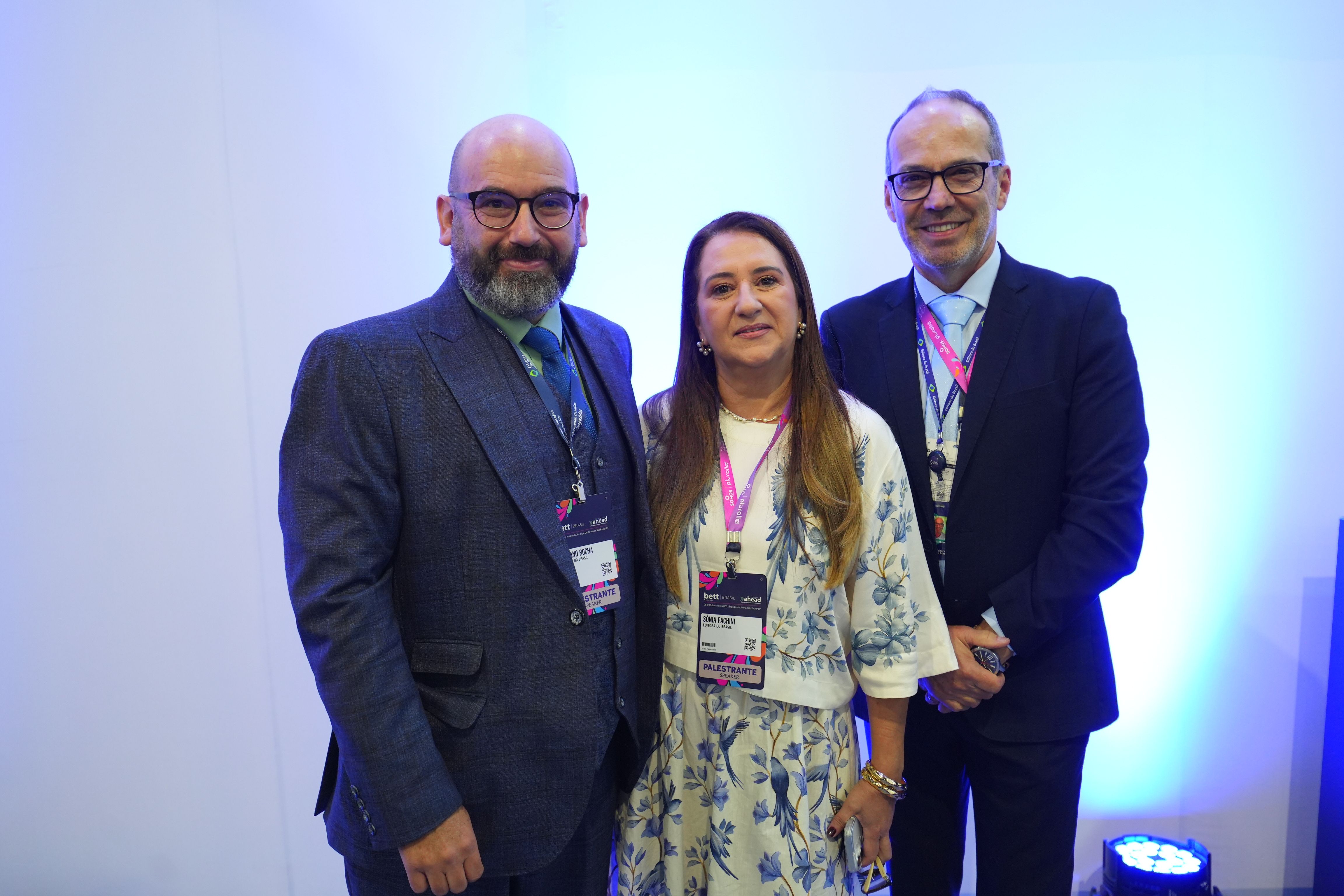
Luciano Rocha, Sônia Regina, and Edilson Kalil participated in the panel at Bett Brasil. Photo: Bett Brasil.
Benefits
The new plan maintains the decade-long planning framework—which is essential to state policy—and allows state and municipal plans to be aligned with the national plan, thereby creating consistency in national efforts by reinforcing the need to reduce historical educational inequalities and recognizing that simply increasing enrollment is not enough, in addition to identifying priority groups: Black, Indigenous, and Quilombola populations; rural residents; people with disabilities; and students in socially vulnerable situations.
The plan also explicitly acknowledges thelearning losscaused by COVID-19 and calls for remedial programs and ongoing pedagogical support, not just one-off, short-term measures.
For the benefit of teaching staff in Brazil, the plan affirms the importance ofcomplying with the national minimum wage, career plans, and work schedules that allow time for planning, and it emphasizes thevalue of initial and continuing professional development—aligned with the actual needs of schools and grounded in evidence.
In the area of early childhood education, the plan reaffirms the goal of expanding childcare center capacity—crucial for equal opportunities—and improving the quality of preschools, while also recognizing early childhood education as a stage with its own identity, not merely a “preparatory” phase for elementary school.
It also provides for mechanisms forperiodic monitoringof the goals, with opportunities for public participation (forums, conferences, councils), allowing for adjustments throughout the decade, rather than only at the end of the 10-year plan.
Critical Points
Many of the plan’s objectives still lack detailed strategies, timelines, and assigned responsibilities, which is likely to lead to a repeat of the 2014–2024 scenario, which saw low levels of compliance with goals and objectives.
Debates over the percentage of GDP allocated to education and the Student-Quality Cost (CAQ) remain central, but the link between targets and resources is not always clear. There is also no definition of stable funding sources (tax revenue, royalties, specific funds), and many targets depend on budgetary “goodwill.”
The National Education Plan (PNE) mentions cooperation between the federal government, states, and municipalities, but the question remains: who does what, with what funding, and under what rules? Without a clear agreement, municipalities—especially the poorest ones, which have limited investment capacity—continue to be overburdened.
The lack of a long-term outlook is one of the plan’s greatest challenges; over the next 10 years, Brazil will have had different federal, state, and municipal governments, each with diverse political agendas. Without a strong social and institutional consensus around the PNE, the likelihood of programs and goals being discontinued increases.
It is also necessary to review the mechanisms for distributing resources to ensure greater territorial equity (for example, by expanding Fundeb supplements in a targeted manner).
Practical Challenges in Literacy
One of the greatest educational challenges today is the consolidation of literacy by the 2nd grade of elementary school, in accordance with the National Common Core Curriculum (BNCC), alongside formative assessments and support for students throughout their entire educational journey—not just at the end of each stage.
Adjustments to the New High School Program toward amore flexible, attractivemodel that is consistent with the BNCC represent another enormous challenge, aimed at avoiding the previous rigidity and disorganized flexibility.
Another focus of the new policies is to expand integratedvocational and technical education—especially for low-income youth—with strong ties to the workforce, as well as to strengthen assessment systems (SAEB, state, and municipal assessments) for pedagogical purposes, rather than merely punitive ones.
Thus, it is urgent and necessary to ensure consistency in delivering public policies that support the PNE’s goals through coherent curriculum programs, high-quality instructional materials, purposeful teacher training, and pedagogical support for teachers to address heterogeneous classrooms and learning gaps.
*Content is the sole responsibility of the advertiser.
**This text does not necessarily reflect the opinion of Bett Brasil.
Share on social media:
Categories
- Sponsored content
- The Future of Education