
Experts gather at Bett Brasil to discuss Brazilian public education
)
The 29th edition of Bett Brasil features an exclusive area dedicated to discussions about public education in Brazil, one of this year’s new additions. On the first day of the event, one of the topics discussed in the auditorium was: “Experience and practice: how Paraná teaches computer science to more than 530,000 students.”
A case study on public education in the state of Paraná was presented, which sparked elementary school students’ interest in software programming. The students who participated in the program shared their experiences in a video, explaining how challenging the program was and how it enhanced their interest, critical thinking, and academic performance.
For Roni Miranda, Paraná’s Secretary of Education and one of the panelists, the auditorium dedicated to public education is a valuable initiative by Bett. “Today, most students attend public schools, and it is crucial to share what is happening in this field. State and municipal education departments are also becoming involved in this modernization process. The case of Paraná offers a wealth of experience in both work and teaching that is well worth sharing.” Panel participant Thais Pianucci, a psychoanalyst and educator who serves as general director of Alura Start, commented that “digital literacy is the new form of inclusion.”
Another panel held in the auditorium dedicated to public education addressed the issue of violence in the school environment, with the theme “Hate-Free Schools: Learn How to Combat Extremism in the Classroom.” Based on a study conducted by Porvir—an educational content platform—the panel discussed how to address the growing climate of hatred and extremism in recent years, including in the classroom.
The survey shows that there is a direct link between extremism and misinformation. Students and the school community are bombarded with misinformation online. Algorithms reinforce users’ preferences based on their online activities and begin to deliver more and more content that does not expose people to opposing viewpoints.
This environment contributes to the rise of hate and attacks in schools. These phenomena, which were once observed only in other countries, have grown exponentially in Brazil in recent years. The main targets of hate attacks are those perceived as different: women, Black and Indigenous people, and the LGBTQIA+ community.
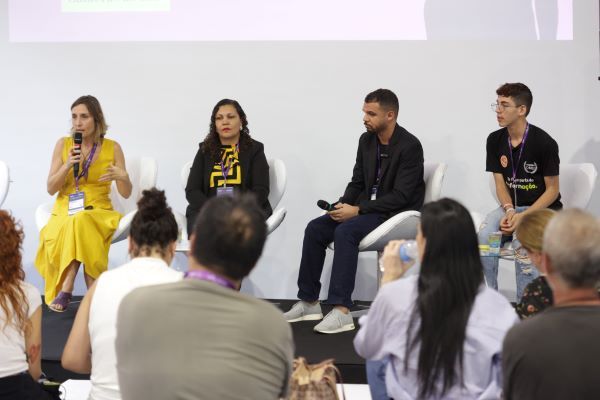
In addition to Tatiana Klix, director of Porvir, who moderated the panel, the discussion featured Margareth Alves, a teacher with the Federal District Department of Education for the past 24 years, and Ronney Santos, a teacher in the Sergipe State Public School System and coordinator of Observa! Observatório de Fake News, who shared their experiences in raising awareness among the school community about how to confront this hostile environment.
“Fostering respect for diversity and media literacy is one of the focuses of the projects we develop to make students feel welcome,” says Margareth. Ronney, meanwhile, highlighted the main types of misinformation, based on studies from Harvard University. “I created a fake profile and ended up getting trapped in echo chambers where algorithms feed users more and more misinformation, using rhetoric that preys on people’s emotional vulnerabilities to attract followers. Based on that experience, we developed strategies to combat them.”
Issues related to the quality of and access to education, sustainable futures, and partnerships between the government and the private sector were also discussed.
Bett Brasil runs through Friday (the 26th) at Expo Center Norte in São Paulo. Registration can be done on-site. Admission is free.
Share on social media:
Categories
- The Future of Education