
Students: Technology Consumers or Innovators? Learn About the Challenges Facing Digital Natives
)
The generation of students born in the digital age—known as digital natives—is held captive by the most common use of computers and cell phones: passively consuming content created by adults. When faced with a screen, the effect is hypnotic, as the rest of the world fades away.
Meanwhile, the same device could be used as a tool for creativity and personal expression. We’re not talking about creating or playing games, but about creating whatever the student is interested in: apps, poetry, music, animations, movies, websites—and, why not, games as well—and much more.
Guilherme Silveira, founder of Alura, cites the example of Google Maps to illustrate the importance of becoming a creator: “If I want to walk from downtown to my house, it shows me the fastest or shortest route. But it doesn’t give me the option of the most scenic route, or the one with the most trees.” He also emphasizes that, as passive consumers of videos and apps, we are at the mercy of their creators and don’t even consider different options for our lives.
Therefore, teaching our children and young people to use computing as a means of creation—creative computing—is giving them the power and freedom to explore their futures through technology.
Who are digital natives?
The term “digital natives” was coined by education expert Marc Prensky in 2001 to refer to those individuals “who have spent their entire lives surrounded by and using computers, video games, digital music players, video cameras, cell phones, and all the other toys and tools of the digital age,” and who have thus been directly impacted by technology. They are recognized by characteristics such as:
- Unlimited access to information;
- Multitasking;
- Instant communication;
- Interest in games and rewards;
- Difficulty concentrating.
Although they are immersed in a technological world, digital natives are struggling even with the simple act of using computers. According to a 2021 study by the OECD (Organization for Economic Cooperation and Development), digital natives are not even equipped to understand, distinguish, or efficiently use the knowledge available on the internet. Only 24% of students were considered highly proficient in navigation skills.
“Being born in the digital age and being a digital native does not mean you will have the digital skills to use technology effectively,” said Andreas Schleicher, Director for Education at the OECD.
Early exposure to technology has led young people to adopt a mindset of constant consumption, where information is readily available, but the ability to synthesize information, use tools efficiently, and create original content remains underdeveloped. This lack of initiative and technological proficiency may have implications for the educational and professional development of digital natives, potentially affecting their readiness for the job market.
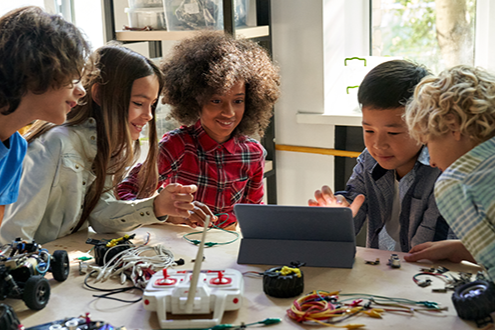
Consumption vs. Creation: The Challenges of Digital Education
Digital education aims not only to provide access to technology, but also to develop essential and cross-disciplinary skills, such as critical thinking and problem-solving, through the use of digital tools.
Developing computational skills, in the words of Guilherme Silveira, “enables students not only to develop more holistically, but also to better understand what they consume.”
Computational Thinking in Schools
To change this reality of passive consumers, digital education in schools is essential and must be achieved through the development of computational thinking, which is key to empowering students to use technology in innovative ways and to their advantage.
Children and young people who become creators take greater responsibility for their actions, develop greater self-confidence, and cultivate a critical eye not only toward the use of technology but also toward their professional and personal choices and decisions. One tool that facilitates this learning is teaching programming.
Through programming, students explore a boundless universe, creating and simulating environments, characters, and actions without physical limits. In practice, they can develop projects that align with their interests, such as rocket simulators, a robot that generates poetry, or a magical Artificial Intelligence (AI) that guesses the user’s name—among many other options that foster creativity and autonomy.
This topic is so relevant to a well-rounded education that the National Common Core Curriculum (BNCC), in its Computing Annex—approved in 2022—recognizes the importance of developing technological skills and defines this learning as a mandatory guideline for Basic Education in Brazil, in accordance with the pillars of “computational thinking,” “the digital world,” and “digital culture.”
Bringing this learning into schools—in a deliberate and methodical way—through educational programs that empower students is the path to enabling them to become active participants in the digital society.
Alura Start: Shaping Students' Futures Through Programming
One solution that addresses this need is Alura Start, an educational platform that provides instruction to elementary and high school students, developing their computational thinking and digital skills through the teaching of programming as part of the curriculum.
According to Thais Pianucci, Head of the Alura Start Unit, “students are encouraged to develop critical and analytical thinking skills for problem-solving through content contextualized in real-life situations from their daily lives, on an intuitive platform and through a dedicated app.” In addition, “with the support we also provide through teacher training, students make significant progress,” she points out.
In addition to making an impact on students, Alura Start provides management support and continuing education for teachers through synchronous and asynchronous content on best teaching practices.
As you can see in this article, digital natives tend to be passive consumers of content; therefore, it is essential that educators and administrators recognize the importance of developing computational thinking. In this way, they enable students to become active creators and use technology critically to have a positive impact on their personal and professional development, as well as on society as a whole.
Alura Start offers an effective solution to this challenge, preparing students for the challenges of the digital future. Want to know how your school can transform students’ lives through technology? Visit the website and become a Start Innovative School!
Share on social media:
*Content is the sole responsibility of the advertiser.
**This text does not necessarily reflect the opinion of Bett Brasil.
Categories
- Innovation
- Teaching Methodologies