

Teacher training is gaining ground amid the rise of artificial intelligence
)
The presence of artificial intelligence (AI) in educational institutions increases the need to prepare teachers to understand, use, and oversee the available tools.
For Professor Fernanda Bérgamo, managing partner at Bérgamo Cursos e Treinamento, professional development is one of the key ways for educators to become proficient with these tools. According to her, schools need to take an active role in this process by offering training that familiarizes teachers and coordinators with AI.
In the professor's view, exposure to artificial intelligence tools must go beyond a one-time experience. Educators must become sufficiently familiar with to understand how these resources work and use them in a way that is appropriate for their professional activities.
“Teachers, for their part, cannot afford to stop researching, learning about, and gaining an ever-deeper understanding of this new reality, which is already bringing about a true revolution in our society. It is essential to develop critical thinking and the ability to ask AI good questions, giving clear instructions—which, at its core, is a communication skill,” he explains.
See also:
Familiarity with the tools is also cited as a prerequisite for teachers to be able to monitor how students use AI. In Fernanda’s view, simply becoming familiar with the platforms is not enough: it is necessary to master them.
“It all comes down to training—a lot of training. Simply ‘becoming familiar’ with AI tools isn’t enough. Professionals need to master AI just as they master their smartphones, word processors, and social media in order to supervise students’ use of AI,” he says.
Faculty supervision involves ethics
The incorporation of artificial intelligence into the learning process also raises questions related to ethics and the teacher’s role in guiding students. Fernanda believes that AI can contribute to knowledge building and stimulate curiosity, but its use must be monitored by educators.
“Artificial Intelligence can be an ally in building knowledge and, above all, in sparking students’ curiosity. And here, the teacher’s guidance is essential,” he points out.
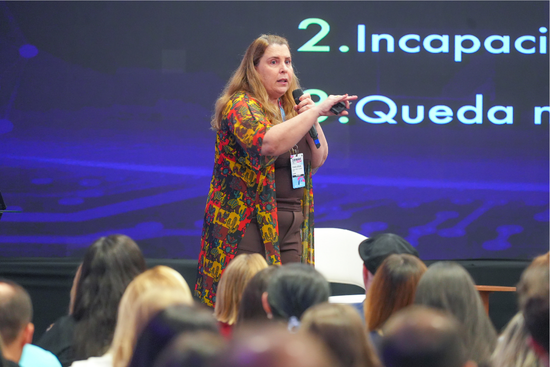
Fernanda Bérgamo during a presentation at the Bett Nordeste 2026 conference. Photo: Bett Brasil.
According to the professor, this supervision depends directly on the teachers’ own preparation. To guide students, educators need to be familiar with the tools they use and keep up with developments in this field.
At the same time, AI itself can be used as a resource to support teachers' professional development. Fernanda cites as an example the possibility of using a language tool to identify which platforms are most popular among students.
“So, when you ask an LLM (Large Language Model) what the main tools students are looking for in the world of AI are, it will provide the answer and allow you to become familiar with that tool without wasting hours and hours on research that used to be necessary,” he says.
Training must involve the entire team
Preparation for the use of artificial intelligence is not limited to individual teachers. In Fernanda’s view, educational institutions need to create opportunities for the entire teaching staff to become familiar with the tools and use them productively.
“Schools cannot fail to provide as many opportunities as possible so that staff can fully master as many platforms as possible that enable them to work more productively,” he says.
Fernanda also notes that artificial intelligence “is not just a passing fad” and is likely to remain a part of professional life in various fields. Therefore, preparing teachers and students to use these tools requires ongoing training that goes beyond basic knowledge of the platforms.
This content is based on Professor Fernanda Bérgamo’s participation in the Bett Nordeste 2026 Conference.
Share on social media:
Categories
- Educational Management