

AI Prompts Reflection on the Future of Schools
)
Artificial intelligence debuted its own auditorium at the 31st edition of Bett Brasil. For the first time, the event is hosting the “AI in Education Summit”, a forum dedicated to discussing how technology is already beginning to reshape education, from K-12 through higher education.
Jointly curated by Bett Brasil and Conexia Educação’s educational AI platform, AI4School, the initiative brings together national and international experts for a program focused on practical applications, challenges, and possible paths for the adoption of AI in schools.
At the opening of the Summit, Bett Brasil’s general director, Claudia Valério, emphasized that the current situation calls for a change in mindset on the part of educational institutions. According to her, the discussion is no longer about whether or not to use artificial intelligence, but rather about the need to understand it and incorporate it in a thoughtful way.
By placing this topic at the center of the curriculum, the goal is to highlight the direct impact of technology on the school environment, without losing sight of the human role in this process. “Innovation only makes sense when accompanied by guidance, context, and responsibility,” says the principal.
Also present at the opening, Conexia CEO Sandro Bonás pointed out a long-standing gap in the debate on technology for education. According to him, although artificial intelligence is already widely discussed in various sectors, education does not always take center stage in these conversations.
“Discussing artificial intelligence without listening to teachers, administrators, and educators limits our understanding of its real impacts,” he said. He emphasizes that the Summit was created to reposition educators as key players in a transformation that is already taking place in classrooms.
Between Advances and Limitations: What Is the Future of AI?
The discussion takes on a broader scope in the lecture by professor and innovation expert Gil Giardelli, who proposes a shift in perspective: rather than simply understanding artificial intelligence, we will need to learn to live with it.
According to Giardelli, this technology is already driving a new global economic paradigm—the so-called “AI economy”—and represents one of the greatest windows of opportunity for the current generation. However, this progress does not come without side effects.
“Increased productivity goes hand in hand with a rise in cases of burnout. We’ve never seen as many cases of burnout as we do now,” he warns.
In this context, the debate inevitably turns to ethics. For Giardelli, although technology is neutral, its use is not, and it requires clear boundaries. He cites examples that are already pushing those boundaries, such as companies working on the de-speciesing of organisms and the development of artificial faces with human expressions. “This brings us to a central question: How far should we take the use of technology?” Gil asks provocatively.
Visible impacts inside the classrooms
While there are still questions about the use of AI in schools, some countries are already showing concrete results. China, for example, has been incorporating artificial intelligence into everyday school life through the use of robots, gamification, and technologies capable of measuring students’ attention and learning levels. There are also technologies that track the athletic performance of children and young people in schools, helping to foster new talent.
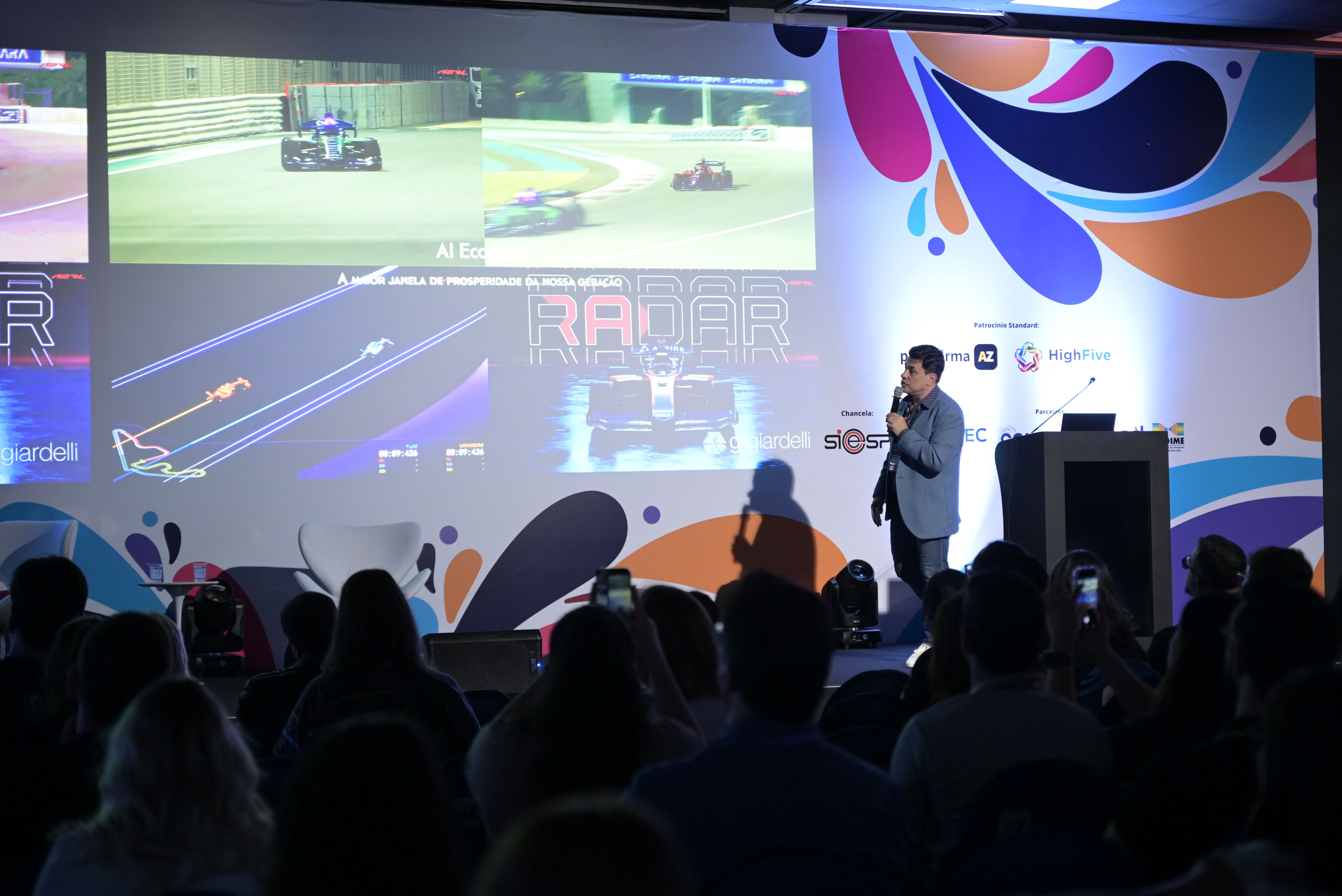
According to Giardelli, after three years of implementation, these initiatives are already showing significant improvements in academic performance, with grades rising by up to 65 percent. Experts argue that the strategic use of data allows teachers to better understand how students are absorbing the material and to adapt their teaching approaches accordingly.
The challenge begins at the grassroots level
Despite the progress made, the speaker draws attention to a critical issue: the excessive focus on higher education. In his view, the greatest potential for transformation lies in basic education, especially early childhood—a stage during which skills such as creativity and curiosity can be developed more deeply.
According to Giardelli, in this context, schools take on an even more strategic role. “More than just imparting knowledge, schools are now responsible for shaping individuals capable of interpreting, questioning, and taking action in a world increasingly shaped by technology. To this end, it is essential to foster children’s curiosity and creativity,” he emphasizes.
Ethics and AI
Also at the Summit, another session addressed topics such as ethics, algorithmic bias, and the risk of delegating educational decisions to technology—debates that have accompanied the rapid advancement of AI worldwide.
During a conversation with Guilherme Cintra, Director of Innovation and Technology at the Lemann Foundation, the Affiliate Researcher at New York University and Founder of Escribo — Educação do Seu Jeito, Americo Amorim, and Gi Santos, a researcher and Innovation Manager at humani:a, discussed how to keep teachers at the center of the learning process, avoiding the excessive delegation of decision-making to technology.
“What AI can enable are good dialogues, good conversations. There’s nothing more ancient than the technology of dialogue. It blurs the lines between mastery of knowledge and the ability to teach, but AI hasn’t yet proven itself to be better than a teacher, and I don’t know if we want it to prove itself,” commented Cintra.
To wrap up the day’s schedule of discussions, a roundtable conversation on protection and education in the digital environment highlighted an important point: fostering digitally literate citizens requires ongoing dialogue between schools, families, and society. Against the backdrop of increasing online risks, this issue takes on even greater relevance for administrators and educators.
Throughout the day, it became clear that, more than just trends, the topics discussed are already part of the reality of schools and require concrete solutions.
Share on social media:
Categories
- Innovation