

Artificial Intelligence is advancing, but experts say the role of the teacher remains more important than any technology
)
Should teachers lose ground in an increasingly autonomous classroom? Is society becoming more and more dependent on generative AI? The rapid advancement of digital technologies and artificial intelligence is forcing schools and educational institutions to rethink not only teaching tools, but also the very role of humans in education.
The need to prepare students for an increasingly automated world without compromising their cognitive, creative, and social-emotional skills is one of the topics of discussion among experts in the field regarding the future of learning.
At Bett Brasil’s Arena Startups, Wisley João Pereira, Superintendent of Education at SESI Nacional; Rodrigo Madeira, Enterprise Account Manager at AWS (Amazon Web Services); and Lucas Sousa, specialist in communities and innovation ecosystems at SENAI Nacional, discussed the challenges of digital transformation in education and the impact of new technologies on the behavior of students and professionals.
With more than 20 exhibiting startups, over 35 speakers, and 18 content sessions, the Startup Arena initiative reinforced its role as a showcase for transformative solutions in education.
Among the sponsors, Nuage—a consulting firm specializing in IT and cloud services and an AWS partner—brings its expertise in IT services, cloud computing, data, and GenAI to support educational institutions in building scalable, secure, and data-driven environments.

Experts discussed the digital transformation in education during a panel discussion at the Startups Arena. Photo: Bett Brasil.
SESI and SENAI, on the other hand, offer an innovation ecosystem focused on training students and professionals to meet the challenges of the new economy, strengthening the national industry through education, technology, and the development of skilled human capital.
The school
In discussing the rapid technological evolution within schools, Wisley João Pereira emphasized that teacher training has become one of the most pressing issues in contemporary education. According to him, the use of digital tools only yields effective results when accompanied by adequate pedagogical training. “Teacher training has never been as essential as it is now,” he said.
However, it is already well known that the shortage of teachers is a global challenge. UNESCO estimates that 44 million new teachers will be needed by 2030 to ensure universal basic education. “With this in mind and to meet this demand, SESI Nacional has been expanding its training initiatives, including a training center with approximately 450 teachers who serve as multipliers throughout the country,” he emphasized.
The executive also drew attention to the effects of excessive digital stimulation on children and adolescents. According to him, countries that have rapidly advanced in screen use are now discussing ways to reduce and better manage this consumption.
Change in Method
Another point raised by Pereira is the teaching method. According to the expert, Brazilian education remains overly focused on the reproduction of content, pushing skills related to creativity, critical thinking, and social-emotional development to the background.
He also argued that the introduction of new technologies into the school environment should be done in a planned manner and in line with pedagogical practice. “No technology should be introduced into the classroom if the teacher is not able to use it purposefully,” he emphasized.
Cognitive impact
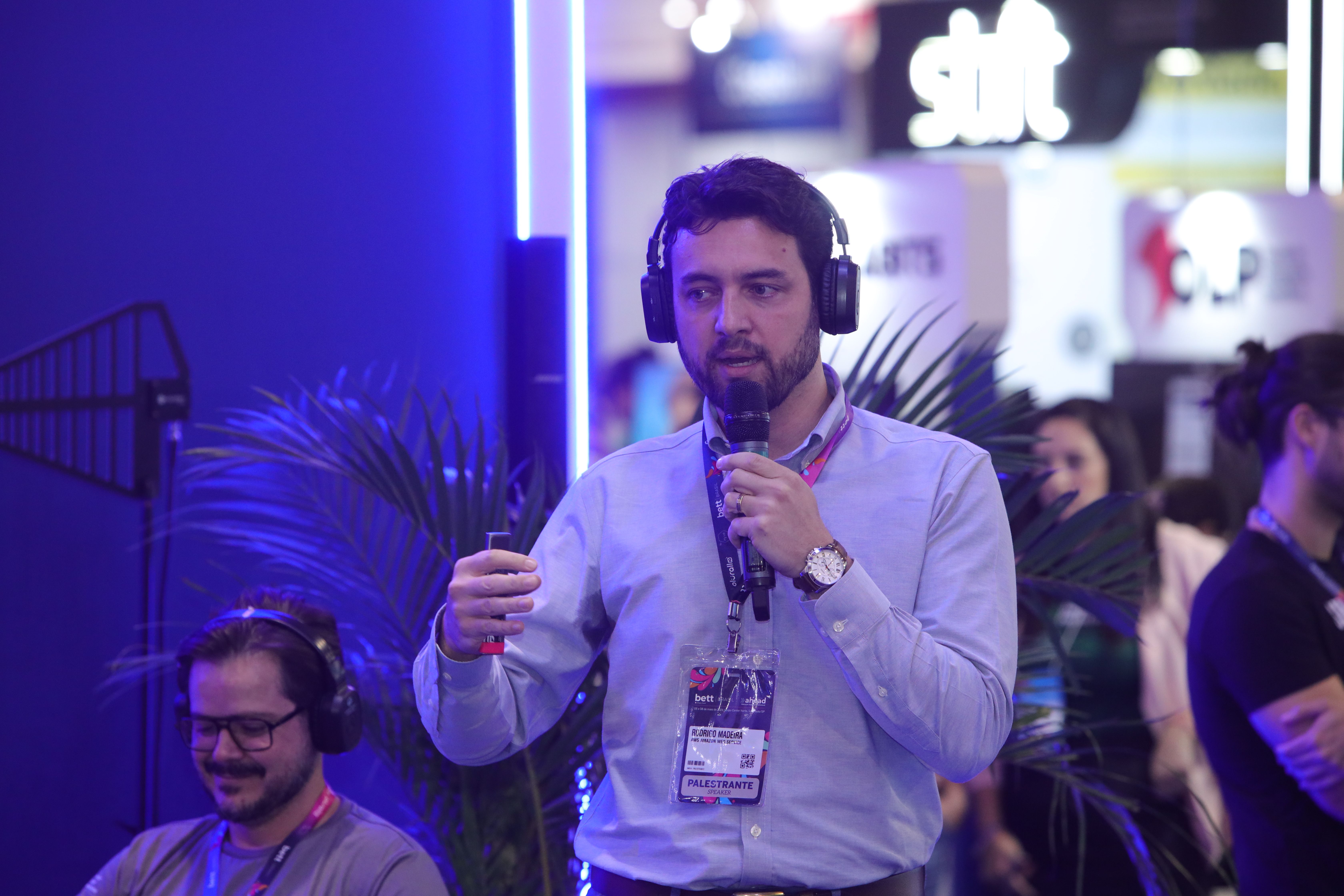
Rodrigo Madeira explained the cognitive impacts of excessive AI use. Photo: Bett Brasil.
The discussion on artificial intelligence and its use took on a more critical perspective during Rodrigo Madeira’s presentation. The representative from AWS (Amazon Web Services) shared insights gained during his time at SXSW 2026, held in Austin, Texas, and stated that there is growing international concern about the cognitive impacts of excessive AI use.
According to Madeira, the rapid pace of automation calls for reflection on the preservation of human intellectual autonomy. “Today, there is a real concern about cognitive sovereignty and the preservation of the human capacity for critical thinking in an increasingly automated environment,” he said.
The AWS representative also warned of the risks of cognitive decline resulting from overreliance on automated tools, especially among young people.
“There is a significant risk of cognitive decline when we fail to exercise certain human abilities due to excessive reliance on technology. How we will ensure critical thinking among young people who are already fully exposed to this is an issue we must seriously reflect on,” he said.
Despite advances in artificial intelligence, the expert points out that a large portion of human skills remains irreplaceable. According to him, about 15% of cognitive work is “digitizable,” while the remaining 85% remains exclusively human.
To wrap up the discussion, Lucas Sousa presented data from a study conducted by SENAI Nacional in partnership with Neo-UFRGS, which analyzed educational trends between 2024 and 2026.
According to Sousa, the survey identified significant growth in technologies related to generative artificial intelligence in just two years, particularly platforms based on LMS (Learning Management System) and autonomous agents.
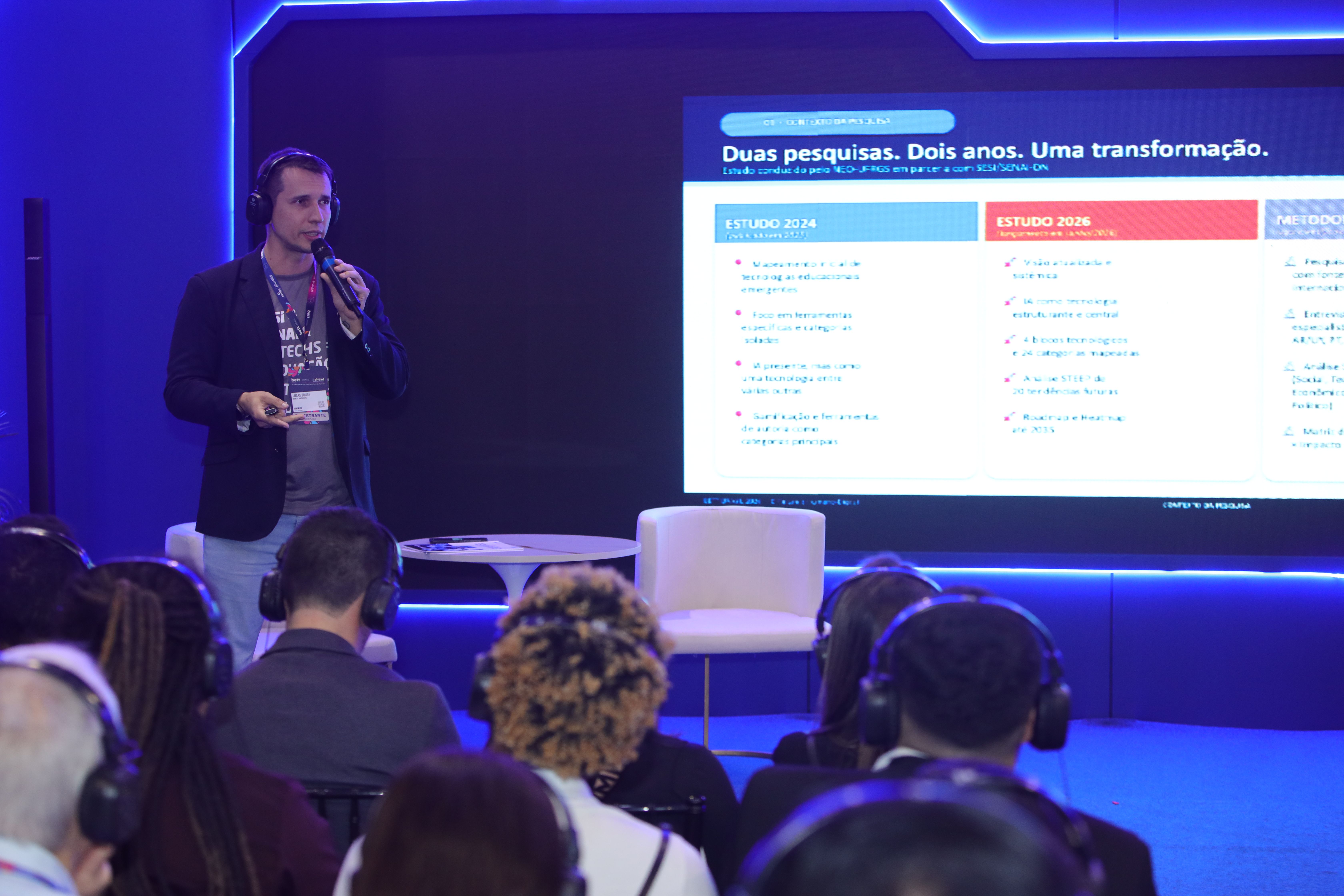
Lucas Sousa presented research data on AI conducted by SENAI Nacional in partnership with Neo-UFRGS. Photo: Bett Brasil.
At the same time, tools that once dominated discussions about educational innovation—such as gamification, plagiarism detection, and content authoring platforms—have begun to lose their relevance. “The technological landscape changes very quickly, and this requires educational institutions to stay up to date,” he said.
Sousa also pointed out that social and human factors are among the key educational trends identified by the study, reinforcing the central role of teachers in the process of transforming learning.
Share on social media:
Categories
- The Future of Education
- Innovation