
More than 80% of teachers see benefits in using AI in education, according to a survey discussed at Bett Brasil 2025
)
On the third day of Bett Brasil 2025, the panel “What K-12 Teachers Reveal About the Use of AI in the Classroom: Challenges, Perceptions, and Possibilities” brought together UTFPR professor —Cornélio Procópio and coordinator of the TEDI (Technology and Digital Education for Seniors) project, Camila Sestito; Robson Bonidia, who holds a Ph.D. in Computer Science and is the leader of the InteliGente project; and Wellington Cruz, founding president of the Significare Institute.
The discussion was based on an original study conducted by the Significare Institute in partnership with the Federal Technological University of Paraná (UTFPR), which surveyed 346 teachers from all Brazilian states. The discussion prompted reflections on the actual use of technology in the classroom, addressing issues such as security, ethics, and digital inclusion.
“With this research, we’ve raised a number of important questions, such as understanding the unique characteristics of Brazil from a human perspective and, from there, discussing Artificial Intelligence. We seek to understand the dilemmas faced by our teachers and our schools, as well as the urgent needs of education,” explained Professor Wellington.
Challenges and Opportunities in the Use of AI
One of the survey’s key findings is that, although most teachers have a basic understanding of AI, few have mastered its advanced use. For Camila, this points to two major challenges: “We need to train teachers to use AI in their daily work and, at the same time, prepare them to support students in this process.”
Despite these limitations, more than 80% of the teachers interviewed see benefits in applying AI in the classroom, especially for lesson planning and creating interactive content. About 61.6% already use generative AI tools to generate ideas, create lesson plans, and develop materials, although only 14.3% have incorporated the technology into the actual creation of instructional materials.
Among the main obstacles cited by educators are a lack of internet access, a shortage of equipment, a lack of technical support, and, above all, a lack of time.
Ethics, Responsibility, and Critical Thinking
Bonidia emphasized that it is not enough simply to bring technology to schools; it is essential to ensure its ethical and responsible use. “There’s no point in introducing AI in one region while neglecting other, less developed ones,” he warned. He also highlighted the need to educate students to be aware of and critical about the use of these tools.

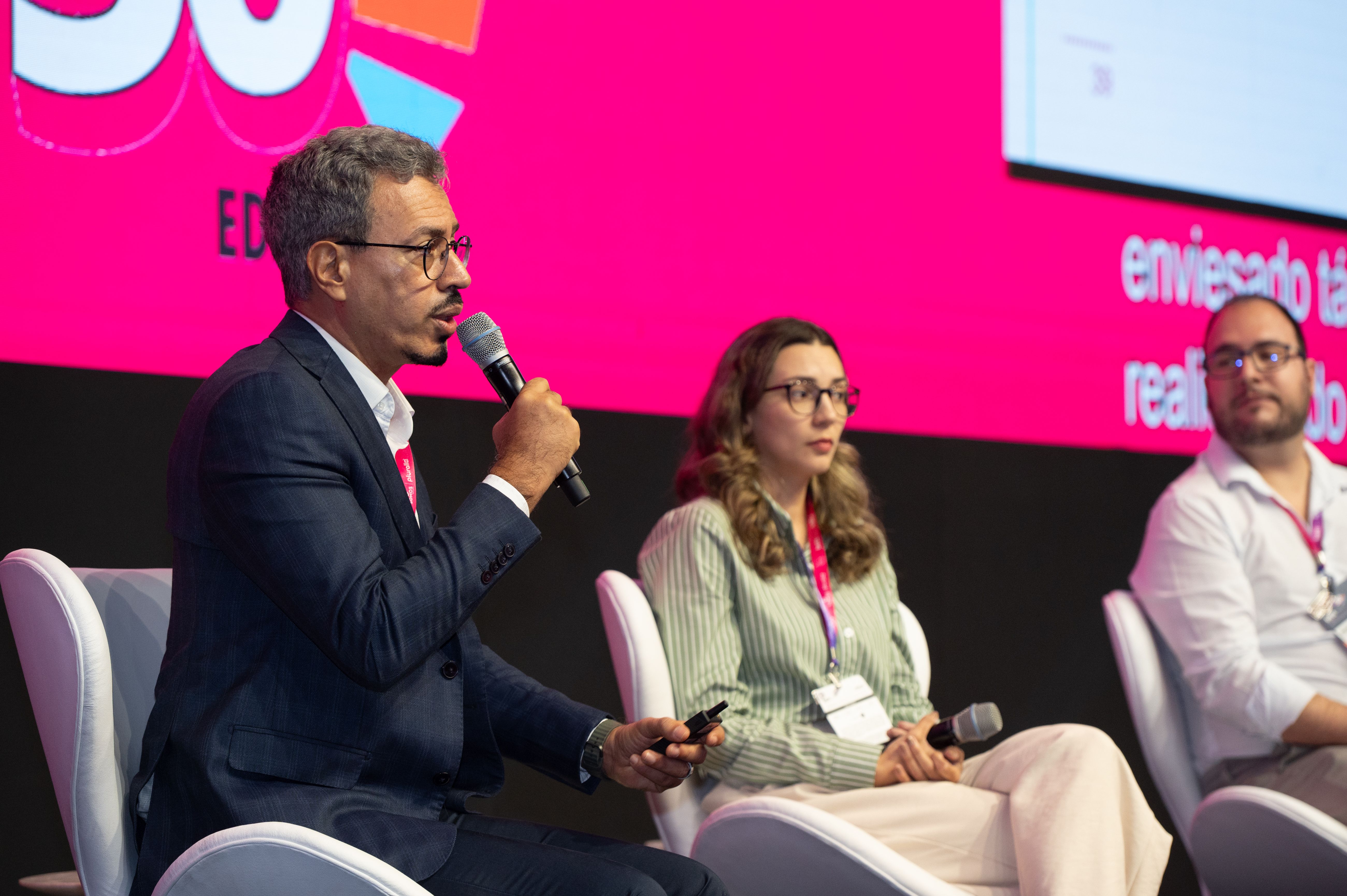
For Cruz, ethical responsibility in the use of AI should be part of students’ education. “About 78.3% of teachers believe it is essential to educate students about ethics in the use of AI—and, more than that, to assess whether they have truly learned to use it critically and conscientiously,” he said.
AI Takes Center Stage in the Exhibition Area at Bett Brasil
Artificial intelligence has moved beyond being a promise to become a reality in Brazilian classrooms. At Bett Brasil 2025, several companies in the sector are presenting AI-based solutions designed to streamline educators’ work, personalize learning, and improve the efficiency of school administration.
One of the most notable initiatives comes from FTD Educação, which has developed an innovative tool for automatically grading handwritten essays. Using computer vision and machine learning, the solution is already in use in public schools in 38 municipalities across seven Brazilian states. The technology generates personalized feedback for students and supports teachers in providing instructional guidance; starting in the second semester, it will also include a plagiarism detection system.
“FTD Educação has consistently invested in innovation and social indicators as performance metrics. As a result, teachers can work more effectively, focusing on student learning and individual guidance, while more time-consuming processes are automated,” explained Ricardo Tavares, CEO of FTD Educação.
SOMOS Educação, for its part, is showcasing Plurall IA at the fair—a solution that combines artificial intelligence with educational curation to strengthen inclusion in schools. The main new feature is the ability to create Individualized Education Plans (IEPs), which uses data and information from educators to propose personalized learning paths.
“Plurall IA functions as a smart and reliable personal assistant that works with the curated content and teaching materials from SOMOS’s brands and educational systems. Teachers, administrators, and educators now have more time to focus on inclusive teaching practices, and schools are strengthening their commitment to equity and diversity,” said Bruno Brusco, partner and director of Digital Solutions at SOMOS Educação.
Celebrating its 25th anniversary, Bernoulli Educação is also participating in Bett Brasil and diving into the debate on AI with a program focused on the future of learning. At the company’s booth, Marcos Raggazzi, executive director of the institution’s schools, discusses the balance between the use of technology and the development of students’ creativity.
“We are facing a generation that is born connected and has access to artificial intelligence even before mastering writing. Given this, it is not the school’s role to compete with technology, but rather to redefine its role. AI can be a great ally in personalizing education and stimulating creativity, but the active presence of the educator will continue to be the key differentiator,” said Raggazzi.
Meanwhile, Agenda Edu, a SaaS platform, is launching a school assistant with AI integrated into its SuperApp. The new feature allows schools to automatically create activities, announcements, and events in an instant.
“AI is revolutionizing various sectors, and education is no exception. Agenda Edu’s SuperApp, which automates 85% of school operations, is gaining even greater autonomy and playing an important role in schools’ daily routines, as AI helps save time and reduce costs while optimizing communication between schools, students, and families,” said Anderson Morais, co-founder and CEO of Agenda Edu. At the event, the company is also launching an integration of the SuperApp with WhatsApp, bringing greater efficiency and convenience to educational institutions.
Finally, the Sofia Platform, conceived by Professor Profinho—who scored 1,000 on the Enem—presented an AI solution for instant and standardized grading of essays, aligned with the national exam’s criteria. Designed to reduce costs, prevent delays, and ensure consistency, the tool already benefits thousands of students and institutions, delivering savings of up to 80%, higher student satisfaction, and absolute standardization in assessments.
“Students were born in the Digital Age, but the study of essay writing remained stuck in the 19th century. Sofia solves this problem with autonomy, agility, and precise feedback. It’s the only platform that uses AI to correct students’ essays and also trains school teachers,” emphasized the creator.
Share on social media:
Categories
- Innovation