

The Ministry of Education (MEC) Proposes a Ban, and Experts Assess the Impacts of Restricting Cell Phone Use in Schools
)
The Ministry of Education (MEC) is drafting a bill that would ban the use of cell phones in public and private schools across the country. “Based on scientific studies and evidence showing the negative effects of unrestricted cell phone use by students in schools, we will also discuss whether the ban will apply in the classroom or throughout the school. Of course, since it is a bill, it will be debated in the National Congress,” stated Education Minister Camilo Santana.
There are indications that the MEC’s bill may still choose to authorize teachers to use these devices for educational purposes. It is worth noting that the United Kingdom, France, Spain, Finland, Italy, the Netherlands, Canada, Switzerland, Portugal, and Mexico have banned these devices in schools. In June of this year, UNESCO also recommended this measure.
In Brazil, the issue of cell phones in the classroom and the amount of time children and young people spend looking at screens has sparked debate among educators regarding the impact on school systems, the effectiveness of bans, and the role of families.
Alexandre Le Voci Sayad, director of ZeitGeist (Education, Culture, and Media) and a UNESCO consultant, believes that the discussion on cell phone use in schools should be explored in greater depth before any bill is drafted. “I think it’s important to start discussing this bill. However, a public debate is necessary, because the issue of cell phones in schools has not yet been fully resolved and requires a more in-depth discussion,” Sayad emphasizes.
He points out that technology has already proven to be essential during times like the pandemic. “The usefulness of cell phones was demonstrated during the pandemic, and schools have been developing an ethical approach to the use of technology—some more so than others—through media literacy education and the digital culture component of the BNCC,” says Sayad, who is also a member of the Bett Brasil Advisory Board.
Sayad argues that an outright ban on cell phones can be seen as a superficial solution. “A ban sounds wonderful to pediatricians—they love the idea—but I don’t think it’s the best approach,” he argues.
According to the educator, the issue should be approached differently for different age groups. “For children under 13, I have no doubt that this is a positive thing. But for teenagers over 14, I believe the debate needs to be explored more deeply,” he explains. He also points out that, currently, children under 13 are already prohibited from using social media, according to the platforms’ internal regulations.
For Adriana Martinelli, Director of Content at Bett Brasil, enacting a law that limits cell phone use in schools could lend legitimacy to the effective enforcement of this rule; however, this measure alone does not solve the problem, which is also linked to a lack of student engagement.
“The misuse of cell phones reflects a deeper disconnect that may be rooted in teaching methods that do not always align with the contemporary world. We need to consider students’ individual issues, such as screen addiction and a disconnect from themselves. Many young people are so immersed in the digital world that they end up using their cell phones as an escape, whether due to a lack of engagement in class or personal difficulties that lead them to seek refuge in their screens,” says Adriana.
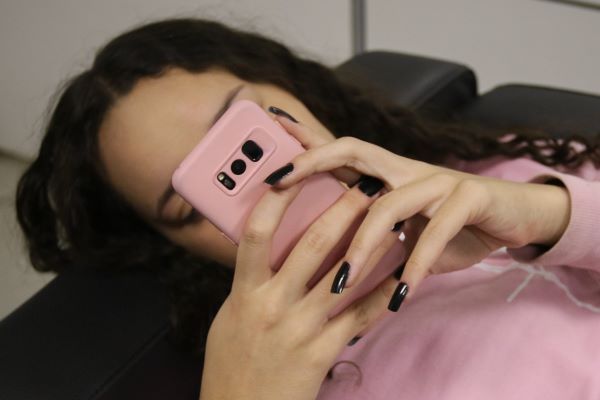
Excessive smartphone use by children and young people is having an impact on schools. Photo: Antônio Cruz/Agência Brasil
She believes the key lies in teaching that engages students. “A student who is truly engaged in a meaningful activity is unlikely to be distracted by their cell phone; they may even use it as a support tool,” she adds. The Director of Content at Bett Brasil emphasizes that schools need to rethink their teaching practices to promote a healthy balance between the use of technology and students’ holistic development.
Regarding the challenges of cell phone use in the classroom, Sayad emphasizes the importance of pedagogical intent. “For children over the age of 12 or 14, pedagogical intent is essential when it comes to cell phone use at school,” he says.
He points out that responsibility for the appropriate use of these devices should be shared between the school and the family. “What we’ve seen is families passing this task on to the school because they don’t know what to do at home. The first step would be for children under 13 not to have a cell phone, and that is the family’s responsibility, not the school’s,” he says.
See also:
- Brazil ranks fourth among the countries that use generative AI the most
- Nonviolent Communication promotes a more inclusive and respectful environment in schools
The educator also criticizes the excessive focus on the amount of screen time as the main problem. According to him, this is just one aspect: “Much of this debate revolves around screen time, but that’s not the real problem. What really matters is the use of algorithms and how they influence children’s and teenagers’ interaction with inappropriate content,” he says. Sayad adds, noting that the central issue involves distraction and the economy of attention—elements driven by social media algorithms.
Adriana notes that distraction has always existed, but that today the options are infinitely greater. “In the past, when we got distracted, the alternatives were limited—paper folding, doodling, or paper airplanes. Today, with the endless array of entertainment and information available on cell phones, distraction is much more intense. The big challenge is to make school a place where the mindful use of technology is part of the learning process,” she says.
She explains that school should be a place for learning about the ethical use of technology, the quality of information, fake news, and privacy. “This requires practice, reflection, and debate,” says Adriana, emphasizing that balance and mindful use of screens are the way forward.
Will the law ensure that cell phones are banned in schools?
In this debate over banning cell phones in schools, another question is whether a federal law will ensure full compliance with the measure, given that some schools already have policies prohibiting the use of cell phones in the classroom.
“The role of federal law is to open and broaden the public debate, which is important, but I don’t think it’s the government’s role to regulate this. Perhaps this debate should take place at the municipal level—for example, in the case of public schools. And in the private school system, each school, in collaboration with families, should find specific solutions to address the issue,” says Sayad.
The educator also emphasizes that this debate must be approached with the necessary depth and complexity. “Digital technology is a defining feature of our time that shapes the way we relate to one another and work. It is part of the evolution of human technology—so how do we deal with it? We can’t turn back or stop time. I’ve seen this debate being conducted in a very superficial way,” he says.
Bett Connection: Patricia Blanco, president of the Palavra Aberta Institute, explains the importance of media literacy in schools:
Finally, Sayad reiterates the the crucial role parents play in monitoring their children's cell phone use. “Parents play the primary role. They need to consider whether or not to give a cell phone to a child under 13 or 14 and what the limits will be,” he points out. He also mentions the complexity of the debate by noting that, not long ago, American schools encouraged students to bring their own devices to class. “It’s a very rapid paradigm shift,” he concludes, emphasizing that the debate must take into account both the home and school contexts.
Adriana notes that legislation can provide more support for schools and teachers, but it is not a complete solution. “Many schools already have similar policies, and yet they still face difficulties in enforcing them. The focus should not be solely on banning cell phones, but on how to integrate this technology into teaching practices. Banning cell phones without rethinking classroom engagement will not solve the underlying problem,” she points out.
In her view, parents need to play an active role in the process and should work in partnership with schools to promote a balanced use of technology. Adriana emphasizes that it is important for parents to reflect on their own digital behaviors at home.
“Do parents also disconnect from their screens? Is there a balance between physical presence in family relationships and digital connection? The success of any policy depends on creating a culture of human connection, both in the school environment and at home,” he concludes.
Share on social media:
Categories
- The Future of Education
- Educational Management