
My Cognitive Radar: When 15 Texts Became a Mind Map
)
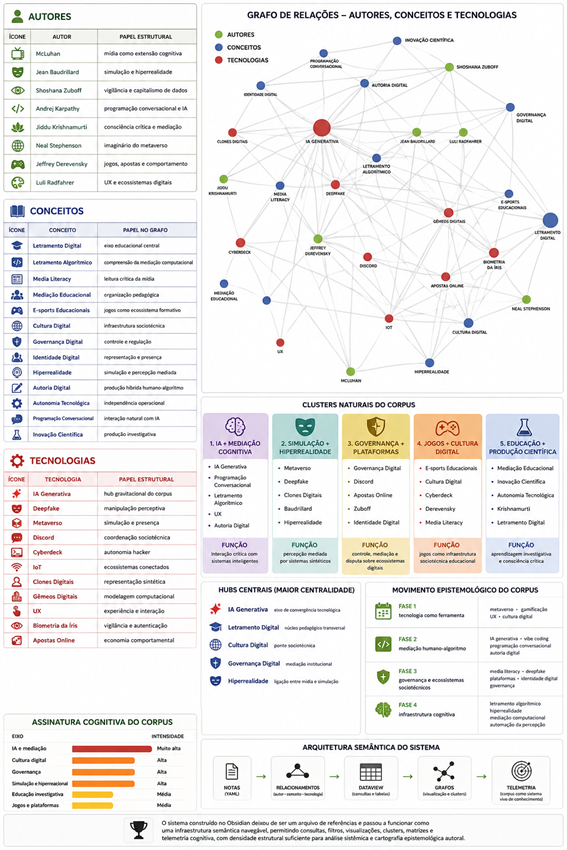
From October 2024 through the end of May 2026, I published 15 posts on the Bett blog. Instead of just looking back, I organized the topics in Markdown, linked the ideas together in Obsidian, and used ChatGPT to visualize these connections. The result was this cognitive radar: a simple, visual, and practical map for understanding what I’ve been thinking about, writing about, and researching.
What is this radar?
This diagram is a way to see the connections between ideas.
Each dot represents a theme, a concept, a technology, or an author that appeared in the texts. The lines show the relationships between them. The more connected a dot is, the more it serves as a central theme within my body of work.
In other words: the analysis shows that the texts were not isolated. They formed a network.
To create this radar chart, I cross-referenced three categories in Obsidian: authors, topics, and technologies. After that, using the hierarchy of words, I connected the texts where there was some synergy.
The key insight
The key insight is this: my writing went beyond technology; it sought to understand how technology changes the way we learn, communicate, trust, create, and interpret the world.
Generative AI appears as one of the focal points on the map, but it is not the only topic. It intersects with digital culture, digital literacy, deepfakes, hyperreality, digital identity, the metaverse, gaming, the Internet of Things (IoT), biometrics, and education.
This shows that the real issue isn't “using AI.” The deeper issue is: how to live, learn, and teach in a world that is increasingly mediated by digital systems.

Why does this matter in practice?
For those who write, conduct research, teach, or work in education, this type of map helps them do something very important: recognize patterns.
Sometimes, we produce a lot of texts, lessons, projects, and ideas, but everything ends up scattered. When we organize this material into a network, we’re able to identify recurring questions, emerging themes, gaps that need to be explored, and connections that weren’t clear before.
In my case, the analysis revealed a strong connection between AI, digital culture, and education. It also showed that seemingly disparate topics—such as deepfakes, the metaverse, biometrics, and video games—are all part of the same overarching concern: the relationship between technology, perception, trust, and critical thinking.
AI as a tool for reading, not just for writing
Many people still view AI solely as a tool for writing faster. But this experience shows another possibility.
AI can help us better understand what we’ve already produced. It can help organize texts, identify relationships, generate hypotheses, and transform a collection of publications into a knowledge map.
Here, AI did not replace thought. It helped make thought more visible.
I used simple tools: Markdown, Obsidian, and ChatGPT. What mattered most wasn’t technical sophistication, but the question behind the process: what do I understand better when I turn my texts into a network?
What the radar shows about my route
The chart shows four major fields:
- Generative AI as a hub of connection
AI emerges as a central theme because it cuts across various debates: writing, education, culture, platforms, authorship, learning, and knowledge production.
- Digital literacy and digital culture as an educational foundation
These topics show that the issue is not just learning how to use tools, but learning how to interpret digital environments, evaluate information, and act responsibly.
- Deepfakes, hyperreality, and digital identity as issues of trust
This raises a major concern: How can we know what is true, trustworthy, or manipulated in a world of artificial images, voices, and profiles?
- Games, the metaverse, IoT, and biometrics as concrete examples
These topics serve as laboratories. They help us think about how technologies enter our daily lives, our bodies, schools, experiences, and social lives.
What this game teaches us
This exercise teaches us that producing knowledge isn’t just about accumulating texts. It’s also about going back to them, reorganizing them, and realizing the pattern that was emerging. Sometimes, we only understand what we’re building when we stop and look at it from above.
This radar helped me realize that the 15 articles are more than just a series of publications. They point to an agenda: to think about education, technology, and digital culture in an interconnected, critical, and practical way.
Conclusion
Ultimately, this cognitive radar is a way to reflect on the path I’ve taken, but also to pave the way for the next step. It shows where I’ve focused my efforts, where I’ve connected ideas, where I can still delve deeper, and which topics have begun to take shape as a research and writing project.
More than just a retrospective, it’s a roadmap. And perhaps that’s the most interesting use of AI in this case: not writing for us, but helping us see more clearly what we’re trying to build.
About the author:

*This text does not necessarily reflect the opinion of Bett Brasil.
Share on social media:
Categories
- Innovation