
New professions and the future of work are topics of discussion at the Managers' Forum
)
Far from attempting to predict the jobs of the future—which always prove inaccurate—or discussing desirable skills—already cataloged at more than 300— the panelists at “New Professions and the Future of Work, ” held at the Managers’ Forum during the 29th edition of Bett Brasil, addressed key points regarding how companies and citizens will respond to a much more complex context of societal transformations and adaptations.
According to Paulo de Camargo, a journalist specializing in education and the moderator of the debate, “all predictions about professions have turned out to be wrong. The world is harder to predict, and there is no list of professions of the future.”
Luciano Meira, who holds a Ph.D. from the Federal University of Pernambuco, stated that “the good news is that the projected job losses are not as rapid as was predicted five years ago. Recently, those dire projections have been revised downward, which gives us a little more time to adapt,” he said.
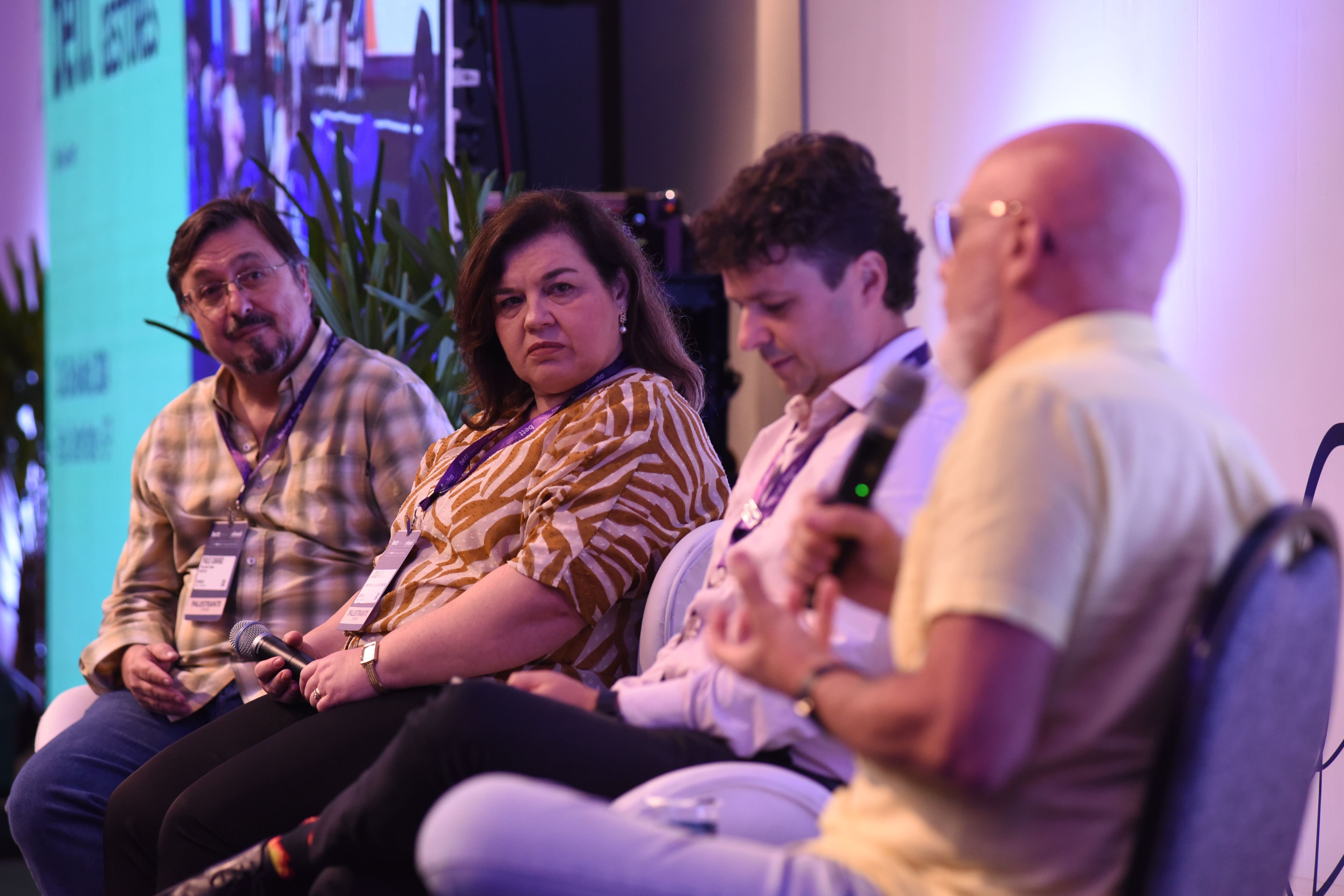
There was a consensus among the panelists that education is a unifying force for overcoming adverse circumstances. “The future of professions is vast, and we must prepare young people to thrive in this new world, aware that new and positive transformations must come from within,” said Lucília Guerra, director of the Center for Technical, Pedagogical, and Management Training at the Paula Souza Center. “We must encourage students to bring about cultural changes in their communities,” added Lucília.
Another panelist, Rafael Gioielli, director of social and environmental impact at Mombak—a company focused on carbon removal—noted that “companies and citizens will need to adapt and mitigate the impacts of living on a planet that is two degrees warmer, facing water scarcity and undergoing an energy transition.”
When asked by the moderator to identify just one skill as essential for young people, the panelists cited: solidarity, critical thinking, and creativity.
Solidarity was the competency chosen by Meira. “For me, solidarity is not an abstract value, but something that takes on practical meaning in everyday life. I strongly believe in our ability to continually reshape the future.”
To illustrate solidarity in practice, Meira cited a discussion held with nursing professionals. “Instead of studying how respiratory diseases are affecting the population’s lungs (and shifting our focus to studying the lungs), we shifted our focus to how to care for the elderly population with respiratory problems. This completely changes the purpose of how the work is done, incorporating solidarity,” she said.
For Gioielli, however, critical thinking is the fundamental skill for young people. “We have to challenge teachers about their mission, which is to prepare citizens and leave young people better off for the planet, since previous generations failed to leave a better planet for these young people.”
In Lucília Guerra’s view, creativity is the essential skill for finding new solutions. “We have to incorporate this into teacher training and change the way we teach—differently from the way we learned in the past.”
Share on social media:
Categories
- The Future of Education