

The New High School Curriculum and SAEB Are Key Topics at Bett Brasil
)
Renato Feder, the São Paulo State Secretary of Education, attended the 29th edition of Bett Brasil—Latin America’s largest event on innovation and technology in education—on Wednesday (the 24th) for a full schedule of meetings with municipal officials and to participate in the Basic Education Congress.
The panel “How to Innovate in Education in the Age of Transformation?” featured Feder, as well as Jair Ribeiro, founder and president of the Associação Parceiros da Educação and Casa do Saber, and Ana Maria Diniz, founder and advisor to the Instituto Península. The three panelists agreed that technology is not the primary tool in the innovation process within school settings; rather, it is necessary, first and foremost, to foster interactivity in the classroom, thereby enhancing collaboration between teachers and students, who will be the key players in the teaching-and-learning process.
“The key innovation is for school to be meaningful to students,” said Ana Maria Diniz. The Secretary of Education, for his part, emphasized that a more attractive school helps increase student interest, thereby reducing the high rates of absenteeism and dropouts.
“Attendance is very important, and it’s only possible with quality—through well-prepared lessons, good teaching materials, and well-trained teachers, among other factors. This way, students become more interested in the school environment, which increases attendance,” Feder emphasized.

Bett Brasil was also the venue chosen by the São Paulo State Department of Education to host a meeting between Feder and the state’s mayors and municipal secretaries. The main item on the meeting’s agenda was the release of the scores and targets for Saresp (the São Paulo State School Performance Assessment System).
Reading Fluency for Children
The São Paulo Secretary of Education took advantage of the event to announce a new phase of “Alfabetiza Juntos SP,” a program designed to promote literacy among children in the early grades of elementary school. This involves expanding the reading fluency test to 3rd, 4th, and 5th grades and implementing a tool that will allow teachers to simultaneously access the results and a progress report for each student and their classroom.
The “Fluencímetro” is one of the activities offered by Elefante Letrado, a reading tool, which is exhibiting at Bett Brasil. “With this initiative, the São Paulo Department of Education is broadening its focus on the literacy process throughout the first cycle of elementary school—another step forward for Alfabetiza Juntos SP. We have a goal of making 90% of second-grade students literate by 2026. In the reading fluency assessment currently underway, the results indicate that we are on the right track and already have 64% of students at the beginner and fluent levels. “We must ensure equity and achieve this level for students enrolled in other grades of the early years as well,” stated Secretary of Education Renato Feder.
Student-centered learning is the path to the New High School
Hélio Daher, Secretary of Education for the State of Mato Grosso do Sul, and Rafael Herdy, a teacher from Pará, participated in Bett Brasil to discuss the New High School Curriculum during a panel discussion moderated by journalist Karla Dunder, assistant editor at UOL.
Regarding how to address the reality of the impact caused by this controversial educational model, Professor Herdy was emphatic in stating that the system has its flaws and its strengths, but that the current situation and the lessons learned present an opportunity to rebuild the methodology.
“The New High School proposal is very interesting, with the possibility of educational pathways, but we encountered problems implementing it throughout Brazil. The states and teachers had a very hard time adapting to and understanding the concept. However, we are now at a new juncture. We’ve already tested it, identified the problems, and now have a new opportunity to transform the future of our children and young people by making the new high school system more flexible,” he emphasized.
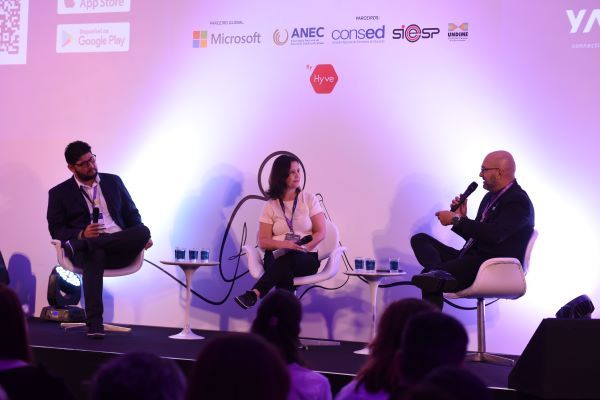
Daher noted that the Brazilian high school system has been undergoing reform and, historically, has been revised over time as a necessary measure, since many students drop out of school due to a lack of interest.
“Today, young people want a high school education that speaks to the world they live in—especially in terms of pace, necessity, and the students’ need for communication. If we don’t do this, we will fail as administrators and see many young people dropping out of school, because many of them believe that school doesn’t make sense and give up on their studies. As long as we have the high dropout rates that Brazil currently faces, high school education needs to be reevaluated and reimagined,” the secretary emphasizes.
And, in his view, regardless of political considerations, the New High School System has both strengths and weaknesses, and flexibility is a path of no return. “We need to build on what has worked and eliminate what isn’t working. For example, increasing the number of hours for basic general education and introducing flexibility are essential. But, on the other hand, the ENEM still isn’t aligned with this proposal, and that causes uncertainty among young people and their families about what the future will hold,” the secretary believes.
In addition, Daher noted that teacher training is a very relevant issue in this context, since educators are often required to teach using the information-based approach without having received specific training, which also causes them to feel insecure.
However, part of the problem in improving high school education also lies with administrative issues, such as teacher payroll, school meals, and public transportation, among others.
“There is a system—one that no one notices, but which underpins this effort to keep students in school—and it needs to be rethought and funded so that we can truly provide a high school education that makes sense to them.”
Finally, Professor Rafael emphasized that the new model is very positive, particularly with the inclusion of flexibility and innovative teaching methods.
“Professional development programs provide an excellent opportunity for schools and teachers to explore active, innovative, and engaging teaching methods for students—something that can also be achieved within basic general education. In this way, we empower students to take on a more active role; they will be more drawn to schools and will want to be part of the school community,” concludes Rafael.
New SAEB
Regarding the future of the Basic Education Assessment System (SAEB), a discussion was held between INEP’s Director of Basic Education Assessment, Rubens Campos de Lacerda Júnior, Fred Amâncio, Recife’s Municipal Secretary of Education; Júlio Meireles, Deputy Secretary of Education for the State of Pará; and Maria Helena Guimarães Castro, holder of the Ayrton Senna Institute Chair at IEA/USP and member of Abave’s Scientific Council.
During the discussion, the panelists commented on the changes that have taken place in the SAEB model over the years since its creation in 1990 and emphasized its importance in informing public and educational policies and providing evidence on the process and evolution of learning in the country. “I have witnessed the evolution of school systems using SAEB results with a focused perspective on the learning process. And I’ve had the opportunity to learn about large-scale assessment systems in different countries, and SAEB is, without a doubt, one of the best in the world,” stated Recife’s municipal secretary of education.

Regarding the future of SAEB, Maria Helena, who served as president of INEP from 1995 to 2002, emphasized the need to update the system beyond the current model of cognitive assessment of learning limited to Portuguese language and mathematics. She cited the improvements made to PISA (Program for International Student Assessment) as an example for SAEB to follow. “PISA, for example, has included an assessment of social-emotional skills in its questionnaire, which is very valuable in today’s world. We face the challenge of modernizing SAEB, which is very good but needs improvement,” she emphasized.
In this regard, INEP’s Director of Basic Education Assessment stated that among the measures planned to update the SAEB are new reference frameworks for elementary and high school and a reassessment of the development of contextual questionnaires.
Share on social media:
Categories
- Educational Management