
ChatGPT's Journey in Schools
)
The title of this article already implies a premise: ChatGPT—or, more generally, generative conversational programs based on large language models (LLMs) that understand and generate text in natural language—will find their way into schools. In reality, these programs are most likely already in schools. Perhaps not in an intentional or institutionalized way, but they are there.
"They" are probably already at school
Since December 2022, these programs—represented by the free, public release of their most famous example, ChatGPT—have been available to anyone with internet access. In addition to being a conversational agent (a chatbot or “smart chat”) that interacts with its users, it has features that allow it to answer assessment questions (both open-ended and multiple-choice), compose texts, assessments, exercises, and tables with formats, narrative characteristics, authorship, and a level of detail tailored to what is requested of it.
That being the case, with nearly two months having passed since the start of the school year—and given the widespread access to ChatGPT, the news about it, and the features it offers—it is very likely that, in any school where students and/or teachers have internet access, someone has already used ChatGPT in some way.
In addition to being part of the social context and daily lives of children, young people, and teachers in schools, this type of generative Artificial Intelligence (AI) is already transforming the world of work in far-reaching ways. A wide variety of professional fields—from artists, social scientists, and doctors to administrators, communicators, journalists, and many others—are already feeling the impact of having an “assistant” capable of consulting billions (or even trillions) of parameters and generating text, an image, a melody, or any other result compatible with human activity.
A school that is genuinely committed to helping children and young people develop the ability to act responsibly in the world must take this potential into account and incorporate values, attitudes, concepts, and practices related to Generative Artificial Intelligence into its educational program.
Two aspects to consider: risks and the process of change
However, it is crucial to highlight two points before continuing with this line of reasoning. Generative AI has limitations and risks that must be taken into account, and the process of transformation in schools must consider the reality and conditions of the school community in order to do so.
Regarding imperfections and risks: ChatGPT itself explicitly states that its responses may not be correct, that its knowledge base (facts and events) is current only through 2021, and that it may produce biased content. Therefore, the first warning is that the responses obtained should not be used as a knowledge base. The content to be taught must be aligned with verified, validated knowledge that has already been selected by the school—which is not the case with a response obtained directly from ChatGPT (in the following paragraphs, you’ll see other ways to use ChatGPT indirectly).
As for the process of transforming schools: more than just a freely accessible program, ChatGPT is an example of what’s possible and a new way of interacting with knowledge. Beyond it, there are other programs and possibilities that go far beyond. For example: it’s already possible to have the same kind of interaction through dialogues and various formats with predefined content.
Instead of searching for answers in ChatGPT’s massive database, one could use a specific program that employs technology similar to that of an LLM but searches for content only in files and texts previously selected by the school, in addition to guiding activities and formats chosen by the school. This means there is potential to reevaluate not only the entire range of instructional materials, but also the way students interact with the available materials, the structure of classes and assessments, and even the school’s pedagogical approach. However, it is crucial to keep in mind that the transformation taking place at the school must be carried out “from the inside out.”
Every school already has a school community—students, teachers, families, staff, partners, and the surrounding community—that is committed to the school model, the educational approach, and daily routines. The beneficial potential of generative artificial intelligence should be incorporated into schools in a way that allows administrators, teachers, families, and students to develop and reap the benefits—not abruptly or on an emergency basis (as we have, unfortunately, seen with Emergency Remote Learning due to social isolation during the COVID-19 pandemic), but in a way that is integrated and consistent with the school’s values and educational philosophy.
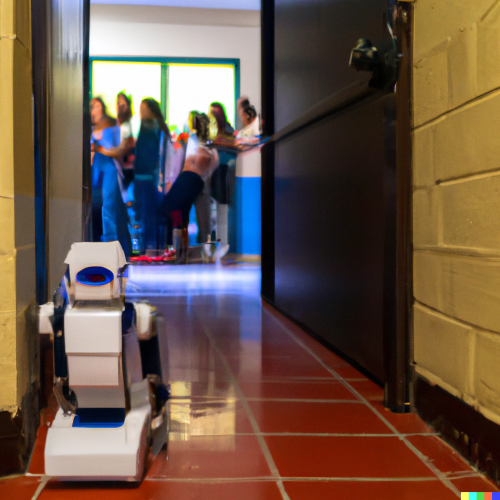
Image generated by the author using OpenAI's DALL·E 2
ChatGPT in Schools: Where It's Headed
When thinking about how ChatGPT will be introduced in schools, rather than simply reflecting on the issue, the goal is to identify possible paths forward; to that end, it seems more instructive to consider alternatives or “forked paths” along the way. Let’s take a look at them:
Occasionally or intentionally
Given that ChatGPT may already be present in some schools, a first dichotomy regarding its introduction in schools becomes evident: it can occur either occasionally or intentionally.
It’s worth noting some findings from a survey conducted by the Walton Family Foundation in early March among 1,000 teachers and 1,000 students in the United States: 51% of teachers were already using ChatGPT, and 72% of teachers and 63% of students agreed that the program is an example of why we can’t continue with outdated teaching practices in today’s world.
Even if ChatGPT is already present in schools in some form, it is crucial for schools to identify the issue, take a stance, and determine “if and how” they will integrate this new type of technology into their educational approach. By failing to take a stance on the matter—leaving it to chance and depending on the ad hoc intentions of teachers and/or students—the school signals to the school community that it is not attentive to or aware of an important change within the context of its school community. Furthermore, students’ use of the program without proper guidance can harm the school, as tasks and assessments generated by the program may compromise student learning and evaluation.
With the aim of improving learning and/or improving processes
Unlike the previous option, this is not a dichotomy—it’s not a case of one path or the other. When considering the desired benefits, one not only can but must think about improving learning and improving processes.
Intelligent conversational agents based on large language models (LLMs) or similar technologies do have their risks, but their ability to quickly search vast knowledge bases—combined with the quality of their text-based responses and the versatility of their formats—is undeniable. This makes a significant difference in school processes.
Even though there is a chance that the content may be biased and sometimes fabricated (yes, it is possible that the answer is generated by a combination of incorrect information, a phenomenon known as “hallucination”), using the program to make more effective use of time in management tasks and the preparation of educational activities is valuable.
Tasks such as creating a calendar, writing a memo to employees, a menu, or even a lesson plan or assessment can be completed (and corrected) in a matter of minutes. It cannot be emphasized enough that the “output” generated by the program should never be used without critical review by the person responsible for the task. Even so, the time saved in preparing a first draft for review is significant, allowing you to dedicate quality time to revision while still saving a considerable amount of time. Google, for example, has already announced the launch of Practice Sets: a set of online tools that assist with common teaching tasks.
As a point of interest, two of ChatGPT’s most common nicknames are “Co-pilot” and “Assistant”: in both cases, it suggests a path, a version, or a text, but the final decision—or “flight control”—rest with the professional in charge.
In addition to management processes, these types of programs offer considerable potential benefits for learning. Once again, whatever response the program generates should be viewed as an “ingredient” in the students’ learning process and never as the final recipe. The applications and practices are countless, and the purpose of this text is not to list them all, but to highlight some of the benefits.
In learning activities, the program has been dubbed a “study partner.” Generally speaking, when considering various possible situations and activities, the program can be thought of as that classmate who always has an answer—one that isn’t always correct or appropriate, but one that can be analyzed, critiqued, and/or improved upon to enhance learning.
It’s important to know that OpenAI (the company behind ChatGPT) is making frequent improvements and has launched the ChatGPT API (application programming interface), a feature that allows the chatbot interface to be integrated with other programs. This means that, rather than simply using ChatGPT (or its improved GPT-4 model, which isn’t free but provides even higher-quality responses), it’s possible to integrate ChatGPT’s logic and capabilities into programs that have been developed specifically for schools and use a knowledge base defined by the school.
This possibility allows a school to adopt a program with features similar to (or even better than) ChatGPT—one that, in addition to aligning with the school’s educational philosophy and practices, makes exclusive use of data, tasks, facts, and any other types of content that the school selects and validates. This opens up yet another set of possible paths.
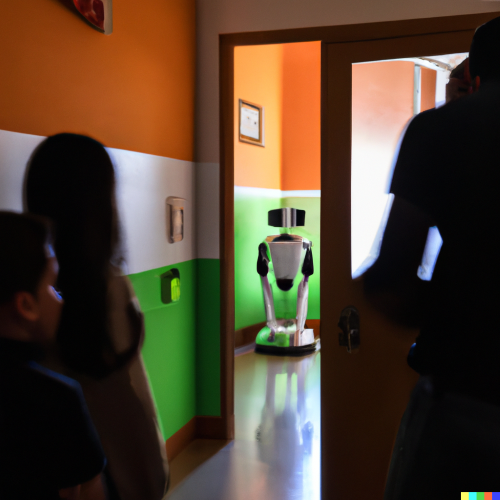
Image generated by the author using OpenAI's DALL·E 2
Integrated with educational solutions or as currently available
The most immediate approach is for the school to choose to use ChatGPT as an open-source program, as it is currently available, and to opt for the latest version, which offers better performance (GPT-4). An alternative option, which can also be adopted, is for the school to purchase software packages that include educational solutions with built-in LLM technology.
It’s worth noting that even before ChatGPT, there were schools in Brazil that were already using programs that leveraged artificial intelligence for certain purposes. It’s not uncommon to find programs capable of assigning exercises to students based on their level of knowledge, correcting essays, and providing personalized feedback, among other features. Now, with the advent of ChatGPT and its interfaces for other programs, applications and programs with even more impressive and valuable features for all students’ learning are emerging.
Perhaps the most promising is a personalized digital tutor that identifies and addresses the quality of students’ work, engaging with them and suggesting new approaches to solving problems, reviewing content, and providing supplementary exercises and additional activities, as needed. As examples, still in testing: Khan Academy launched Khanmigo, which integrates GPT-4 features into the Khan Academy platform, and Microsoft announced Reading Coach, which, using voice programs powered by GPT-4 technology, can assess and recommend practices to improve reading and public speaking skills.
The complexity of introducing new platforms and the pace of technological innovation point to another fork in the road of innovation.
On an ad hoc basis or as part of an innovation process
One way to incorporate a new program or technology into a school is on a case-by-case basis, following these steps: an assessment of suitability, alignment with the school’s mission, financial and operational feasibility, and an implementation plan.
Another way is to think of schools as institutions that will have to learn to transform themselves more and more rapidly; they will therefore need to establish an internal innovation process that is more comprehensive than a series of decisions to adopt new technologies.
It is a fact that the 2020 pandemic forced a shift toward the adoption of information and communication technologies, which now enables a faster adoption of artificial intelligence solutions. As we observe technological trends and developments, schools will increasingly face new processes and possibilities made possible by emerging technologies. The availability and integration of LLMs into new programs point to a near future in which schools will need to understand, analyze, decide on, and implement changes to their routines—changes that will require attitudes, people, relationships, and processes that were not part of their previous routines.
Fortunately, this is not an emergency like the one the COVID-19 pandemic forced upon us, but it is important to be aware of this potential future scenario and to pay attention, as these are potential changes that will impact the school model. And this brings us to another fork in the road
As part of or in support of the revision of the school model
The incorporation of ChatGPT (or similar/integrated programs) can be seamlessly integrated into the school’s current curriculum as a tool to be used in activities similar to those already taking place. The organization of learning objectives, the sequence of classes, subjects, content, and projects remains largely unchanged, and the technology is integrated into what already exists.
The alternative to this is more radical. The fact that these new programs enable a new relationship with knowledge—which, once validated and made available digitally, can be combined, analyzed, and used in an interdisciplinary manner—could make possible a school model quite different from the current one. Schools can embrace and put into practice the idea that teachers’ most important role is to develop students rather than teach content. With the goal of truly putting the student at the center, schools can transform themselves through new technologies and the empowerment of teachers.
Teachers could focus their energy on becoming better facilitators, nurturing their relationships with students through a distinctive teaching approach in which Jacques Delors’s four pillars of education (learning to learn, learning to do, learning to be, and learning to live together) are not merely explained but, above all, put into practice. With the support of technology, teachers would be able to direct their attention, resources, and care to those who need them, in the way they need it.
The way in which the school puts its educational approach into practice would be revised with the help of technology to enable teachers to take a more humane and meaningful approach.
The radical nature of this last alternative leads us to the final fork in this path—and perhaps the most important one.
Through a collaborative or prescriptive process
As a parent, teacher, researcher, and consultant, I have a wealth of experience with change processes in schools. It is not always possible to predict the success of a transformation in a school, but certain factors strongly suggest that the process will leave more “scars” than one would like.
Time pressures, hierarchical demands, and situations beyond management’s control sometimes necessitate top-down processes. In an essentially top-down process, the decision regarding the change to be made (in this case, the adoption of new technology), the choice of the path to follow, and the plan to be drawn up are implemented without any consultation with or consideration for the school community.
In a more collaborative process, the goal is to listen, engage in dialogue, and deliberate (when possible) with representatives of the school community so that decisions and plans are based on real-life situations: the challenges and opportunities that students, teachers, and others involved experience at school. Although I am aware that schools have different realities and a collaborative process is not always feasible, I will be a bit biased here.
When decisions are made without an understanding of the reality they will affect, there is a risk that their implementation will be impractical. The decision to adopt a technology that is not feasible in practice at a school is not a good decision: the effort to make it work can be exhausting, cause disruptions, and ultimately be in vain.
When planning improvements for the school, it is important to consider that the most valuable time in a school is the time devoted to students’ holistic learning and the time teachers dedicate to making that happen.
Regardless of a school’s specific circumstances and the path it chooses to incorporate new generative artificial intelligence technologies, it is important to listen, engage in dialogue, involve, and develop the school community along this journey.
Finally, not a week has gone by without some major media stories about new generative artificial intelligence systems. The latest was an open letter from renowned business leaders, historians, philosophers, and politicians calling on major technology companies to implement a six-month moratorium on the development of technologies more advanced than GPT-4, so that the uses and controls of these technologies can be better defined and risks associated with their indiscriminate and poorly regulated use can be mitigated.
It is worth noting that everything described in the preceding paragraphs is already a possible reality, regardless of the proposed moratorium.
If the growing integration of information and communication technologies—now including generative artificial intelligence—is a path of no return for schools, may we follow this path in an ethical, consistent, and collaborative manner, with a focus on fostering learning for all.
About the author:

*This text does not necessarily reflect the opinion of Bett Brasil.
Did you like this article? Then share it on your social media:
Categories
- The Future of Education
- Innovation