
Care as an Educational Principle
)
In the discussions I have been having with various municipal education departments, as well as with public and private schools, it is clear that the period of social distancing has exacerbated existing inequalities.
In addition to the grief, suffering, and emotional strain caused by the ongoing risks experienced by educators, there are now the scars left on students, who have been brutally impacted by the pandemic due to varying degrees of insecurity, loss, and harm that have affected them personally or within their immediate circle.
However, there are reasons for optimism even amid the challenges of this new phase of the pandemic in which we find ourselves. One need only consider the possibilities for educational innovation opened up by the new regulations on Professional and Technological Education; the implementation of the New High School System; the interdisciplinary approach proposed in the National Common Core Curriculum (BNCC); the possible approval by the National Congress of the long-awaited National Education System; the changes to the Fund for the Maintenance and Development of Basic Education (Fundeb); and, without intending to exhaust the list of topics, the public consultations promoted by the National Education Council on Hybrid Learning and the National High School Exam (Enem).
These are public policies that highlight the need to rethink teaching and learning practices and to create, today, a school system that helps build a better future—one in which democratic principles and technology work closely together to enhance the learning experience for new types of students.
I recommend carefully reading the Reference Document of the National Education Conference—CONAE 2022—which has been made available as an additional resource for drafting the National Education Plan 2024–2034. This, incidentally, already represents an excellent opportunity to change the course of history in order to promote the common good, inclusion, equity, and quality in education.
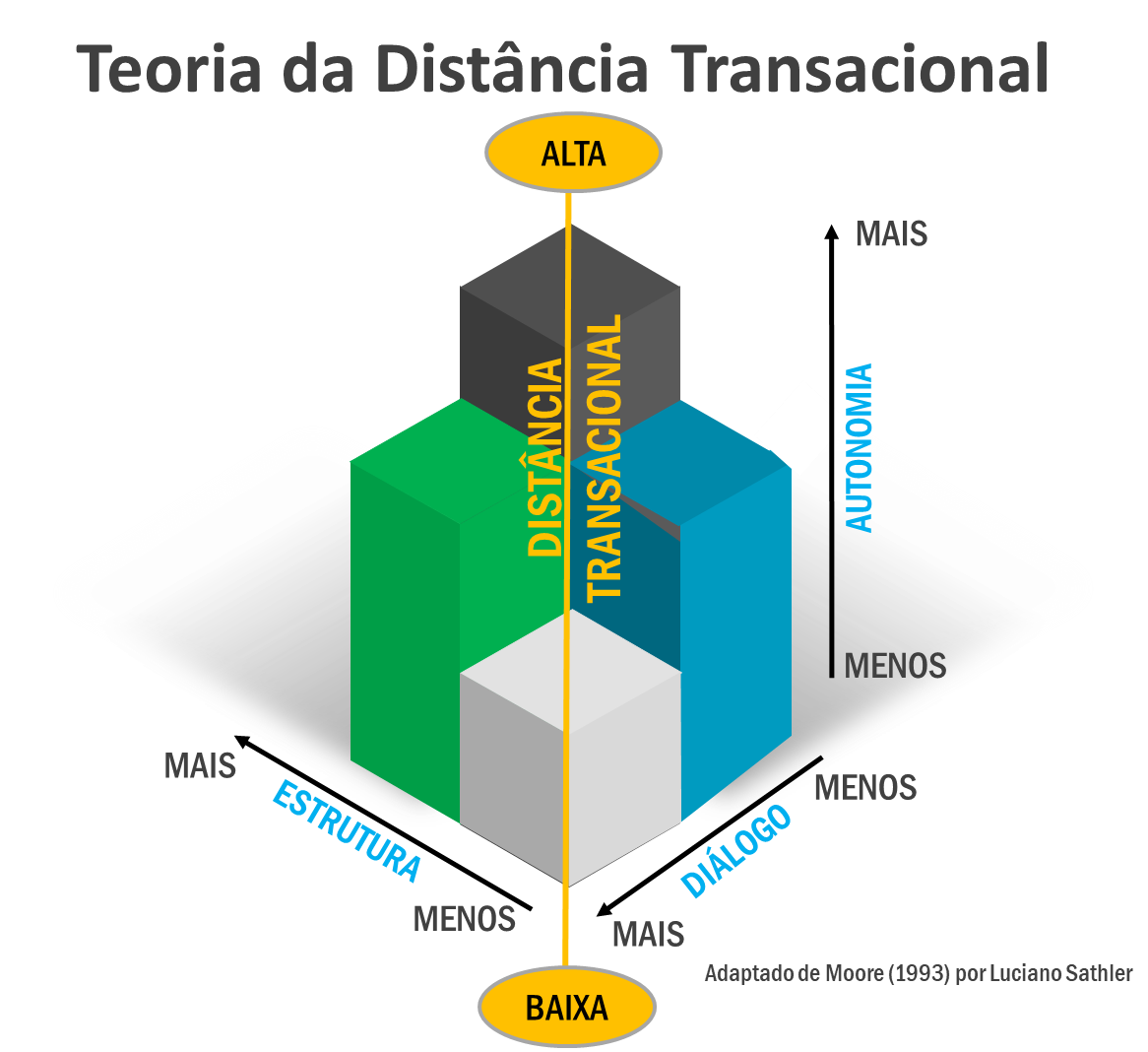
As classes and other school activities resume, what immediately becomes apparent is the need to draw on the experience of distance education to mitigate problems related to transactional distance*. This theory was originally developed for distance education, but it is also applicable to analyzing certain phenomena present in face-to-face instruction, thanks to the blurring of boundaries caused by the ubiquity of screens and digital resources.
In short, according to the Theory of Transactional Distance, the dialogue between students and teachers is understood as intentional, constructive, democratic, and valued by each party, where everyone can and should contribute, with the goal of mutual improvement. The degree of prior structuring—particularly in digital environments—will determine the level of flexibility in educational pathways and objectives, teaching strategies, and methods of assessing learning. Student autonomy is the third element under analysis and can be encouraged and incorporated to varying degrees in the design of an educational program. Figure 1 illustrates how these three components interact to result in either a low or high transactional distance.
A recent survey** found that “37% of students may still drop out of school, according to their guardians; this figure remains at an alarming level, and most of these students may drop out because they are unable to keep up with classwork and have lost interest in their studies; about 13% may not return because they do not feel welcomed by the school, and 45% because they are unable to keep up with the coursework.” This is a clear sign that, in addition to trying to reduce transactional distance, it will be up to educators and administrators to demonstrate a caring attitude—toward one another and toward the students.
Care, as understood here, is a combination of empathy—putting oneself in another’s shoes—solidarity—acting on behalf of another—and compassion—overcoming indifference, feeling another’s pain as one’s own, and making it a priority to alleviate or eliminate the suffering of others.
Learn more about the author:
Luciano Sathler holds a Ph.D. in Business Administration from FEA/USP. He is a member of the Basic Education Committee of the Brazilian Association of Distance Education (ABED) and a member of the Deliberative Council of CNPq. He is the president of the Izabela Hendrix Methodist University Center. His articles, interviews, and presentations can be accessed at https://www.researchgate.net/profile/Luciano-Sathler.
* Michael Moore’s original article, which introduces the concept of transactional distance, was published in 1993. Prof. Wilson Azevedo kindly translated it into Brazilian Portuguese. See MOORE, Michael G. “The Theory of Transactional Distance.” In Revista Brasileira de Aprendizagem Aberta e a Distância, São Paulo, vol. 1, August 2002. Available at http://seer.abed.net.br/index.php/RBAAD/article/view/111, accessed on November 20, 2021.
** DATAFOLHA. Remote Learning from the Perspective of Students and Their Families: Wave 7, National Sample, September 2021. Available at https://www.itausocial.org.br/publicacoes/, accessed
Did you like this content? Share it on your social media!