

São Paulo Secretary of Education Presents Strategies for Public Education in São Paulo at a Global Education and Technology Event
)
Brazilian education took center stage on the first day of the Bett Show UK, the world’s largest education and technology event, with a presentation by Renato Feder, Secretary of Education for the State of São Paulo, on the panel “Public Education in the State of São Paulo: Strategy, Indicators, and Innovation.” The session was introduced by Claudia Valério, Executive Director of Bett Brasil.
“Brazil is a very large country and faces significant challenges. But there are success stories across the country,” said Claudia, noting that the state of São Paulo has the largest school system in Latin America. It has 5,000 schools and 3 million students.
In her remarks, Feder explained that the first thing the department does is support schools. “We ask ourselves: How can we help each classroom?” she said. In addition to providing support, the administration also monitors whether schools are improving. “Support and monitoring are our secret,” she said.
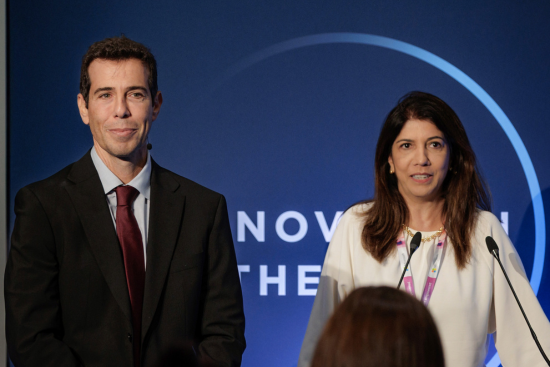
The Director General of Bett Brasil moderated a panel with the São Paulo Secretary of Education at Bett UK. Photo: Bett Brasil.
Teachers in the classroom can receive this support in many ways: physical textbooks, PowerPoint presentations, continuing education, pre-prepared bimonthly tests, and even homework assignments. “If a Brazilian history teacher finishes a lesson on Getúlio Vargas, for example, all they have to do is press a button, and everyone receives their homework assignment,” Feder explained.
In addition, several metrics are monitored, ranging from class attendance to teacher participation in training sessions, all the way to the number of hours students use technology tools each day. And there’s more to come: “Starting this year, we’ll also be sending people to the schools to check on maintenance: the restrooms, the kitchen, and the children’s meals,” he said.
See also:
Even student attendance—which may seem like a very basic metric—is essential for measuring a school’s improvement. “If a school is poor, students miss more classes. The school system used to have high absenteeism rates, but we ended the last semester with an 89% attendance rate. That’s 300,000 more students every day,” said the secretary.

Renato Feder highlighted how management, data, and innovation have been combined to strengthen public education in São Paulo. Photo: Bett Brasil
In addition to support and monitoring efforts for the entire network, there are specific projects for different stages. Feder spoke about the Alfabetiza Program, inspired by the positive experience in Ceará, where the state partners with municipal departments of education. He also discussed the expansion of vocational education, which has grown from 30,000 to 200,000 enrolled students. “This is a watershed moment; vocational education is essential for high school,” he said.
Another of the network’s innovations is the Provão Paulista. Students take the exam at their own school on a weekday and can secure a spot at one of the state’s leading public universities—USP, Unicamp, Unesp, and Fatecs. “We’re starting to see ambitious students who are studying harder and, for the first time, aspiring to attend college,” said Feder.
Share on social media:
Categories
- Learning Strategies
- Educational Management