
Technology and Inclusion: Ways to Address the Reading Gap
)
The Urgency of Inclusion Through Reading
Brazil has 18.6 million people with some form of disability, representing about 8.9% of the population, according to the IBGE. This data underscores the importance of policies and initiatives in education focused on accessibility. The need is even greater when considering the state of reading in the country: for the first time since 2007, the 6th edition of the “Retratos da Leitura no Brasil” survey, conducted by the Instituto Pró-Livro, revealed that the number of non-readers (53%) exceeded that of readers (47%).
This scenario raises a red flag: if reading is a cornerstone of critical thinking and social inclusion, it is urgent to create alternatives that bring the population—especially people who face physical, sensory, or cognitive barriers—closer to books. In this context, technology emerges as a tool capable of broadening horizons.
Technology as a Bridge to Knowledge
In recent years, digital innovation has profoundly transformed the way knowledge is produced, transmitted, and consumed. Technologies such as augmented reality (AR) and virtual reality (VR), when applied to literary works, have become a powerful tool for companies like the Elo Editorial Group, enabling immersive and interactive experiences.
These technologies not only spark greater interest among readers and make reading more enjoyable, but also enable inclusive adaptations:
Virtual Reality (VR): recreates three-dimensional environments that transport the reader into the book, providing an immersive experience within the narrative. For people with visual impairments, sounds, textures, and additional narration enhance understanding.
Augmented Reality (AR): adds digital layers to printed content. When you point the camera on a cell phone or tablet at a page, characters can come to life, maps become interactive, and so on.
The use of these tools transforms reading into a multisensory and, at the same time, inclusive experience.
Elo Editorial: Accessibility Is in Our DNA
Since its founding, the Elo Editorial Group, which includes Elo Editora and PeraBook has made accessibility an integral part of its identity.
The entire catalog is designed from the outset with features such as audio description, translation into Brazilian Sign Language (Libras), companion apps, and, more recently, augmented reality (AR) and virtual reality (VR) experiences. These unique features allow readers with or without disabilities to fully engage with the content, accommodating different learning styles—something that is also essential for neurodivergent children.
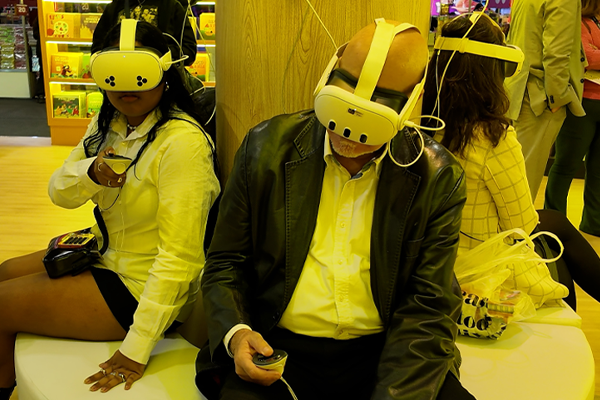
By incorporating AR and VR into its books, the Elo Editorial Group offers readers the opportunity to experience the work at the invitation of the author himself, who presents the narrative in a virtual environment, bringing readers and creators closer together and making the act of reading more immersive.
Educational and social impact
In addition to breaking down individual barriers, inclusive and technological initiatives also have a collective impact. The numbers demonstrate the scale of the challenge:
- More than 6.5 million Brazilians live with visual impairments, including 500,000 who are blind and approximately 6 million with low vision (IBGE).
- Among children aged 6 to 14, 93.9% of those without disabilities attend elementary school, compared to 89.3% of those with disabilities (IBGE).
- In elementary school, there are 61,594 students with hearing impairments (School Census/MEC).
These figures underscore the importance of practices that democratize access to education and culture. In addition to social inclusion, there is also economic potential: according to CBL/Nielsen, Brazil has approximately 25 million book consumers, and the main reasons for purchasing books are related to leisure and personal growth.
In other words, investing in accessible and innovative works is both a matter of social responsibility and a strategy for expanding the publishing market.
The future of reading is inclusive
The combination of accessibility, virtual reality, and augmented reality represents a promising path toward addressing Brazil’s reading deficit. More than just technological tools, these are strategies to ensure equity, foster a love of reading, and nurture new generations of readers. By bringing together literature, inclusion, and innovation, publishers such as the Elo Editorial Group are paving the way for a future in which books are, in fact, for everyone.
*Content is the sole responsibility of the advertiser.
**This text does not necessarily reflect the opinion of Bett Brasil.
Share on social media:
Categories
- Diversity, Equity, and Inclusion (DE&I)