

The final day of the 30th edition of Bett Brasil addresses the challenges facing schools in the digital age
)
On the final day of the 30th edition of Bett Brasil, the discussions highlighted that the challenges facing contemporary education extend beyond school walls and cannot be addressed with simplistic or polarized solutions. Experts, administrators, and educators gathered to share experiences and propose possible solutions, combining innovation, active listening, and public policies that are more responsive to the realities of schools.
One of the issues within this challenging landscape is the use of cell phones in schools, a topic that was the focus of the debate at the Administrators’ Forum this Thursday (the 1st) at Bett Brasil. Journalist, educator, and writer Alexandre Sayad and Vanessa Cavalieri, presiding judge of the Rio de Janeiro Court for Children and Youth, spoke to the audience about the pros and cons of the era of hyperconnectivity in schools.
Sayad advocated for the need for digital governance in schools, with innovative models that involve government, educational institutions, and families. “We need regulation, media literacy, and parental education. We live in a hyperconnected world where information moves too fast; we need governance to navigate this universe safely,” he said.
According to the expert, technology is not the villain, and there is potential for learning through cell phone use— as long as it is supervised and governed by clear rules. “To have a candid discussion on this topic, we need to start with a few assumptions. For example, studies show that cell phones have saved the education of many students in a country with such deep inequality as ours. We need to envision a multidimensional network to make this work, integrating all aspects of the curriculum: school, digital, and the community.”
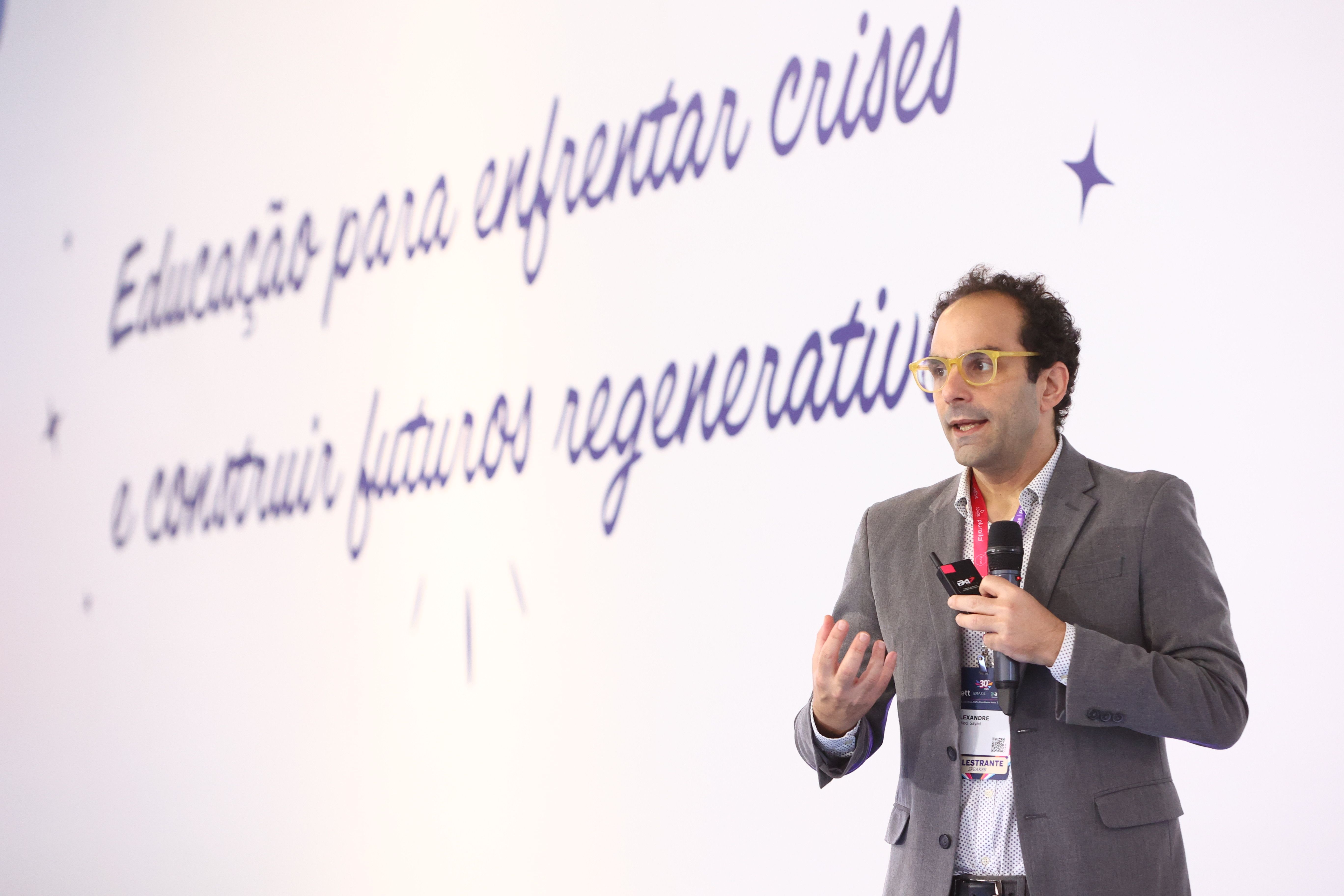
Educator and journalist Alexandre Sayad during his appearance at the Managers' Forum. Photo: Bett Brasil.
Vanessa Cavalieri warned about the dangers associated with social media. The judge has noticed a marked change in the nature of the cases she handles at the Rio de Janeiro Children and Youth Court and draws a direct link to the excessive use of technology. “There is a growing increase in violence among children and young people, as well as tensions and conflicts in the school environment, and this is directly related to the use of cell phones at school. Studies show that children feel lonely in the school environment; they don’t socialize with one another and spend recess alone, staring at a screen,” she said.
Cavalieri compares the use of technology to the rise of cigarettes in the past, a harmful social habit that shaped young people for decades. “Today we’re experiencing the same situation with cell phones. When smartphones were first introduced, we didn’t see any danger; we thought it was great that children and young people were exposed to them, but now we see that it’s not quite like that—that we have absolutely no control over what our children see on the internet.”
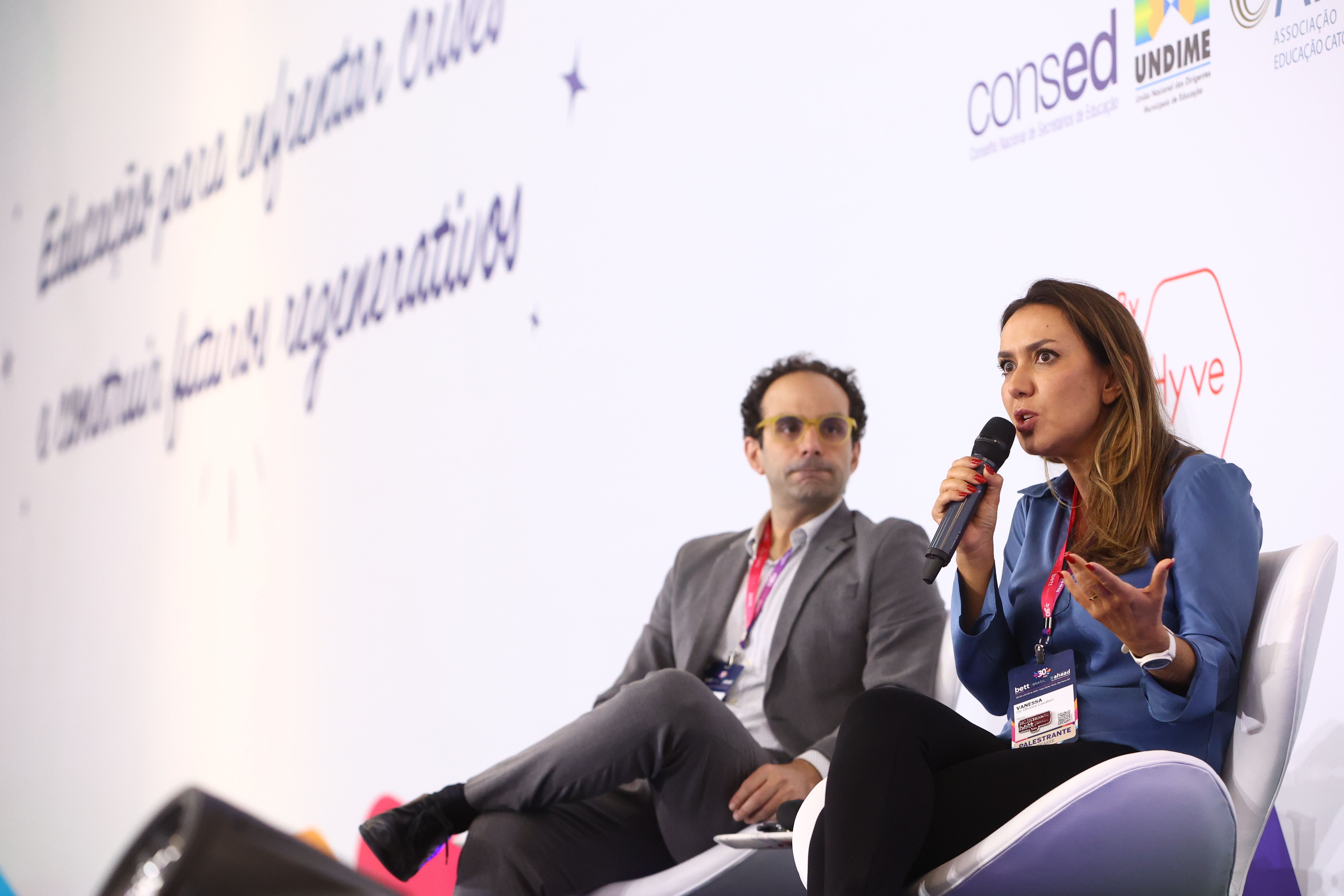
Vanessa Cavalieri, presiding judge of the Rio de Janeiro Court for Children and Youth. Photo: Bett Brasil.
One of the statistics cited by the expert shows that the suicide rate among girls aged 12 to 14 has increased by 200% over the past decade. Most of these cases are linked to the behavioral and aesthetic pressures imposed by social media.
Vanessa believes that schools need to be more welcoming and less punitive, actively investing in human connections. “Violence is a symptom. Until we address the unmet needs, we won’t solve this problem,” she said.
The judge commented on the need to pass laws on this issue, such as Bill 4474/2024, currently under consideration in the Federal Chamber of Deputies, which holds big tech companies accountable for the content they provide to children and adolescents. Today, Brazil is the second-largest user of social media in the world.
New High School Curriculum: Preparing Young People for Life
At Bett Brasil, the debate over the future of the New High School Curriculum took center stage during a roundtable discussion that brought together experts and educational administrators. The central role of the “Life Project” course and the need to make education more closely aligned with the realities of young people were key points discussed in light of the new guidelines approved by the National Education Council (CNE).
According to the CNE resolution, training programs now have new requirements regarding course load—a minimum of 600 hours for advanced programs and between 600 and 1,200 hours for technical and vocational programs, which must have recognized certification. They will be organized around four core areas: Method, Knowledge, and Science; Mediation and Sociocultural Intervention; Innovation and Technological Intervention; and the World of Work and Social Transformation. The goal is to offer a more integrated, practical education focused on developing essential skills for the 21st century.
Luciana Guimarães, a basic education specialist at SESI, emphasized the importance of the model as a pedagogical tool: “The new high school curriculum places greater emphasis on life planning, and that’s a benefit for young people—it’s a path forward,” she said.

Experts discussed the future of the New High School Program. Photo: Bett Brasil.
She also highlighted the need for greater family involvement in school. “Parents closely monitor their children during elementary school, but become less involved in high school. We need to develop strategies to improve this communication and ensure their participation.” The expert advocated for a model in which parents experience a trial class to gain firsthand knowledge of the subjects and methods used in the new high school curriculum.
Talita Marcília, the educational coordinator of a school system that adopted the new model even before the federal government’s decree, shared her experience with the transition. “Since 2017, we have structured subjects that have become learning pathways. The ‘life project’ already existed in school experiences and has been strengthened under the new model.”
She expressed regret over the reduction in the variety of curricula proposed in the current overhaul and emphasized the importance of social-emotional topics. “We address essential topics such as self-awareness, interpersonal relationships, and conflict resolution. This helps prepare young people to better handle the challenges of adult life,” she said.
Vinicius Oliveira, editor and director of the Porvir website and moderator of the panel, asked the participants about what they had learned from the process. Their responses highlighted the importance of actively listening to students and valuing life and work skills, in addition to teacher training and technical curriculum.
The new high school system, therefore, goes beyond a simple curricular change. It envisions a school that prepares students to be independent, critical thinkers who are ready to make choices—both inside and outside of school.
Share on social media:
Categories
- Educational Management