

Bett Brasil Outlines Ways to Improve Mental Health Care for Adolescents
)
The growing number of violent attacks on schools has been causing concern among parents, students, educators, and school administrators. From September 2022 to April 2023, at least five schools in Brazil were the scene of some form of violence. During Bett Brasil 2023, Latin America’s largest education and technology event, experts discussed the connections between these incidents and, more than ever, emphasized the importance of dialogue, active listening, and mental health within educational settings. The event continues through next Friday (the 12th) at the Transamerica Expo Center.
During a panel discussion on the topic, Telma Vinha, a professor at Unicamp’s School of Education, presented the main characteristics and motivations of perpetrators who commit such acts. “The main focus—though not exclusively—is the school. And this can happen at any school. In some way, the school is the setting for some form of suffering experienced by the student who commits these acts,” she explains.
According to the expert, the profile of those who commit this type of violence consists mainly of males, young people (ages 10 to 25), white individuals, who hold oppressive values and have a taste for violence. These perpetrators are also generally linked to some online hate community. “These people seek a sense of belonging, so since they don’t have that sense of agency in other settings, they end up joining extremist groups that operate online. In these communities, they are valued and listened to, which drives them to commit such crimes for notoriety,” says Telma. The panelist also warns that this sense of prominence online no longer occurs only on the deep web: it is also present on mainstream social media platforms traditionally used by young people.
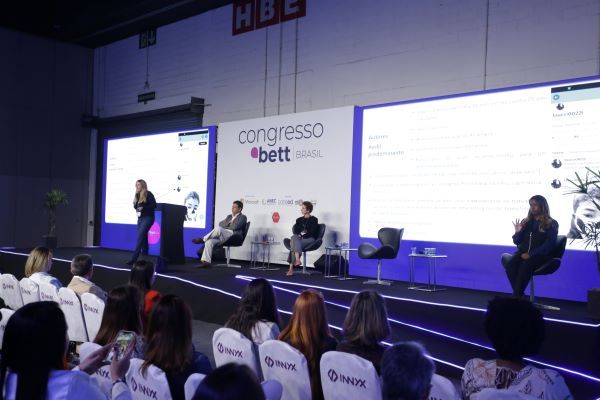
According to data presented during the lecture, the first attack on a school in Brazil was recorded in 2002, in Bahia. Over the past 21 years, 22 attacks committed by students and former students have been identified, resulting in 35 fatalities. Also according to the study, most of these attacks took place in public schools (10 state schools, 9 municipal schools, and 4 private schools) located in regions with a low vulnerability index—that is, outside the outskirts of cities. The frequency of these crimes is also a cause for concern, as they are becoming increasingly common.
To change this reality, the professor identifies listening and providing a welcoming environment as priorities, especially in schools. “Public policy shouldn’t be limited to security and surveillance; that doesn’t change values. This is a sociological and cultural problem that we need to address through support, mediation, and by giving these young people a sense of belonging. Schools can promote well-being,” she emphasizes.
For Juliana Hampshire, a psychoanalyst and panelist, this care must also extend to teachers, who are often overwhelmed by their workload and emotions. “Schools need more time, especially for teacher development. We need more time to listen, to understand, and to build relationships. The fast pace at which things happen today doesn’t allow for active listening and hinders communication, especially with young people. We need to work on this.”
Education and Democracy in Diversity
To discuss diversity further, the Bett Brasil Conference welcomed João Marcelo Borges, Research and Innovation Manager at Instituto Unibanco, and Michael França, a researcher at Insper, on Wednesday (the 10th).
França spoke about a new demographic composition of Brazilian society that is going unnoticed by the upper class. This is happening, in part, due to differences in fertility rates among women based on their socioeconomic status. “Poorer women tend to have more children than those from higher economic classes, who generally have only one child.” He explains that, over time, some “elites” are ceasing to exist, while young people from less privileged backgrounds are gaining greater prominence in public debate.

The Insper researcher also addressed concerns about the education of the wealthiest students, who are not accustomed to sharing spaces in K-12 education with the poorest students. “To reduce the current segregation between the rich and the poor, early exposure to diversity is essential for building this new society. One way to achieve this goal is the idea of providing subsidies to all private schools with quotas for low-income students. We need to bring about this disruption in education,” said França.
Borges has already commented on the real contribution of diverse individuals in the labor market. He explained that over the past 25 years, the perception that more diverse work environments yield better results has shifted the focus of companies and social organizations, which have begun hiring professionals with diversity in mind. “There has also been a significant increase in social pressure for inclusion in the labor market. The more pressure builds up, the worse it will be for companies that fail to adapt to the current reality,” said the Research and Innovation Manager at Instituto Unibanco.
Inspiring Talks
The series of inspirational talks continued on this second day of Bett Brasil 2023. One of the highlights was the “Movimento Led” panel featuring journalist Eliane Scardovelli and Rene Silva, a journalist and founder of “Voz das Comunidades,” a newspaper dedicated to the favelas and communities of Rio de Janeiro. Rene launched the project at age 11 at a public school in the Higienópolis neighborhood, near the community where he still lives today, Morro do Adeus.

The publication plays an important social role, as it is produced from the perspective of those who live in and know the community, and its main objectives are to combat stereotypes and inform the public clearly and reliably. Rene points out that, during the COVID-19 pandemic, Voz das Comunidades played a direct role in education and social awareness. “We were approached by the U.S. Consulate during the pandemic to help combat COVID-related fake news, which was widespread and had a profound impact on people in the communities. That’s how the Vozes app was born, and—along with other initiatives—it directly contributed to the health and well-being of the population,” he explains.
According to Forbes, Rene is currently on the list of Brazil's 30 most influential young people under 30. He is also considered one of the most influential young Black people in the world.
NeuroConecte Director Adriana Fóz also delivered one of the inspirational talks, addressing how essential it is to engage parents, students, and the school in restoring young people’s mental health. She highlighted some alarming statistics, such as data from the World Health Organization (WHO) showing that 10 to 20% of young people suffer from mental health problems, and other studies indicating that 50% of mental disorders manifest by the time a young person is 14 years old—that is, during their elementary and middle school years.
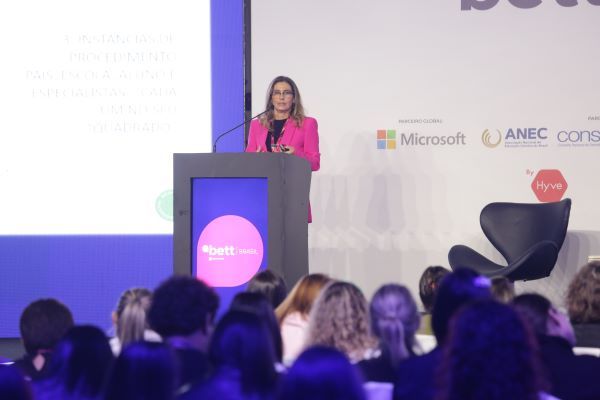
“It’s essential to mobilize and build connections,” says Adriana. The neuropsychologist explains that by mobilizing parents, teachers, and other educational stakeholders, it’s possible to create stronger connections to the situations at hand. Another point raised was the need to establish new protocols for recognizing and identifying potential problems, with everyone involved staying alert and working together on the intervention.
Among the inspiring talks, the Bett Brasil audience also had the opportunity to attend presentations by Augusto Cury, a psychiatrist, writer, and founder of the Escola da Inteligência, who spoke on “Emotional Management for the Job Market: How to Become an Emotionally Healthier Professional”; Martha Gabriel, one of Brazil’s most influential digital thinkers and an award-winning international speaker, who presented the talk “Artificial Intelligence: Impacts on Education”; Luciano Pires, creator of the “Café Com Leite” podcast, who presented “The Formula for Innovation”; and Felipe Anghinoni, professor and founder of Perestroika, who discussed “Teaching as a Form of Creative Expression.”

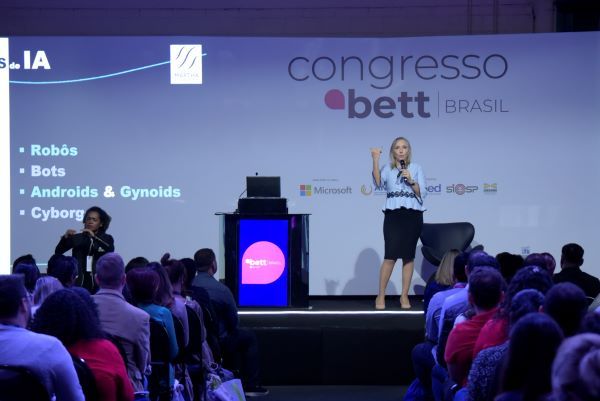
Bett Brasil runs through Friday (the 12th) at the Transamerica Expo Center in São Paulo. Those interested in visiting the trade show can register for free directly at the event.
Bett Brasil 2023
Date: May 9–12
Location: Transamerica Expo Center (São Paulo).
Hours: 9 a.m. to 7 p.m.
Website:Bett Brasil
Full Schedule:Click here
About Bett Brasil
Bett Brasil is the largest education and technology event in Latin America. It is part of the global Bett Show series organized by the Hyve Group, one of the world’s leading organizers of events considered industry benchmarks. Bett aims to inspire and discuss the future of the sector and the role of technology and innovation in the education of educators and students.
About Hyve Group
The Hyve Group was founded in 1991 and is now one of the world’s leading organizers of international trade shows, conferences, and events. The Hyve Group’s primary strategic vision is to build a global portfolio of events grounded in high-quality content, delivering an excellent experience and ROI (return on investment) to its clients. Hyve strives to deliver the best services to clients worldwide, regardless of location. It places exhibitors and visitors at the center of its efforts and drives sustainable growth for its investors. Hyve Group is a publicly traded company that has been listed on the London Stock Exchange since 1998.
Press Information:
Communication Collective
Valeria Bursztein
+55 11 9 9104-2031
valeria@coletivodacomunicacao.com.br
Arucha Fernandes
+55 13 9 9768-3476
arucha@coletivodacomunicacao.com.br
Berlitz Communication
Ricardo Berlitz
+55 11 9 9645-2067
berlitz@berlitzcomunicacao.com.br