
Cyberdeck and AI Gadgets: From Hacker Culture to the Transformation of Education
)
Education has always kept pace with the dominant forms of technology, albeit with some lag and tension. The blackboard, the textbook, the computer, the smartphone, and now artificial intelligence are not just tools: they are embodied models of thought.
In this context, the convergence between the cyberdeck— heir to hacker culture and retrocomputing—and AI gadgets —products of contemporary cognitive automation—reveals a profound shift in the way knowledge is produced, mediated, and appropriated. Understanding this convergence is essential to grasping where education is headed and what risks and opportunities lie ahead for schools.
Where This Comes From: Technology as Educational Culture
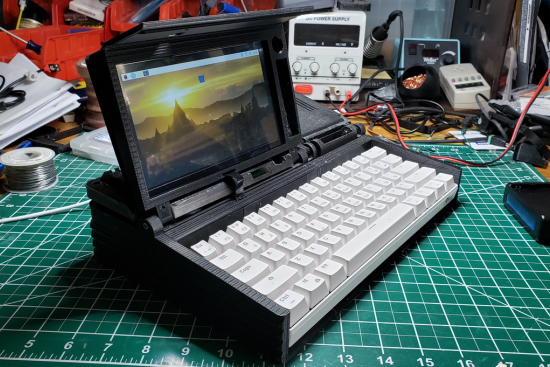
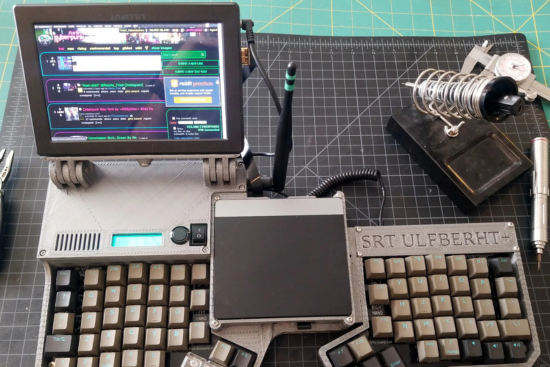
The cyberdeck stems from an informal yet powerful educational tradition: learning by taking things apart, making mistakes, configuring, and recreating. This approach has its roots in the hacker movement, home computing in the 1970s and 1980s, and the implicit pedagogies of the “do-it-yourself” movement. Before it is a machine, the cyberdeck is an active learning environment, where understanding the system is part of using it.
Source: hackerday.io
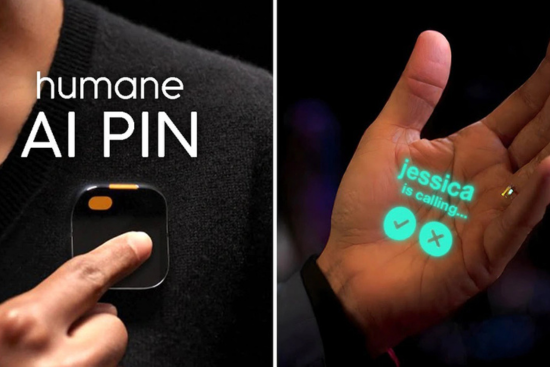
AI gadgets, on the other hand, stem from a different cultural framework: that of technology as a service. Here, learning to use them means learning to ask, not to understand. The implicit pedagogy is one of delegation: the system knows, decides, and suggests, while the user consumes the results.

Source: 20minutos.es and eyerys.com
These two origins reflect distinct educational models. One is based on cognitive autonomy and the construction of knowledge; the other is based on efficiency, quick responses, and the reduction of intellectual effort.
Examples of devices:
| Device | Type | Primary Function |
| Rabbit R1 | Pocket AI Device |
Voice Assistant and Task Execution |
| Humane AI Pin | Wearable |
Smartphone-independent AI assistant |
| Bee AI Pendant | Clip / Pendant | Automatic summaries and daily reminders |
| Limitless | Wearable | Assisted memory and smart search |
| Plaud NotePin | Wearable | Audio Transcription and Note Organization |
| Pebble Index 01 | Smart Ring | Audio capture with on-device AI processing |
| Smart Glasses (e.g., Even G2) | AI-Powered Glasses | Displaying Information in the Field of View |
Where This Is Headed: From Digital Literacy to Algorithmic Literacy
The convergence of cyberdecks and AI points to an inevitable transition: from simple digital literacy to algorithmic literacy. It is no longer enough to know how to use tools; we must understand how decisions are mediated by intelligent systems.
In this scenario, AI ceases to be merely a pedagogical tool and becomes a subject of study in its own right. How does it respond? What does it prioritize? What does it conceal? What data does it use to learn? These are educational questions, not technical ones.
The future of education does not lie in teaching people how to “use AI,” but in teaching them how to engage critically with intelligent systems—something that the cyberdeck model, with its transparency and control, fosters far more effectively than closed-off gadgets.
Impact on the world: a shift in the relationship between knowledge and authority
On a broader level, this convergence is changing the very notion of authority in knowledge. Whereas teachers and textbooks once held that position, today it is contested by algorithms that respond instantly and with apparent certainty.
This brings about a profound shift in education: the challenge is no longer accessing information, but evaluating, contextualizing, and interpreting automated responses. The AI-powered cyberdeck symbolizes this shift by requiring the user’s active engagement, while the closed-system gadget tends to present the response as the truth.
In the worlds of work, science, and citizenship, this difference results in individuals who are either critical thinkers or those who are dependent on systems they do not understand. Education is the arena where this fork in the road begins.
See also:
- The Accompanying Voice: Assisted Consciousness, Agents, and the Role of the Teacher in the Age of Artificial Intelligence
- Esports Scholarships in the U.S.: Facts, Dilemmas, and What Matters to Brazilian Schools
- Deepfakes are already part of our reality — and they can be really cool (if we know how to use them)
Direct impact on schools and teaching practices
In schools, this convergence calls for a reevaluation of traditional practices. The teaching model based on repetition, memorization, and correct answers breaks down when an AI can respond faster and better. Educational value shifts toward processes, criteria, and decisions.
Educational cyberdecks—whether real or conceptual—point to practices such as:
- project-based learning;
- maker culture;
- critical programming;
- problem-based research;
- Conscious and explicit use of AI.
AI gadgets, on the other hand, when used without pedagogical guidance, tend to reinforce passivity, the outsourcing of thinking, and the erosion of autonomy. The teacher’s role becomes that of an epistemological mediator, not a conveyor of answers.
Conclusion: Education as a Negotiation with Technology
The convergence of cyberdecks and AI gadgets reveals that the future of education will not be technological in an instrumental sense, but rather cognitive, ethical, and cultural. The central question is no longer “which tool should we use?” but rather “who decides, who understands, and who answers?”
The education of the future will need to prepare individuals capable of navigating technology: knowing when to delegate to AI, when to question it, and when to operate without it. This requires reviving the values of hacker culture—curiosity, autonomy, transparency—and integrating them with new algorithmic capabilities.
More than just preparing students for the job market or for exams, this education prepares them for a world where thinking remains a human trait, even when mediated by intelligent machines.
About the author:

*This text does not necessarily reflect the opinion of Bett Brasil.
Share on social media:
Categories
- The Future of Education
- Innovation