

Experts view the New High School Reform as a positive development, but uncertainty surrounding the ENEM is a cause for concern
)
Brazilian students’ school routines will change starting in 2025, following the passage of the law reforming the New High School System on July 31. Among the main changes are the establishment of educational tracks and an increase in the number of class hours for Basic General Education ( which includes traditional subjects such as Portuguese, math, physics, chemistry, English, history, and geography).
The total number of hours for the three years of regular high school will remain at 3,000, divided as follows: an increase in the number of hours for Basic General Education to 2,400, as defined by the National Common Core Curriculum (BNCC), plus 600 hours to be filled with courses from the educational tracks. Students will be able to choose from four tracks: languages and their technologies; mathematics and its technologies; natural sciences and their technologies; or applied humanities and social sciences.
For students who choose technical and vocational education, the minimum number of hours for Basic General Education will be 2,100, with 300 hours allocated to in-depth study of BNCC content related to technical and vocational education, totaling 3,000 hours when added to the minimum 900 hours of technical/vocational coursework.
Katia Smole, former Secretary of Basic Education at the Ministry of Education (MEC) and current executive director of the Reúna Institute, views the consensus reached regarding the New High School Program positively. In her view, the adjustments made took into account the consultations conducted by the Ministry of Education (MEC) with students and teachers, which resulted in an increase in the number of hours for Basic General Education from 1,800 to 2,400.
"Overall, key aspects of the reform were retained, such as greater curricular flexibility through in-depth study in specific areas of knowledge, the Basic General Education provided for by the BNCC, and the option of a technical track in vocational education," Katia points out.

Katia Smole analyzes the impacts of the New High School Reform. Photo: Courtesy.
According to Maria Helena Guimarães de Castro, former executive secretary of the Ministry of Education (MEC) and current holder of the Ayrton Senna Chair at the Institute of Advanced Studies at USP’s Ribeirão Preto campus, the high school reform “was what was possible—not the best, but what could be negotiated with the MEC.” The educator believes that the final bill approved by the Chamber of Deputies was significantly better than the Federal Senate’s original proposal.
The text of the high school reform bill underwent changes in the Senate after its first reading in the Chamber of Deputies. Upon returning to the Chamber of Deputies, the text underwent further amendments before going to the president for approval, with 21 changes that had been included by the Senate in the bill being rejected. The rapporteur in the Chamber of Deputies was Representative Mendonça Filho (União-PE), who served as Minister of Education when the New High School Reform was proposed in 2017 during Michel Temer’s administration.
"Thanks to the changes made to Representative Mendonça Filho’s bill, it was possible to ensure, for example, that English is a required foreign language, in addition to guaranteeing 2,400 hours of Basic General Education for all students and 2,100 hours for those who choose Technical and Vocational Education, with flexibility allowing these students to take 1,800 hours of Basic General Education and 1,200 hours of technical and vocational education,” explains the holder of the Ayrton Senna Chair at IEA/USP.
In addition, Maria Helena highlights the importance of another measure approved by the Chamber: the implementation of two stages in the National High School Exam (ENEM). “The first stage would assess Basic General Education, which is common to all students, while the second stage would focus on the flexible portion of the curriculum, whether it involves a path of academic specialization or technical-vocational training,” she notes.

According to Maria Helena Guimarães, there are aspects of the approved text that could have been improved. Photo: Courtesy.
Although she considers the final version of the bill to be the best possible, Maria Helena still believes that the ideal would be a Basic General Education program that is the same for all students, regardless of the track they choose. “I believe that 2,100 hours for everyone, with no distinction between technical-vocational and academic tracks, would be fairer to students. This would prevent inequalities in the assessment of Basic General Education and in the National High School Exam (ENEM), providing equal opportunities for access to higher education,” she argues.
Vetoes on the ENEM
When he signed the high school reform bill into law, Lula vetoed two sections of the law that dealt with changes to the ENEM, which means that, as of now, there are no plans to alter the exam.
The bill passed by the National Congress provided that, starting in 2027, exams would cover the content of the educational tracks (the flexible portion of the curriculum that each student chooses to study in greater depth). Thus, the exam will continue to cover only the subjects in the Basic General Education curriculum, which is the same for all students.
In its message to the National Congress regarding the veto, the federal government argued that requiring flexible content “could compromise the equivalence of exams, affect the conditions of equal opportunity in participation in admissions processes, and exacerbate inequalities in access to higher education.”
Katia and Maria Helena criticize these vetoes for their potential to harm and discourage students from choosing Professional and Technological Education (EPT) tracks, since the ENEM will now assess only Basic General Education. Both argue that without changes to the ENEM, high school education risks remaining very similar to the current model.
“The definition of the ENEM’s content framework and format, which takes effect in 2027, must be finalized by the end of 2025 so that schools can properly prepare students. This is a crucial point,” emphasizes the executive director of Instituto Reúna. According to Katia, the veto could encourage the continuation of traditional college entrance exams focused exclusively on Basic General Education. “As a result, the choice of EPT pathways will be compromised, and schools may end up prioritizing only general education, perpetuating the logic of traditional high school,” she warns.
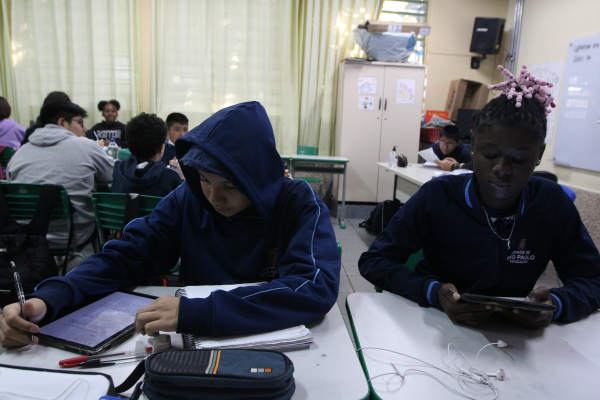
The definition of the ENEM is one of the topics under discussion in the reform of the New High School System. Photo: Rovena Rosa/Agência Brasil
The chair of the Ayrton Senna Institute at IEA/USP also expresses concern about the lack of clarity regarding the future of the ENEM. She states that this change could discourage many students from pursuing the technical education track, which is increasingly popular among the country’s youth. “Surveys show that 40% to 42% of students who complete high school would like to pursue a technical track. With this ban, we may see a significant decline in that interest,” she points out.
What about next year?
The law stipulates that school systems must begin implementing the New High School Curriculum in 2025 for students in their first year of high school, with the rules also applying to the second and third years in 2026 and 2027, respectively. However, the delay in approval could set back the implementation of the changes.
"I believe it is far too late for the National Education Council (CNE) and the Ministry of Education (MEC) to approve new guidelines that can be adopted by all public and private schools as early as 2025. I think the deadline is extremely tight, given that it is already mid-September," says Maria Helena.
See also:
- Student-centered learning is the path to the New High School
- What Will Change in High School Starting in 2025
She emphasized that schools need time to adapt their curriculum and teaching materials, as well as to revise their implementation plans, which must be approved by the state boards of education in every state in the country.
In her view, implementing these changes as early as 2025 is problematic. “All Brazilian states and curricula are in the process of implementing the proposed new high school program with 1,800 hours of general education, rather than the 2,400 hours stipulated by the new law, with the option of 2,100 hours for students who choose technical and vocational education,” she explains.
Katia reiterates that there is still a whole process that needs to be completed before the reform can be implemented in 2025, including decisions by the CNE and MEC, followed by the necessary adjustments at the schools.
“The Ministry of Education (MEC) must establish guidelines for educational pathways and provide technical and financial support to the states. Depending on how all of this is carried out—and given the perspective I mentioned above regarding the ENEM—we run the risk of repeating the problems that have historically marked this stage and continuing to leave young high school students without an education aligned with their interests. That is why I have been emphasizing the need to plan the implementation of these changes carefully and through an intensive collaborative process between the MEC and the state governments, since they are responsible for more than 90% of the students at this level,” he concludes.
Share on social media:
Categories
- The Future of Education