

Teacher training needs to be more closely connected to real-world practice
)
Enhancing the status of the teaching profession is one of the challenges facing education in Brazil. Despite initiatives such as the federal government’s recently launched “Mais Professores” program , the profession still suffers from low appeal, uncompetitive salaries, and a training program that lacks a stronger connection to classroom practice.
Rosemary Schettini, founder and director of the School of Education (Feduc), believes that initial teacher training needs a thorough reevaluation. In her view, teacher training is still overly focused on theory, with little practical application, which compromises the preparation of future educators.
"A teacher needs to have a broad worldview, be able to make connections, and create an enriching learning environment. However, that is not our reality," he says.
Rosemary argues that the socioeconomic background of students entering teacher-training programs is a factor that impacts their education. She states that best practices in teacher education are still concentrated in public universities, which primarily enroll students from private schools. However, most students entering teacher education programs come from lower-income families and attend private colleges in the evening or through distance learning (EaD).
“This situation poses a challenge for practice-oriented academic training. This is because the requirement for a minimum number of hours for mandatory internships becomes an obstacle, since schools—where the internships are supposed to take place—operate during the day, precisely when most of these students are in the workforce,” says the director of Feduc.
Another critical issue, according to the educator, is the lack of recognition for the profession. “Teachers face low salaries, poor working conditions, overcrowded classrooms, and even violence in schools. This lack of recognition discourages young people from pursuing a teaching career and undermines the quality of education,” she says.
The low appeal of the profession is also a concern for Mozart Neves Ramos, holder of the Sérgio Henrique Ferreira Chair at the Institute of Advanced Studies at USP in Ribeirão Preto. Like Rosemary, he emphasizes the importance of linking initial training to teaching practice from the very beginning of the program, using a model that more closely mirrors the reality of the classroom.
Furthermore, Ramos points out that a large proportion of students entering teacher education programs face academic difficulties from the very beginning, as evidenced by their performance on the National High School Exam (Enem). Many of these students do not even score 450 points on the exam—the minimum score that, in practice, would indicate satisfactory completion of high school. Despite these shortcomings, they enter higher education, bringing with them learning gaps that compromise their training as educators.
“It is impossible to ensure quality education in the country without well-prepared and valued teachers, since teachers are the most decisive factor within schools for student learning,” notes the holder of the Sérgio Henrique Ferreira Chair at IEA-USP.
Teacher-training residencies?
Rosemary believes that a significant curricular transformation is needed, including the adoption of a pedagogical residency model.
“Adopting a model based on pedagogical residency involves changes such as encouraging students to reflect continuously on the specific characteristics, challenges, and dynamics of the school environment, ensuring that their training is aligned with the real demands of the profession. In addition, future teachers need a mediation process that helps them gradually transition from the role of student to that of education professional, providing them with concrete, guided experiences within the school,” he says.
She explains that it is essential for internships to be integrated into the educational institution’s curriculum in an organic and strategic manner. “The internship should be understood not as a peripheral element of education, but as a central pillar, serving as the backbone of practical learning. However, this issue has not yet been addressed consistently in Brazil,” she says.
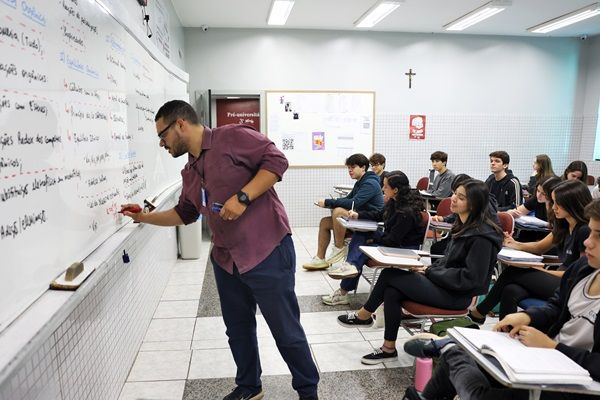
Enhancing the status of the teaching profession is one of the challenges facing the country. Photo: José Cruz/Agência Brasil
Another major problem, according to the director of Feduc, is the lack of adequate guidance and supervision for student teachers. “Currently, many students complete their teaching internships without receiving any kind of ongoing feedback, which prevents them from truly improving their teaching skills,” she adds.
In addition, Rosemary points out other areas that require attention to enhance the status of the profession. “It is essential to improve educational management by reducing bureaucracy, combating violence in schools to create safer environments, and providing emotional support to teachers. The stress and pressure faced by teachers are enormous, and a more welcoming environment could make a difference,” she concludes.
MEC’s “More Teachers” Program
In January, the Ministry of Education launched the “Mais Professores” program, which brings together a series of measures designed to enhance the status of the teaching profession in Brazil. Among the initiatives is the “Pé-de-Meia Licenciaturas” program, which offers a monthly stipend of R$ 1,050 to students who enroll in teacher-training programs through SISU, PROUNI, or FIES Social.
Regarding the federal program, Neves notes that the initiative deserves recognition and serves as a starting point for changing young people’s perception of a career in teaching. However, it is essential that the Ministry of Education (MEC) understand that this initiative, on its own, will not be enough to solve the problem.
He suggests that one of the key ways to enhance the status of teachers would be to create a national career plan for teachers trained in this new context. The plan could be modeled after the Fund for the Maintenance and Development of Basic Education and the Enhancement of Education Professionals (Fundeb), ensuring ongoing funding and consistent policies for compensation and career advancement.
See also:
- Law 15,100/25: The new law governing cell phone use in schools
- 11 Free Tools for Teachers to Manage the School Year
- Four Trends for the Education Sector in 2025
In addition, the Ministry of Education (MEC) could invest in incentives for teacher-training programs offered by private educational institutions recognized as high-quality by the Coordination for the Improvement of Higher Education Personnel (Capes). Currently, these institutions face difficulties competing with distance-learning teacher-training programs offered at nominal fees, such as R$ 99.00.
Even with the increase in the number of applications from high-achieving students in the Unified Selection System (Sisu) for teacher education programs—as recently reported by the Ministry of Education (MEC) following the announcement of the “Mais Professores” initiative—Rosemary believes that offering more job opportunities for teachers may be part of the solution, but it does not resolve the structural problems in teacher education.
She believes that this type of program is important for providing teachers with greater financial security throughout their careers, but it does not directly address the quality of initial or continuing education for education professionals.
"It's not enough to simply have more teachers; we must ensure high-quality training. Without robust training programs for both initial and continuing education, combined with the creation of incentive policies, better working conditions, and higher salaries, the attractiveness of the teaching profession will continue to be a problem," argues Rosemary.
The director of Feduc also criticizes the name of the government’s financial incentive program. “The term ‘Pé-de-Meia’ already carries a connotation that does not value the profession. I prefer to call it a training grant or retention scholarship, as that better reflects the need to support students throughout their academic journey,” she concludes.
Share on social media:
Categories
- Educational Management