
Emotional intelligence influences relationships among administrators, teachers, and students
)
It is becoming increasingly clear to educators and experts in the field that developing emotional intelligence skills in schools is just as essential as teaching Portuguese and math. This is because the ability to identify and manage one’s own emotions and those of others plays a decisive role throughout students’ lives, both personally and professionally.
In this context, synergy among administrators, educators, and teachers in the school environment is essential. The social-emotional development of these professionals strengthens interpersonal relationships and is necessary for them to be capable and comfortable in fostering the development of social-emotional skills among their students.
“Administrators and teachers face challenging situations that require more than just technical skills to navigate. Examples include low student engagement, conflicts, and impulsive reactions that impact the quality of the school climate, as well as the fragility of bonds of affection, trust, and a sense of belonging at school. All of these issues require a set of social and emotional competencies on the part of education professionals, who also need to be welcomed, cared for, and supported in developing skills such as self-awareness, self-care, empathy, collaboration, openness, flexibility, and resilience, among others,” explains Anna Penido, executive director of the Lemann Center for Leadership in Educational Equity.
See also:
- Brazil ranks fourth among the countries that use generative AI the most
- Nonviolent Communication Promotes a More Inclusive Environment in Schools
- Personalized Learning: A Tool for Educational Innovation
Continuing education in social-emotional skills for professionals working in the field of education is a relatively new concept and requires careful planning.
Anna states that, when planning these training programs, it is important to conduct more thorough assessments of the challenges faced by administrators and teachers and to create opportunities for them to reflect on and rethink their attitudes, as well as to find ways to approach and address these situations with greater awareness and effectiveness. Another recommendation is to offer mentoring activities so that professionals can share their dilemmas and learn from their peers.
“When they become more aware of their own attitudes and emotions, administrators and teachers are better able to understand the effect these have on students’ attitudes and emotions. They also find more effective ways to build relationships that are more empathetic, dialogic, and participatory—relationships that allow them to get to know their students better and to better understand and take into account their interests and needs, both to foster more positive interactions and to offer teaching strategies that are more relevant and meaningful to them,” notes the executive director of the Lemann Center.
Emotional Intelligence in Education
On September 4 and 5 in Recife (PE), the Bett Nordeste Conference, a traveling event organized by Bett Brasil, will feature a series of lectures and panel discussions centered on the theme: “Artificial Intelligence (AI) and Emotional Intelligence (EI) in education: what should we learn?”
“Social-emotional development in the training of educators and administrators” is the topic of one of the panel discussions, featuring Anna Penido as a speaker, along with Karen Cristine Teixeira, Research Manager at the Ayrton Senna Institute, and Normando Júnior, Educational Solutions Analyst at CESAR School.
Also on the list of speakers for the traveling event is Paula Carneiro Leão, director and partner at Escola Vila Aprendiz—an early childhood education school located in Recife. She will participate in the panel “The Power of Emotions in Learning,” alongside Guilherme Brockington, a researcher at the D'Or Institute for Research and Education, and Luis Fernando Gonçalves, an educational specialist at the International School.
“Since our founding 15 years ago, we’ve approached the classroom from a psychological perspective. For students ranging from age two up to our teenagers, we have a practice of having a psychologist spend 45 minutes a week in the classroom. This is something that cannot be done separately, as an afterthought; it is not content like a subject. The philosophy of caring for each individual must be part of the very essence of the school and must be instilled in everyone in this community we call school,” says Paula.
She also believes that the social-emotional aspect cannot be separated from learning. “As the psychoanalyst and educator Rubem Alves once said, ‘emotion is the glue of memory.’ Therefore, the entire school must understand that caring is the primary role of each individual who makes up this community. At Vila, we believe that social-emotional education cannot be a separate curricular subject or the specialty of a single teacher. On the contrary, it is embedded in the organic system of daily relationships, with all of us playing leading roles in this process—there is no room for supporting roles,” she emphasizes.
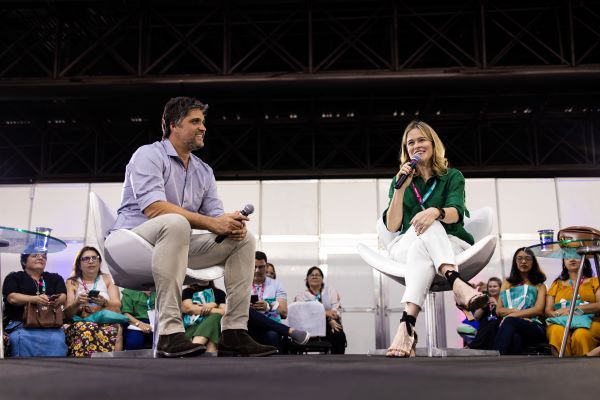
Paula Leão was one of the speakers at the latest edition of the Bett Nordeste Conference
Another speaker at the Bett Nordeste Conference is Pierre Lucena, president of Porto Digital—one of Brazil’s leading technology parks and innovation hubs. He will participate in the closing panel of the traveling event alongside Luciano Meira, Science and Innovation Coordinator at Proz Educação and professor at the Federal University of Pernambuco (UFPE), and Marina Pinheiro, a professor in the Department of Psychology at the Federal University of Pernambuco (UFPE).
Pierre believes that the challenges of undergraduate education lie precisely in the quality of training—both in technical and emotional skills—since both factors make a difference in one’s professional life. “When people enter the professional world, they’re expected to have emotional intelligence and know how to work in a group, as well as write and read well, which isn’t easy. They’re also expected to know how to create graphs and work with data and numbers. I mean, these are the skills required in modern life, no matter what profession you choose,” comments Lucena.
The traveling event also features: neuroscientist Carla Andrea Tieppo; Alessandra Borelli, partner and CEO of Opice Blum Academy; writer and clinical psychologist Rossandro Klinjey; Alex Sandro Gomes, full professor at the Federal University of Pernambuco (UFPE); Rafael Ferreira Mello, senior researcher at CESAR School and professor at the Federal Rural University of Pernambuco (UFRPE); and Karen Teixeira, research manager at the Ayrton Senna Institute.
- Click here to view the complete schedule for the Bett Nordeste Conference
- Register for the event here
In addition to panel discussions and presentations, the Bett Nordeste Conference will also feature an exhibition area showcasing solutions, products, and services. The exhibitor space will provide an environment for networking among solution providers for the education sector, educational institutions, suppliers, and qualified buyers with significant decision-making authority.
Share on social media:
Categories
- Diversity, Equity, and Inclusion (DE&I)
- Teaching Methodologies