
Educational Marketing: The Challenges of Communicating With and Engaging a Society That Is Focused on Immediate Gratification and Becoming Increasingly Individualistic
)
The transformation of societal behavior, driven by digitalization, has been demanding a profound shift in how educational institutions position themselves in the market. In this context, targeted communication, personalization, and close relationships with families have become central elements of educational marketing strategies .
The topic was discussed during Bett Brasil 2026, at a panel discussion featuring Unimark’s managing partner, Walter Longo, and the Communications and Marketing Manager for Rede Santa Catarina – Educação, Julia Contier Fares.
Longo pointed out that the post-digital society has profoundly transformed people’s relationship with consumption, communication, and learning. According to him, contemporary behavior is characterized by individualization, immediacy, and the pursuit of personalized experiences.
“People today are not the same as they were ten years ago. They pamper themselves more, value individuality, and look for shortcuts in their personal lives,” he said.
The expert compared the current situation to the model of streaming services and apps, in which each person chooses exactly what they want to consume, whenever they choose. In his view, the education sector needs to understand this new dynamic and rethink overly standardized models.
“Education needs to understand this moment and learn not to cater only to certain groups. Today, society is focused on shortcuts and fleeting trends. But education operates on a timescale of years, not hours. It’s a huge challenge that deserves attention and needs to be studied in depth,” he said.

Walter Longo emphasized the importance of education adapting to new forms of learning. Photo: Bett Brasil.
When discussing advances in technology and artificial intelligence, Longo argued that AI should be viewed as an ally in the educational process. Among the examples he presented, he cited the possibility of reducing the time devoted exclusively to conveying content in order to expand the development of human, social, and creative skills.
According to him, the traditional model of education was designed for a society that valued the accumulation of information, whereas the current context demands greater flexibility and student involvement.
“Today we talk about the flipped classroom, which involves learning at home and lessons at school. In this new context, the teacher takes on a more inspiring and less mechanical role,” he said.
As he concluded his remarks, Longo emphasized that education is undergoing a period of irreversible transformation. “We are facing a disruptive evolution. Everything has changed, and there’s no going back to the way things were before. We must adapt.”
See also:
- The Northeast Region’s Leading Role in Education Highlights the Importance of the Bett Northeast Conference
- Schools in Action: A First-of-Its-Kind Initiative Opens Registration to Bring School Projects to the Stage at the Bett Northeast Conference
- Managers' Forum Promotes Discussions on the New Challenges of Educational Leadership
From a practical perspective on school management, Julia pointed out that educational institutions are vying for attention in an increasingly broad and dynamic market, where competition extends far beyond neighboring schools.
“Today, schools aren’t just competing with other educational institutions. They’re vying for attention within an extremely volatile ecosystem,” he said.
The expert highlighted the key role played by mothers in the enrollment decision-making process and emphasized the importance of tailoring communication strategies to this audience. According to her, about 80% of enrollment decisions are made by mothers.
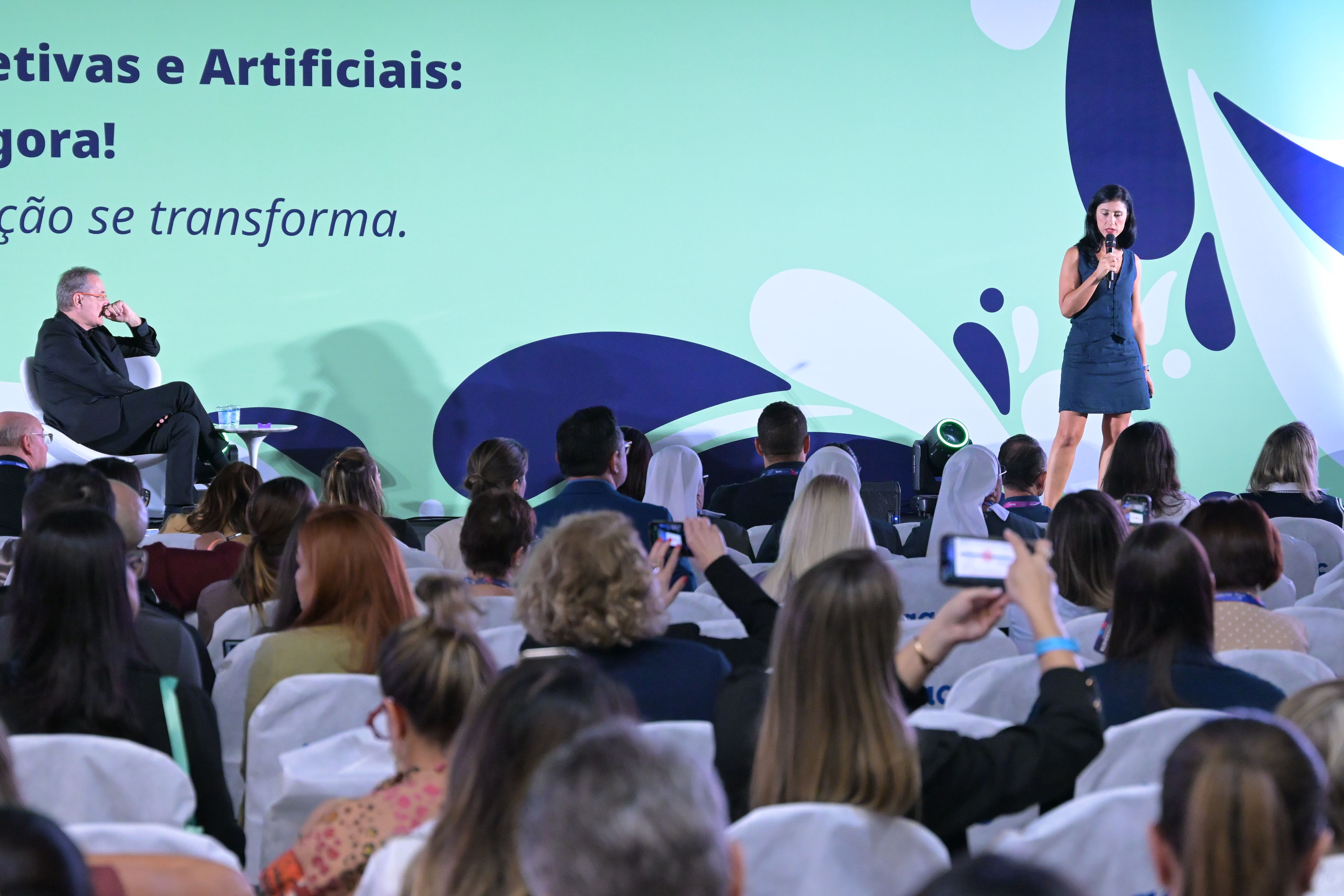
Julia Fares explained the importance of mothers in the enrollment process. Photo: Bett Brasil.
For Julia, building credibility in educational marketing depends on authenticity and staying true to the reality of the school. “A testimonial from a family talking about the school is the best social proof you can present in marketing,” she said.
She also emphasized that the families' experience begins even before enrollment and involves all departments of the institution, especially the customer service and sales departments.
Among the strategies mentioned, Julia highlighted the use of apps and communication tools that bring parents and schools closer together, reducing confusion when monitoring students’ daily routines. In addition, she emphasized the need for institutions to maintain ongoing crisis management and communication plans.
The experts emphasized that the future of education depends not only on the adoption of new technologies, but above all on schools’ ability to understand social changes and offer more human, individualized experiences that are aligned with the expectations of new generations.
Share on social media:
Categories
- Educational Management