

Math from an Early Age: The Challenge of Teaching Numeracy in Early Childhood
)
The gap in mathematics learning is a growing concern among educators and public officials in Brazil. The latest TIMSS (Trends in International Mathematics and Science Study) revealed that 51% of Brazilian children in the 4th grade of elementary school (ages 9 to 10) have not mastered basic skills, such as multiplication tables or simple operations with three-digit numbers.
The data highlights a problem that, according to Katia Smole , executive director of Instituto Reúna and a board member of Bett Brasil, has deep roots in educational policies and in the way the country approaches the teaching of mathematics from the earliest years of schooling.
“Unfortunately, this outcome has become a recurring pattern. We wait too long to start teaching math to children,” says Katia in an interview with Conexão Bett. She explains that, traditionally, educational policies in Brazil have focused their efforts on language literacy, leaving mathematical literacy in the background.
The expert points out that learning math is a cumulative process that needs to be built gradually from an early age. “We’re talking about young children who aren’t afraid of math. That fear comes later. So we need to take advantage of this phase when learning comes naturally,” she explains.
She advocates the use of play, games, and children’s literature as effective strategies for introducing mathematical concepts in a lighthearted way that is integrated with language literacy.
“The BNCC already calls for the development of math skills starting in early childhood education. Ensuring that this is done in a playful and coordinated way is essential for children to learn the right things at the right age. Otherwise, they fall behind, and it’s impossible to catch up all at once in the following years,” she says.
See also:
- Brazilian teachers spend 21% of class time maintaining discipline
- Students are turning to AI for schoolwork, and the challenge now is to teach them how to use it as a tool to support their learning
- Emotional education in schools helps young people become more empathetic and well-adjusted
Priorities
Katia highlights three priorities for improving the national education system: providing high-quality teacher training, ensuring that mathematics instruction begins at age four, and promoting the consolidation of learning.
“Today, we have seventh-grade students who were in second grade in 2020. The pandemic has exacerbated gaps that already existed. The country needs to urgently address this issue, especially in mathematics, because the gap is widespread,” he warns.
Teacher training, she says, must be connected to the reality of schools. “It can’t be detached from reality. The students in the classroom are very real. There’s no point in studying every theory in the world and then walking into the classroom without knowing what to do,” she says.
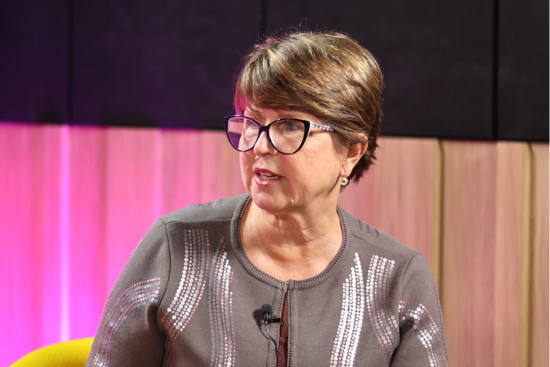
Katia Smole highlighted the priorities for improving mathematics education in the country. Photo: Bett Brasil.
Katia argues that teachers need to master the content they teach, understand who their students are, and know how to assess the learning process. “No one can teach what they don’t know. That’s why it’s essential to balance conceptual and pedagogical training.”
However, the responsibility should not fall solely on teachers. “They are on the front lines and make a huge difference, but they cannot shoulder this burden alone. Administrators, coordinators, and principals need to provide adequate working conditions, support, and pedagogical consistency so that teachers can teach what children are expected to learn,” she points out.
As an example of best practices, Katia cites initiatives in India, a country that has achieved positive results. “They provide ongoing professional development that is aligned with the instructional materials used in the classroom. This helps teachers understand how concepts build on one another and plan their lessons more effectively,” she explains.
She also highlights the peer-training model, in which teachers learn from other teachers who develop best practices within the school system itself. “This is extremely important. When there is pedagogical consistency and collaboration, teachers gain confidence and students learn more.”
In addition to YouTube,Conexão Bettis also available on major audio platforms, such asSpotify,Deezer,Apple Podcasts,Amazon Music, andGoogle Podcasts, among others, as well as on theEducador21 website.
The talk show is yet another forum for dialogue at Bett Brasil, featuring various experts who offer a different perspective on the most relevant and current topics in the education sector. Turn on notifications on your favorite platform to be notified whenever a new episode is available.
Share on social media:
Categories
- Learning Strategies