
A Datafolha survey indicates that improvements in education are a priority for public school students
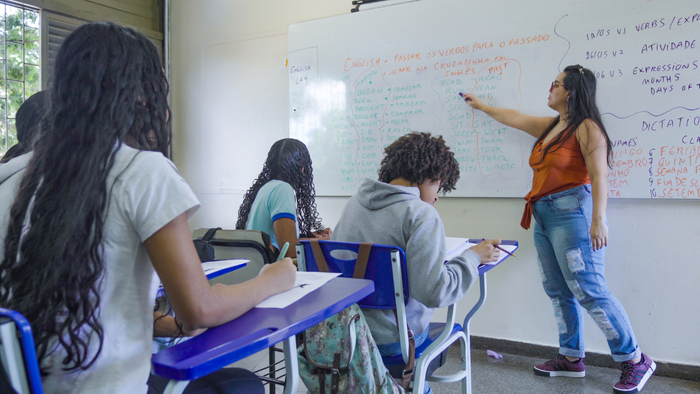
Improving the quality of teaching and learning is among the top expectations Brazilian students have of public schools. This is revealed by the opinion poll “What Do Students Think About Education?”, conducted by the Datafolha Institute at the request of seven education-related organizations.
Among high school students in the state public school system, at least one-quarter spontaneously cite improvements in the teaching and learning process as their main expectation regarding the governments that will take office in 2027.
The survey polled 5,296 middle and high school students, aged 12 to 21, across the country’s five regions. The study examined young people’s perceptions of learning, teacher performance, vocational education, the use of technology, full-time education, and options for choosing educational pathways in high school.
The results indicate that the quality of instruction is directly related to students’ perceptions of the school. Among the aspects students spontaneously mentioned are the variety of classes offered, the use of interactive classroom activities, teacher training, and a reduction in teacher absences.
Teachers' Performance Influences School Evaluations
The way teachers explain the material is linked to students’ evaluation of the educational institution. Among students who say that teachers explain the material well, 75% rate the school as good or excellent. Among those who believe that teachers do not explain the material well, however, that percentage drops to 48%.
Perceptions of teacher motivation vary across educational levels. In upper elementary school, 78% of students believe that teachers are motivated to teach. In high school, the figure is 69%.
See also:
The lack of teachers in certain subjects is another area of concern, especially in high school. At this level, 66% of students agree fully or partially with the statement that there are subjects that go without a teacher for a period of time. In upper elementary school, the percentage is 61%.
Vocational training is a priority for young people
The survey also points to a significant increase in the value placed on vocational education. More than 90% of students consider it important to have the opportunity to take a technical or vocational course during high school.
This interest stands in contrast to the current participation of young people in this field. According to the 2025 School Census, about 20% of high school students are enrolled in Professional and Technological Education (EPT).
The gap between the importance students place on technical training and the availability of such programs highlights an area requiring attention in public policy. Expanding access to vocational courses is one of the issues related to the educational opportunities offered during high school, a stage at which students also begin to chart their paths for continuing their studies and entering the workforce.
The use of artificial intelligence is part of the studies
Technology is also present in the school routine described by the students. According to the survey, 70% say that teachers use technology in class at least once a week.
Artificial intelligence is already part of young people’s study habits: 71% say they use AI tools frequently or sometimes to study. The results show that these tools are part of the strategies adopted by a significant portion of students.
At the same time, students’ familiarity with digital resources does not mean that they consider their teachers’ preparation to be sufficient. About one in three of those surveyed disagrees that their teachers are well prepared to use technology in the classroom.
Cyberbullying and School Violence
The school’s and teachers’ response to incidents of bullying, cyberbullying, and violence is viewed favorably by the majority of students. 72% agree fully or partially that the school administration responds appropriately when such incidents occur. Nevertheless, it is worth noting that about one-quarter of students take a more critical view of the school’s response to these situations.
See also:
Full-time education
Of the students enrolled in full-time education programs, 74% rate their school as good or excellent, compared with 68% of students in the regular education system.
Among the associated benefits are more time to learn, participation in sports, arts, and cultural activities, preparation for the future, and more time to study for college entrance exams and the ENEM. Among high school students who say they are not enrolled in a full-time program, 20% say they work or engage in other activities to earn money.
The students’ responses help shed light on aspects of the school experience that deserve attention in the formulation of educational policies, especially as new state governments take office in 2027. The data also underscore the importance of considering young people’s perspectives in the discussion about teaching conditions and the opportunities offered by public schools.
Source: Todos pela Educação.
Share on social media:
Categories
- Learning Strategies