
The first day of Bett Brasil features discussions on artificial intelligence, citizenship, and educational management
)
With the theme “Innovation with a Purpose: Education in Dialogue with Social Change,” the 29th edition of Bett Brasil kicked off this Tuesday (23) in São Paulo. With more than 300 exhibiting brands and 400 national and international speakers, the largest Innovation and Technology for Education event in Latin America brought together the entire educational community—including teachers, administrators, principals, public officials, and companies from elementary through higher education—and will continue through Friday (26) at Expo Center Norte in São Paulo.
During the opening ceremony, Bett Brasil Director Claudia Valério emphasized the importance of the event for Brazilian education and highlighted the relevance of the chosen theme, demonstrating its applicability both during the fair and in the day-to-day life of the school community.
“Bett Brasil is a time to celebrate all initiatives that support public and private education. And when we realize that we’ve managed to bring the entire community together—schools, teachers, educators, school administrators, and educational solutions—we know just how meaningful our work is and that we’re on the right track. This year’s theme is ‘innovation with purpose’ and ‘education in dialogue with social transformations,’ centered on inclusive, high-quality education, seeking equality and lifelong learning opportunities for all,” he said.
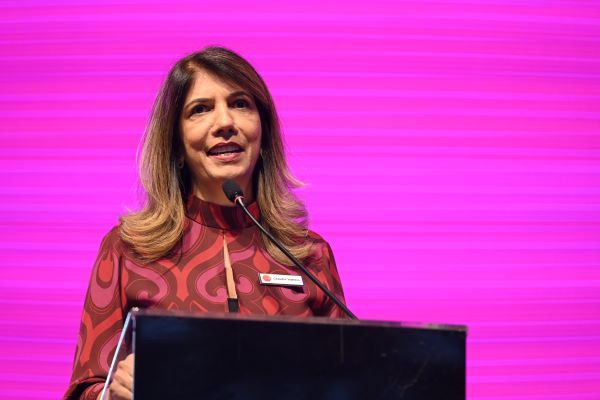
The executive also emphasized that the year-long effort to make Bett Brasil a reality serves an even greater purpose: “The topics presented at the event cut across a variety of other areas, including artificial intelligence, connectivity, and other technologies developed to support Brazilian education. There are four days filled with networking, business opportunities, speaking opportunities, and chances to make connections so that everyone can make the most of these days of inspiration and learning and apply the knowledge gained here,” she emphasized.
Students, teachers, the market, and the government
To kick off the 2024 edition on a high note, Bett Brasil hosted a roundtable discussion with key figures from the world of education. One of the special guests was Professor Francisco Leitão Freitas, who teaches history at the Teaching Center of the Santa Maria (DF) Detention Facility for young people serving socio-educational sentences. Leitão Freitas is one of the finalists for the Transformative Educator Award, with the RAP (Resocialization, Autonomy, and Empowerment) project—an initiative that uses hip hop as a foundation to stimulate learning.
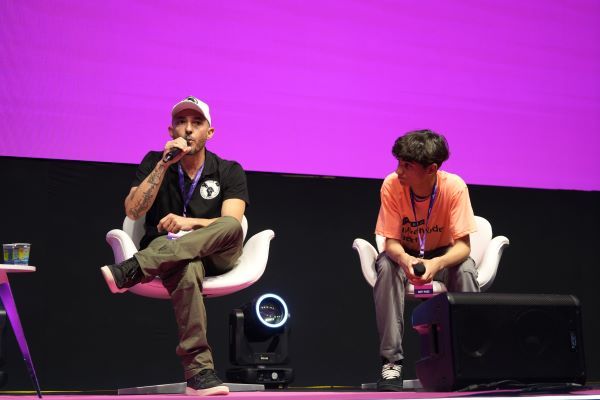
During the conversation, the professor emphasized that innovation isn’t just about technology, but also about finding new ways to teach. “The approach must also be innovative. We face the challenge of understanding and encouraging young people to learn in multiple ways,” he said. During the meeting, Francisco revealed that he, too, had struggled with the school environment when he was younger. “I wasn’t a model student; I failed twice and was away from school for a few years because I didn’t feel welcome—I was very shy. That’s why I stress that educators and schools must make a pact: schools must be welcoming; after all, young people aren’t a problem—they’re a source of potential.”
An inclusive school is also the hope of 14-year-old student Lucas Coelho. He is part of the Bett Youth Project and is in his first year of high school at Lourenço Castanho School in São Paulo, where he receives a scholarship.
The Bett Youth Project encourages high school students from public and private schools to explore educational trends and innovations at Bett Brasil. The initiative is a collaboration between Bett Brasil, Instituto Criar, and CESAR School, which provides technical and creative support. At Bett, 24 students will participate in a four-day program that includes visits to exhibitor booths, attendance at lectures, and workshops on creating audiovisual content that reflects their own perceptions of the event. The students will have access to a fully equipped workspace to develop their project.
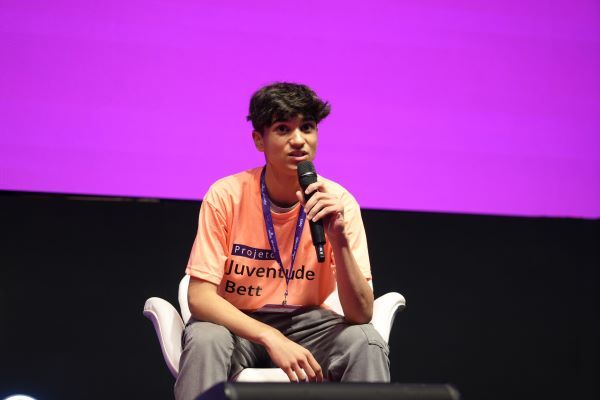
The son of a public school teacher, Lucas was invited by Bett Brasil to share his vision of what the ideal school would look like. “I believe the ideal school should, first and foremost, be humane and inclusive. It should encourage critical thinking among students, use art and music as tools for learning, and also be participatory, placing the student at the center of the educational debate,” he said.
The student also spoke about the importance of good teachers and the lasting impact they have on our lives. “I’ll never forget Ms. Teka, who encouraged me to write my poems. Once she read one of my pieces and included it in a test. Afterward, she framed it and gave it to me. It was very rewarding.”
As a participant in the roundtable discussion, Aberson Carvalho—a member of the Fiscal Council of CONSED (National Council of Education Secretaries) and Secretary of State for Education, Culture, and Sports for the state of Acre—emphasized the importance of technology in building a “more ideal” education system.
“The country’s public education system is undergoing a process of transformation. The pandemic has brought challenges that have ushered us into a new era in education—a shift from a conservative academic model, with teachers at the front of the classroom using blackboards and chalk, to the integration of technology, not only through computer labs, for example, but also through technological devices such as tablets, among other elements that make up this landscape. All of this demonstrates that technology is integral to the pedagogical relationship and is part of the learning process.”
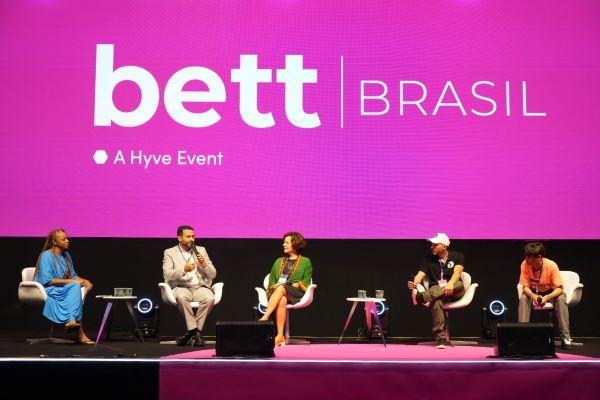
Another point highlighted by the secretary concerns the perception of and respect for students’ individuality. “Today, when we talk about equity, the major challenge in education is precisely for teachers, schools, and school administrators to view things from the student’s perspective, without the mindset that we are the owners of knowledge, which is passed down from the top.” We need to foster this teaching-learning relationship and not lose sight of the fact that the student is the main actor,” he emphasized.
Vera Cabral, Director of EDU Industry Advisor Americas at Microsoft, spoke about how the democratization of technology is important for us to achieve certain results. She also shared her perspective on what innovation in education means.
“The key to this discussion—and what drives us—is innovation. We come from a very rigid, very formulaic educational model that doesn’t account for differences. Education needs to be human-centered and make use of technology; that’s very important,” he said.
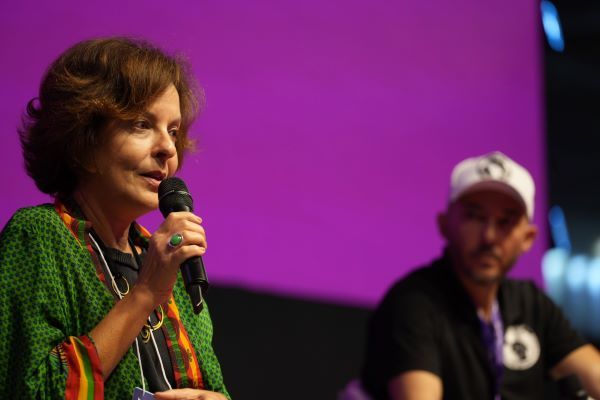
However, Vera emphasized that technology is a tool to help democratize education. “Technology doesn’t create education; it is educators and students who create education. Technology offers resources that significantly amplify this entire wave of innovation we’ve been discussing. And, particularly now that we’re seeing this development in generative artificial intelligence, it’s a very important moment for us to reflect on how these technologies can democratize education and transform it—as well as make it much more equitable and create an education system for all that includes everyone,” Vera added.
Artificial Intelligence and Education
The use of Artificial Intelligence in educational and social contexts was one of the key topics of the first day of Bett Brasil. Fabio Campos, an educator and researcher at New York University (U.S.), and Ivan Claudio Pereira Siqueira, coordinator of the interdisciplinary bachelor’s program in the Humanities at the Federal University of Bahia, discussed how Artificial Intelligence can connect with human intelligence and the best ways to use this technology. The panel was moderated by José Brito, director at Jeduca (Association of Education Journalists).
Fabio Campos opened the discussion by saying that there is a tension between engineering and education that should not exist, alluding to the resistance of some institutions to new technologies. “The best way to safely introduce an innovation in schools is to test it first in the teachers’ lounge and then in the classroom. Once that’s done, there are many benefits,” he noted.
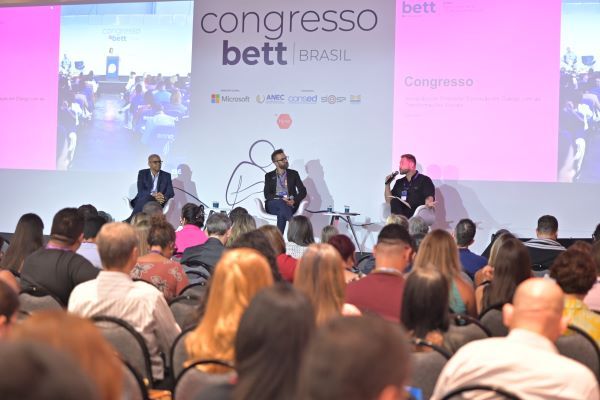
During the debate, Ivan Siqueira emphasized the importance of asking well-crafted and thoughtful questions of Artificial Intelligence platforms, so that they are not used merely as simple question-and-answer chats. “There is a study in Germany that suggests that using these tools without careful consideration during the early stages of education can affect children’s cognitive development. Therefore, the most important thing in this context is knowing how to ask questions. A question requires careful thought, analysis, and evaluation.”
As a tip for improving this process, Fabio highlights the use of generative AI for images. “A great resource for helping students refine their questions is AI-powered image-generation software. When trying to create a scenario, students can gradually enhance their scene with more elements, which ultimately encourages them to formulate more precise questions.”
The panelists also discussed the need to advance national education in comparison with other developing countries, as well as regulations governing the use of social media and artificial intelligence to improve the mental health of children and adolescents, and to ensure greater control over accurate and fact-checked information.
Citizenship on the Agenda
Journalist Milton Jung attended Bett Brasil to discuss his latest book, *“We Must Not Remain Silent! We Need to Talk to Our Children About Ethics and Citizenship.”* The book reflects on the importance of intergenerational dialogue, drawing on the journalist’s own experiences as a father and citizen.
Jung emphasized the need for us, as individuals, to interact with people who think and act differently, because only in this way will we achieve development and evolution. “Diversity is a necessity for those who seek creativity. We do not evolve when we are with people who think like us. When no one is willing to listen to others anymore, a void is created, and this is a problem because it hinders development and citizenship,” he said during the panel discussion.
In his book, Jung highlights the importance of challenging four societal clichés—phrases and arguments frequently used to define or deal with young people. They are: “All teenagers are the same”; “Back in my day…”; “He just needs to study”; and “My child won’t put up with any nonsense.”
According to the author, such statements reflect resistance to change and fail to respect individualism and the needs of others, especially young people. “These are clichés that must be vigorously combated—at home, at school, and in society. “We, as parents, must be better than our parents were to us, just as a teacher cannot teach the same way for 30 years,” he adds, concluding: “If I hold the same opinion I had 40 years ago, it’s a sign that I haven’t evolved at all.”
Bett Brasil runs through Friday (the 26th) at Expo Center Norte in São Paulo. Registration can be done on-site. Admission is free.
Share on social media:
Categories
- The Future of Education