

When the Future Became Too Small
)
Digital and media literacy isn’t just about knowing how to use tools: it’s about learning to interpret the world when communication takes place through screens, platforms, algorithms, and artificial intelligence. In this regard, science fiction plays a small but crucial role: keeping curiosity alive. It allows us to ask not only “How does this technology work?” but also “What kind of society does it help build?”
There’s something strange about our times. We’ve never been surrounded by so much technology, and yet it seems we imagine the future less than ever. What once seemed like science fiction now fits in our pockets, in schools, at work, and in everyday politics. When reality becomes too technological, fiction runs the risk of losing its sense of distance. And without that distance, perhaps it will cease to open up new worlds and instead merely comment on the world in which we’re already trapped.
The time when imagining meant walking through a door
There is an important difference between predicting and imagining. Classic science fiction was never merely an exercise in prediction. Flying cars never materialized, space colonies never became commonplace, and many of the robots imagined in these works remain a distant prospect. Still, these works remain relevant because their goal was not to be right. It was to expand our horizons.
By transporting humanity to other planets, other societies, or other forms of intelligence, science fiction created enough distance to allow the present to be viewed from a different perspective. Before a technology exists, it must first be imaginable. Before a society accepts a change, it must first be able to conceive of it.
See also:
- My Cognitive Radar: When 15 Texts Became a Mind Map
- Understanding Media and Algorithmic Literacy (MAIL) Skills
When the present started moving too fast
In recent decades, the relationship between imagination and technology has changed. For much of the 20th century, there was a time lag between scientific discovery and its incorporation into everyday life. Today, that time lag seems to be getting shorter and shorter.
An innovation emerges, makes headlines, transforms markets, and changes habits within a few months or years. Perhaps that is why the future no longer seems like a distant continent. It feels more like the next software update.
When the horizon narrows, fiction itself takes on a new role. Instead of exploring the unknown, it begins to interpret what is already unfolding before us: less “What might we become?” and more “What will this technology do to us?”
When the screen arrives before the lab
But there is also the other side—the one that got it right: the cultural form of technology before its physical existence. Long before tablets, video calls, digital assistants, gesture-based interfaces, and mobile devices became part of everyday life, film and television had already given these technologies a visual identity, a scenario for their use, and a place in the social imagination.
That is why science fiction should not be judged solely by what it got right or wrong. Its deepest role is to make the impossible open to discussion. Before a technology is built, it must be desired, feared, debated, or at least recognized as a possibility. Art, precisely because it is not bound by the immediate demands of technical feasibility, often arrives first: it does not deliver the finished device, but it does provide the first mental image of how it might exist.
"Black Mirror" and the Future That Came Too Soon
It’s hard to find a better example of this transformation than *Black Mirror*. Although it’s often presented as science fiction, its subject matter rarely involves impossible technologies. Its focus is on recognizable trends: digital surveillance, online reputation, artificial intelligence, hyperconnectivity, and technological dependence.
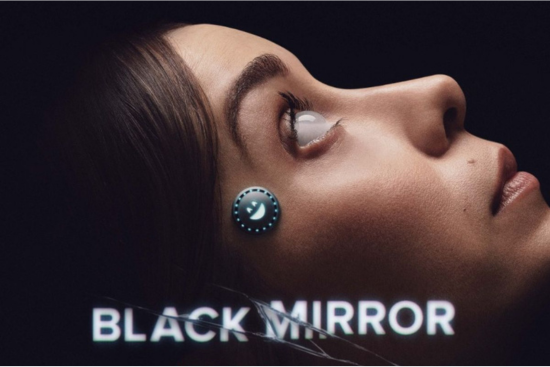
Photo: Courtesy of Netflix
The discomfort stems precisely from this closeness. The viewer isn’t looking at a distant century. They’re looking at a slightly exaggerated version of the present itself. Over the years, it has become common to hear that certain episodes “have become reality.” Perhaps the issue is something else: the series was never as far from reality as it seemed.
Behind the screens, algorithms, and devices, *Black Mirror* explores fear, belonging, loneliness, power, and recognition. Technology serves as the backdrop. The issue remains a human one.
The Disappearance of Fantasy
As science fiction has gained the ability to interpret the present, it may have lost some of its capacity to create a sense of strangeness. Much of today’s fiction builds on existing trends: it observes a direction and tries to imagine where it leads.
The problem is that projecting trends is not the same as inventing the future. Projecting extends a line. Imagining changes its direction. Major cultural, scientific, and technological breakthroughs rarely arise from linear projections; they are born of ideas that, at first, seem improbable or absurd.
That’s where fantasy becomes important. Not as an escape from reality, but as an intellectual tool. It creates space for impossible hypotheses to exist long enough to be explored. Without that space, the imagination becomes nothing more than a sophisticated way of managing the present.
Science Fiction, PISA, and Literacy for the Future
This discussion may seem literary, but it relates directly to education. PISA 2022 assessed creative thinking as the ability to generate diverse and original ideas, as well as to evaluate and refine ideas in different contexts. PISA 2029, on the other hand, will feature media literacy and artificial intelligence as its innovative domain, focusing on the ability to assess the credibility, quality, and purpose of digital content and to act in an informed and ethical manner in environments mediated by media and AI.
This reinforces a central idea: knowing about technology is not enough. We must understand its impacts, interpret information, identify mediations, and question narratives. But there is an additional layer: in addition to interpreting the world, we must continue to imagine worlds.
In this sense, science fiction can serve as a laboratory for the future. It helps students realize that technologies are not natural phenomena; they are human constructs laden with choices, interests, and consequences. Rather than asking whether a piece of information is true or false, it allows us to ask what kind of society we are helping to build.
Perhaps its greatest contribution to the 21st century is not predicting the future, but reminding us that the future remains open-ended. In an era marked by rapid technological advancement, information overload, and a constant sense of urgency, imagination remains a strategic skill. Because societies that merely adapt to the present may survive, but it is the societies that can imagine alternatives that truly create the future.
About the author:
*This text does not necessarily reflect the opinion of Bett Brasil.

Share on social media:
Categories
- The Future of Education
- Innovation