
Reggio Emilia: A School That Embodies the Principles of Education and Social Work
)
The Reggio Emilia school, which is enjoying such success in Brazil, is an educational approach that originated with a group of feminist women. It is a school that was built from the ruins left behind by the Germans at the end of World War II. That alone explains part of the history this school has forged.
This school experience is rooted in the struggles of parents—especially working mothers. It is a school that adheres to the principles of social welfare while also providing an education. It is a school where parents participate effectively. It is a school where professional development takes place on the job. It is a school whose leaders play a social role and work within that context.
Reggio is not just a school with pedagogical documentation, investigative contexts, atelieristas, and pedagogistas. This early childhood education approach is winning over educators around the world.
In Brazil, there is a growing demand for information and training based on this pedagogical approach, because it places the child at the center of their own learning.
What Happens in Practice
In the classroom, for example, I found nails, broken glass, pieces of wire, scissors with sharp tips, and pens with caps that come off. When asked about the danger these items posed to the children’s safety, the Reggio educators responded with a look that seemed to say: “What kind of world do the children you work with live in?” The response was a provocation that many Brazilian educators attending the training were unable to understand.
See also:
- Reading is a tool for raising awareness
- The Pedagogy of Error
- Nonviolent Communication Promotes a More Inclusive Environment in Schools
They failed to understand that where they see danger for the children, Italian educators see opportunity; where they see restrictions, Italian educators see real-life contexts. On that occasion, the Brazilian educators were left with the impression that the Italian educators did not take sufficient care of the children or provide them with the same level of protection that Brazilian educators did.
The child in this educational process
Reggio truly places the child at the center of their own story. While they receive support and guidance from a pedagogist (what we Brazilians call “educadoras”), it is the child who is the author of their own learning. Children can develop projects that reflect their own identities. They can do this alone, with a friend, in pairs, in groups of three, or in other group formats.
Reggio provides freedom and, at the same time, builds that freedom together with the children. Reggio provides opportunities and, at the same time, helps those opportunities take shape before the child and empowers the child to take the lead.
We, as parents and educators in Brazil, have not yet been able to let go of the lecture-style class, the desks lined up in rows, and the textbooks—which so greatly limit a child’s world and confine the child to only a part of it. Reggio gives children the whole world and puts them in the driver’s seat. Children feel free to explore it.

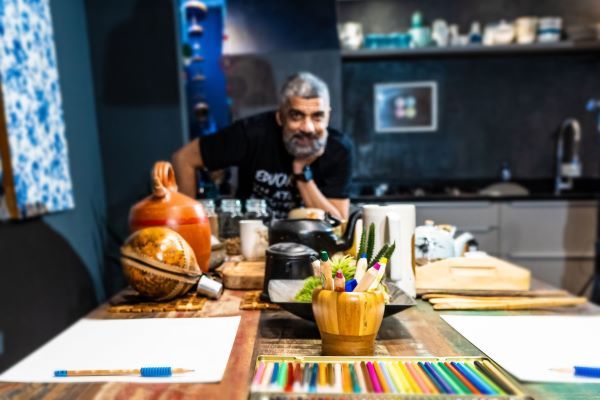
Tea workshop designed to show educators how the work can be carried out in practice
Reggio schools don’t have playgrounds filled with colorful plastic toys. Instead, their outdoor play areas are empty. Whether there’s a little grass or none at all, there are trees, dirt, and a few pre-built wooden play structures. The rest is a large blank, empty space that children can fill with their imagination.
How to Evaluate Students
There is a very important aspect of the Reggio approach, which is pedagogical documentation rather than report cards, portfolios, or structured assessments consisting of questions to be answered.
Educational documentation is, in fact, a form of documentation. Similar to a legal document, it records, day by day, information about the child’s progress—how the child behaved when making choices and how the choices that were expected of that child did not materialize.
Educational documentation provides a longitudinal view of a child’s development up to that point. It is precisely this longitudinal perspective that allows educators to assess and understand what is missing, what needs to be added, what to introduce, and how to share these children’s experiences with their peers on this journey. Educational documentation is, perhaps, the most enchanting aspect of this educational project.
Benefits for the Family
Families benefit greatly from a practice like this, because it is through this documentation that parents—as well as educators—can see the direction their child is taking.
The Mission
Reggio schools have an important mission for educators: to demonstrate the importance of an educator who is motivated, loves what they do, and is fully immersed in the classroom environment.
The educator’s passion is the great transformative force in a classroom. The educator is the driving force behind the learning process. It is this learning process that takes place in schools there but does not happen in Brazil. When this learning process takes place, students and teachers are in the same boat—the boat of discovery.
About the author:
*This text does not necessarily reflect the opinion of Bett Brasil.
Share on social media:
Categories
- Teaching Methodologies