
Ahead by Bett fosters strategic reflection on innovation and the future of higher education in Brazil
)
The 3rd edition of Ahead by Bett, an event held concurrently with Bett Brasil and dedicated to higher and vocational education, fostered an environment of ideas, learning, and networking among administrators, institution operators, directors, solution providers, and educators. The event took place from April 28 to May 1 at Expo Center Norte in São Paulo.
This year, Ahead by Bett brought together approximately 35 speakers for a forum dedicated to discussing key issues related to the reinvention of higher and professional education, guided by the central theme: “Education to Address Crises and Build Regenerative Futures.” The event also featured an exhibition area that brought together more than 35 companies, including solution providers and educational institutions.
Among the forum’s highlights, the panel “Reinventing Higher Education: AI Strategies to Transform Institutions” discussed the role of Artificial Intelligence as a strategic tool in the transformation of universities. Pedro Henrique, who holds a master’s degree in Communication from the Federal University of Fluminense (UFF), noted that “seven out of ten undergraduate students already use AI to support their studies,” ranging from automated summaries to the development of academic projects.
Bruno Rocha, head of Digital Technology at YDUQS, cautioned against the thoughtless use of AI and the risk of superficial learning. “Teachers remain essential for fostering critical thinking,” he said, arguing that AI should enhance the personalization of education without replacing reflective reasoning.
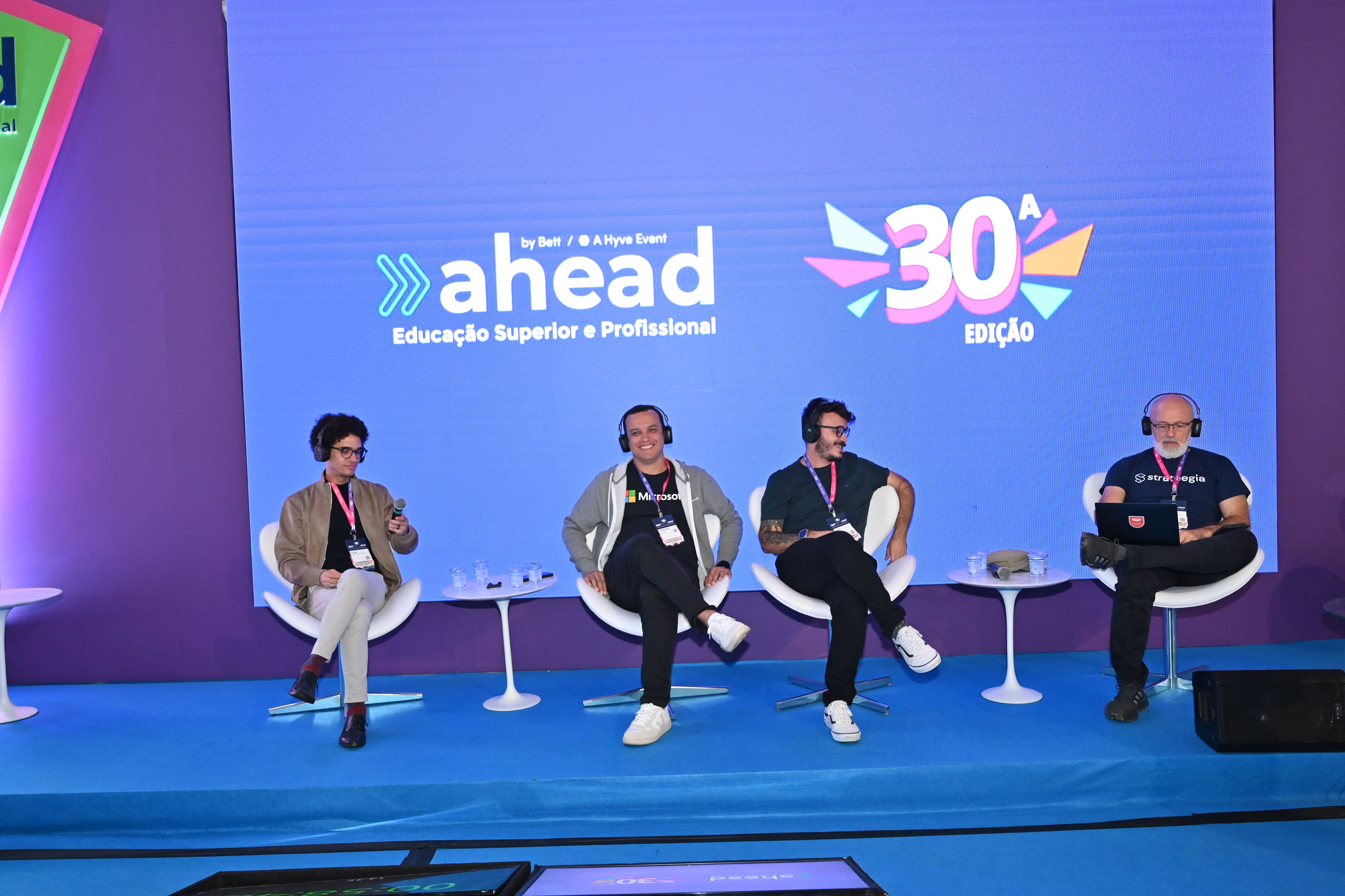
The session explored how AI can collaborate with educational institutions. Photo: Bett Brasil.
The role of AI as an enabler of human capabilities was the focus of Microsoft’s Director of Education, Fernando Cruz, who cited tools such as Copilot, a Microsoft platform that uses AI to assist with academic and administrative activities. He highlighted a LinkedIn survey that found: “83% of companies expect to hire professionals with new skills by 2027.”
Also on the panel, TDS Company’s chief scientist, Silvio Meira, proposed the concept of “Generalized Intelligence” to explain the transformative impact of AI. “We are still exploring the practical possibilities of AI. To move forward, we need to experiment, test, and adapt to real-world scenarios,” he argued.
For him, the biggest challenge is to modernize the educational system by training teachers to work in this new environment. “Education needs to stop focusing solely on memorizing content and start fostering the development of human intelligence, encouraging critical thinking and problem-solving skills,” he concluded. The expert noted that AI could spark a revolution comparable to the invention of Gutenberg’s printing press.

The Ahead exhibition area showcased new products, services, and solutions for higher education. Photo: Bett Brasil.
Rethinking Undergraduate Education
Another notable panel was “Rethinking Undergraduate Education: A Product-Centric Approach to Education,” which addressed the need to restructure degree programs with a focus on the student experience. Jeferson Pandolfo, a consultant at Hoper Educação, pointed out that Generation Z prefers to learn through short videos and interactive activities. “They have a ‘maker’ mindset. They want to learn by doing,” he commented, also advocating for the adoption of micro-certifications that recognize the learning journey from the very beginning of the program.
Rector Ricardo Ponsirenas presented the model for developing educational products at FMU and FIAM-FAAM, which involves actively listening to faculty members and aligning with market demands. “A product is a foreign concept in the academic world, but it takes study and dedication to make it work,” he noted.
See also:
- The 30th edition of Bett Brasil brings together thousands of educators and underscores the key role of education in social transformation
- Managers' Forum Discusses Mental Health, Hyperconnectivity, Financial Management, and Leadership at the 30th Edition of Bett Brasil
- Check out the winners of the Bett Brasil Edtech Awards
João Vianney, a partner at Hoper Educação, criticized the proposed new regulatory framework for distance education, pointing out that the proposal lacks statistical support and, “rather than promoting quality, it threatens educational inclusion, exacerbates regional inequalities, worsens the teacher shortage, and isolates Brazil academically from the international scene,” he said.
According to him, INEP data show that teacher training through distance learning does not compromise the quality of education because the IDEB score improved in the early grades while the number of teachers with degrees in education increased significantly.
In closing, the experts emphasized that the education sector faces an increasingly competitive and challenging environment. To attract and retain students, it will be essential to invest in innovation, curricular flexibility, data-driven strategies, and public policies that ensure access and retention. “Understanding the profile of the new student is essential to creating a more personalized and effective education,” concluded Ponsirenas.
Ahead by Bett demonstrated that the future of higher education requires innovations that break with existing paradigms and build models more closely aligned with students’ realities and the changes taking place in society.
Share on social media:
Categories
- The Future of Education
- Innovation