
Vocational education requires civic education to address historical inequalities
)
The discussion on the role of vocational education in Brazil must necessarily take into account the country’s history and the inequalities that have shaped Brazilian society. This was one of the insights shared by Lucila Sciotti, Superintendent of Operations at Senac São Paulo, when addressing the relationship between vocational education and civic education.
According to the expert, the historical difficulty in accessing education has helped to solidify a social structure that continues to influence how work and professional qualifications are understood. In her view, vocational education cannot be analyzed solely from the perspective of employability, but also as a tool for human and y development and the strengthening of citizenship.
“We live in a country marked by limited access to education,” Lucila said as she provided context for Brazil’s historical development. In her analysis, the legacy of a society built on deep-seated inequalities has contributed to the unequal valuation of certain forms of work and to the segmentation of educational opportunities.
The expert pointed out that access to education has expanded gradually over the past few decades. She noted that it was not until 1961 that technical school students were first given the opportunity to continue their education at the higher education level. Education was recognized as a right for all under the 1988 Federal Constitution, while the guarantee of a school seat for the entire population began to take shape in 1996. Compulsory attendance for children and adolescents up to age 14, however, was not extended until 2012.
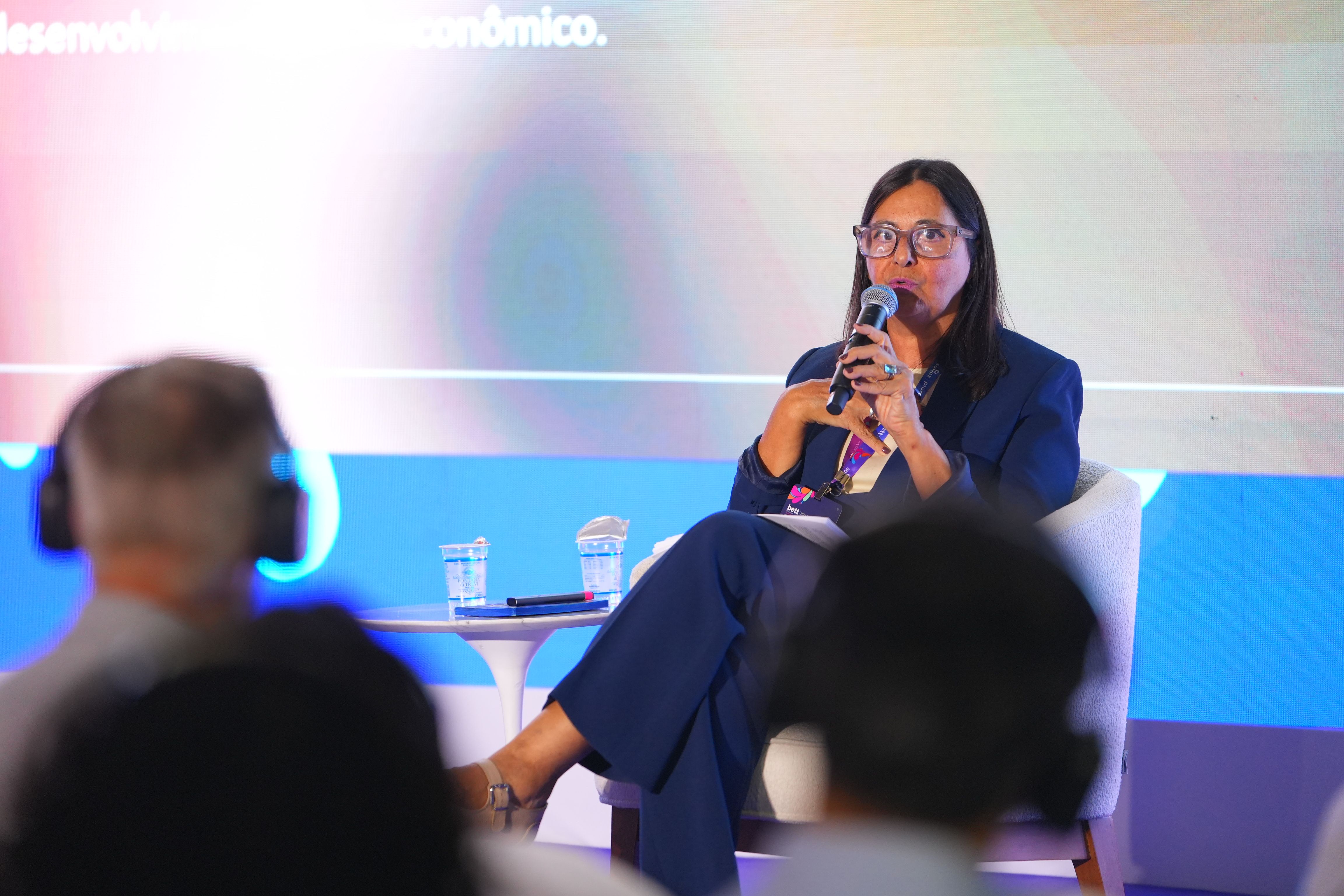
Lucila Sciotti discussed the current state of higher education in Brazil. Photo: Bett Brasil.
In this context, Lucila argues that vocational education still bears the marks of historically constructed social differences. “Today, vocational education reflects the class divisions rooted in the country’s labor history. It is up to us, as educators, to create a vocational education environment that takes a comprehensive and generous approach to shaping citizens,” she notes.
Training That Goes Beyond the Technical Aspects
The expert notes that vocational education serves a diverse range of audiences, from young people seeking their first career opportunity to professionals looking to gain specialized skills or re-enter the job market.
This diversity, she says, requires approaches that go beyond the development of technical skills. Recognizing students’ life stories and understanding their needs become central elements of a more comprehensive education.
For Lucila, vocational education has the potential to contribute not only to entry into the labor market but also to the development of ethical values and more conscious participation in society.
See also:
- CIEE Ahead Forum – Higher Education Expands the Debate on Innovation, Work, and the Future of Universities at Bett Brasil
- Experts advocate for universities that are more closely connected to the job market and social change
- Higher Education Reinventing Itself Through Innovation, AI, and a Focus on Employability
Work as an Educational Principle
Another point highlighted by the superintendent is the need to view education as a lifelong process. In Brazil, the economically active population consists of people between the ages of 15 and 64, a group that includes approximately 140 million individuals.
Within this context, educational challenges remain significant. Lucila pointed out that 29% of this population is considered functionally illiterate and that 7% is illiterate. “Many of these people enter vocational education programs with gaps in their basic education, which increases the responsibility of educational institutions,” she said.
For her, preparation for work must be linked to an understanding of the role each individual plays in society. “Viewing citizens as agents of a developing society, grounded in ethical principles, contributes to a broader perspective on work. In this context, the role of vocational education is to create environments that, in addition to technical training, provide students with a comprehensive education focused on building the common good,” she concludes.
The remarks by Lucila Sciotti, Superintendent of Operations at Senac São Paulo, were presented during the CIEE Ahead Forum, held at Bett Brasil 2026.
Share on social media:
Categories
- Learning Strategies