
Leaders at the Heart of Transformation: How Education Will Tackle Crises and Build Regenerative Futures
)
The challenges facing quality and equitable education have never been more urgent. Today’s world calls for new strategies to address crises and prepare schools and administrators for a new future. Now is the time to rethink, rebuild, and reimagine education.
As a basic premise, to discuss how managers and educators can prepare for a rapidly changing world, where innovation and adaptation are essential.
To this end, several paths are identified to further discussions, dialogues, and effective practices. One of the main ones places the manager at the center of the conversation about this rapid, accelerating transformation that poses new challenges on a daily basis. Another involves the intrinsic aspects of these new times, which include addressing existing crises and working to build regenerative futures.
The manager at the center of the conversation
School administrators must take action to transform their schools. Strategies such as strengthening collaborative networks, investing in technology, and promoting ongoing professional development are essential for addressing the challenges facing education today.
Making decisions, taking decisive action, and acting cause anxiety for everyone. It’s understandable that this also affects educators and administrators. This anxiety stems from the fact that administrators must set in motion actions that, in practice, have not yet been defined but require solutions in order to be implemented.
As we focus on urgent matters and the various challenging crises we face, it is essential that the manager be at the center of the conversation. After all, when urgent matters multiply, we need to show empathy and be supportive in the face of individual crises in the midst of a complex world. And within each school, individually, is the administrator.
It is against this backdrop that Bett Brasil—a long-standing event recognized as the largest and most comprehensive gathering on Innovation and Technology in Education in Latin America—serves as a platform for dialogue, showcasing opportunities, solutions, and trends.
From April 28 to May 1, at Expo Center Norte in São Paulo, the 30th edition of Bett Brasil will serve as a key forum for this debate on the present and future of education.
It won’t provide all the answers, but it will offer an up-to-date overview of what’s happening in Brazil and around the world. It won’t offer easy, immediate answers to pressing challenges, but it will open doors to a reimagining of our current education system, as well as “glimpses” of future trends.
It’s no wonder that this year’s event centered on a theme that carries profound and symbolic messages for all educational institutions, for future generations, and for educators and administrators: “Education to tackle crises and build regenerative futures.”
The proposal is to explore the endless possibilities of sustainable and resilient systems, with a focus on the regeneration of natural resources, as well as social, emotional, and—inevitably—educational issues.
This is an issue that requires the participation of everyone in society. Clearly, since education serves as the key link in addressing a wide range of crises and building regenerative futures, it is worth reiterating the importance of leaders at the center of these conversations.
Over the years, Bett Brasil has refined the Administrators’ Forum, a space dedicated to dialogue, debates, and proposals, with the aim of addressing and resolving the crises facing humanity—crises that, of course, affect education, students, educators, and administrators.
Based on the reality of education in Brazil and around the world, we can develop strategies to address crises and prepare administrators for the rapid changes that require constant adaptation.
Macrotema and Its Foundations
How can we address crises and build regenerative futures through education? Thecentral theme of the 30th edition of Bett Brasil proposes reimagining and presenting a wide range of possibilities so that education can serve as the starting point for addressing various crises, with a view toward building regenerative futures.
That is why it is important to discuss this issue, to understand what crises we are facing, and to determine how education can help resolve them. And this requires a debate grounded in solid and deep foundations.
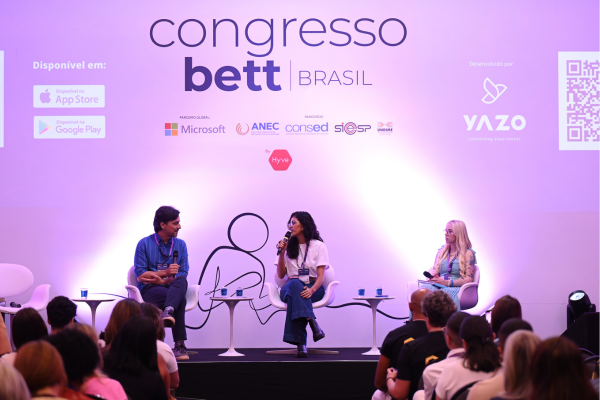
The 30th edition of Bett Brasil will bring together experts to discuss challenges, trends, and solutions in education. Photo: Bett Brasil.
This reimagining and reconstruction through education are feasible and require a foundation that prevents the educational structure from collapsing or becoming distorted over time; that protects it against ground movement, erosion, and other natural forces; and that extends its useful life and ensures the safety and integrity of society as a whole.
To reimagine and build regenerative futures, it is also essential to understand the relationship between families and the educational ecosystem and to further promote student agency, as well as teacher autonomy and administrative leadership.
All of this while continuing to ask essential questions, such as: What is working inside and outside the classrooms and in schools? If it’s not working, how can we address these problems and concerns?
And it is to raise questions, spark debate, and foster dialogue that Bett Brasil once again brings together renowned Brazilian and international experts, educators, opinion leaders, and influencers to present different perspectives on schools, society, and the world.
For these discussions, a number of subtopics have been identified—the foundational elements that will underpin the event’s main theme—such as:
- Climate Crisis: environmental education, ESG in education, and the green economy;
- Artificial Intelligence: Impact on Learning, Personalization of Education, Ethical Challenges, and School Restructuring;
- Mental Health: anxiety , bullying, the impact of social media, the school climate, and the well-being of students, teachers, and administrators;
- Learning to Do: vocational training aligned with the job market and the New High School Curriculum. And the existing gaps in vocational education and higher education;
- Access, retention, and equity in education: inclusion, school dropout rates, neurodiversity, representation, full-time education, anti-racist education, Indigenous education, Quilombola education, and riverside communities’ education;
- Human Development: social-emotional learning , teacher training, and new methodologies.
Learn How to Make
When addressing regenerative futures in the context of education, Bett Brasil also promotes teacher training and teachers’ engagement with the world.
Regenerative pedagogy serves as a tool that promotes the development of a critical and transformative mindset, introducing educational models into schools that emphasize creativity, problem-solving, critical thinking, constructive feedback, the co-creation of knowledge, and peer interaction—all of which are central to a dynamic and ongoing process of collaborative learning.
The Managers’ Forum is one of the venues at Bett Brasil, where we will discuss key educational topics of interest to educators and administrators. As we observe trends and look ahead, learning how to do things is one of the issues on the radar of the entire educational system—and not just for Brazilian administrators, but for those around the world as well.

There will be 16 sessions over the course of 4 days at the Managers' Forum. Photo: Bett Brasil
To shed light on this topic, we invited Xavier Araguay, founder and president of Reimagine Education, who has more than 45 years of experience in leadership, change management, and educational innovation at universities, schools, and school districts.
Araguay will be at the 30th edition of Bett Brasil to discuss precisely the concept of “Learning to Do.” It will raise questions, encourage us to reimagine education, and ask whether we are prepared to lead the educational transformation that lies ahead in a world that is changing at breakneck speed—a world that is constantly evolving under multiple pressures: social, demographic, familial, economic, educational, administrative, and technological—especially with the emergence and development of Artificial Intelligence and its impact on the teaching and learning process.
One of Araguay’s proposals is to take a break—a break to reflect, look toward the horizon, anticipate the major changes underway, and figure out how to address the profound transformations that require leadership and effective school administrators.
After all, the manager is a key player in the transformation of education. Their role goes beyond administration: they must lead change, develop solutions, and adapt to challenging situations, always with a strategic and innovative vision. It is also up to the administrator to listen and lead such changes while navigating challenging contexts.
So, what's next?
With so many changes and advances, the future of education is moving toward becoming more personalized, technologically advanced, dynamic, and aligned with the needs of a society in constant transformation.
In particular, regenerative futures—restoration through actions that can improve ecosystems, communities, and social and economic processes over time.
This approach is linked to sustainability, ecology, and social design, with the aim of creating a regenerative culture—a continuous process of recovery, renewal, and strengthening of systems—that revitalizes and even improves what has been damaged or worn down.
Environmental and science education for democracy are two areas that are deeply interconnected. Both seek to foster critical-thinking citizens who are committed to the collective well-being and sustainability. This is especially true because educators, administrators, and students are agents of change, committed to resisting forces that threaten a just transition to a low-carbon economy, where profit is not prioritized at the expense of social and environmental justice.
Technology, especially artificial intelligence, will have a significant impact on education and promises to further this transformation in 2025 and beyond. It is likely to establish itself as an indispensable partner for schools, serving as a virtual assistant and helping to generate detailed performance reports.
AI will help teachers and administrators plan more effective teaching strategies. Practices such as augmented reality and maker labs, when integrated into the school day, can provide immersive and innovative experiences, transforming the teacher’s role into that of a facilitator and mentor.
The focus on individualizing instruction—by adapting curricula and methods to each student’s profile—remains a priority, creating inclusive environments focused on maximizing individual performance. For this reason, technologies for detailed data analysis are valuable allies, as they can ensure that each student’s needs are identified and addressed effectively.
The traditional assessment model is being rethought, making way for formative and ongoing assessments that prioritize the development of skills such as problem-solving, critical thinking, and collaboration.
Inclusion is also gaining momentum as the number of diagnoses of unconventional educational needs increases. Individualized education plans (IEPs) and personalized activities for gifted students or those with high abilities demonstrate a commitment to equity.
Project-based learning should also be established as an effective methodology for engaging students and developing skills beyond the school setting. It will be necessary to bridge the gap between theory and practice and foster skills such as teamwork, leadership, and independence.
There is also the urgency of listening. And, since it never hurts to turn to the educator Rubem Alves, let me give an example: “I always see ads for public speaking courses. I’ve never seen an ad for a course on listening. Everyone wants to learn how to speak. No one wants to learn how to listen. I thought about offering a course on listening. But I don’t think anyone would sign up. Listening is complicated and subtle…”.
As everyone knows, school is a place to think, rethink, do, redo, and reimagine. That is precisely why the 30th edition of Bett Brasil is committed to innovation and technology—such as reimagining our thinking for regenerative futures, transforming knowledge into wisdom, identifying trends, and preparing for what lies ahead.
Bett Brasil 2025 marks a new era for education: one that is more humane, connected, innovative, collaborative, regenerative, and ready to tackle the challenges of the 21st century.
About the author:
Article originally published in *Revista Escola Particular*—March/April issue.
)
Share on social media:
Categories
- Educational Management