
Participation in Bett Brasil Boosts the Visibility of the Sérgio Henrique Ferreira Chair
)
In keeping with its commitment to collaborate on the development of public education policies that help improve the quality of education and combat educational inequality, the Sérgio Henrique Ferreira Chair at the Ribeirão Preto Campus of the Institute of Advanced Studies at USP significantly expanded its reach in the first half of 2023. One result of this was the partnership established with Bett Brasil, the organizer of Latin America’s largest education and technology conference.
The program for the event, held in May at the Transamérica Expo in São Paulo, featured content curated by the Chair and bore its seal on the certificates issued to participants. In all, more than 35,000 people attended over the four days. Three panel discussions and a workshop featuring researchers involved in the Chair’s projects and affiliated with USP Ribeirão Preto drew packed audiences.
The activities covered topics such as literacy, the use of data in learning, educator development, and holistic education. Speakers included prominent professors and researchers on campus, such as Elaine Paiva Assolini and Fabiana Versuti from the Ribeirão Preto School of Philosophy, Sciences, and Letters; and Luiz Guilherme Scorzafave from the Ribeirão Preto School of Economics, Business Administration, and Accounting.
New High School
The Chairholder, Mozart Neves Ramos, also participated in other activities. Alongside the president of the National Association for Hybrid Basic Education, Maria Inês Fini; the director of the Reúna Institute, Kátia Smole; and the holder of the Ayrton Senna Institute Chair for Innovation in Educational Assessment, Maria Helena Guimarães de Castro, he discussed the challenges of the New High School System.
The debate highlighted the importance of continuing the work to implement the model in school systems across the country, a process that has been underway since early 2022. “There is a great responsibility at every level. Repealing the New High School Reform would be a failure to uphold the democratic rule of law. What is needed, rather, is to improve it,” said Maria Helena.

Kátia noted that the Ministry of Education’s failure to oversee the process at the time prevented the creation of an implementation plan. According to her, this would have prevented distortions, such as confusion between elective and required courses, and would also have aided in the planning necessary for implementation—which includes hiring teachers and training them.
“A recent survey conducted by Firjan SESI in partnership with the UNDP [United Nations Development Program] showed that 500,000 young people drop out of school each year. This reflects these students’ disillusionment with school. We need to develop a school of choice. The training pathways cannot be eliminated because they are directly linked to all aspects of this model. And no teacher is prepared for this ‘school of choice.’ It is precisely the implementation roadmap that will help plan teacher training for this purpose,” he said.
Maria Inês, meanwhile, addressed the discussion on how to adapt the National High School Exam (Enem) to the new reality. She emphasized the importance of the National Common Core Curriculum (BNCC) in this process and in other aspects of the New High School System. “If you look at the BNCC and the current Enem framework, you’ll see that they align. No one is going to reinvent the wheel; we need to continue doing what’s already being done. The BNCC framework provides the foundation for everything: assessment, teacher training, and instructional materials.”
The Use of Data in Education
The participation of the Sérgio Henrique Ferreira Chair at Bett Brasil also highlighted the importance of using data to understand the reality of education and develop effective public policies. In a lecture held in partnership with the Telefónica Foundation for members of the National Union of Municipal Education Directors (Undime), Mozart emphasized the need to carefully interpret educational indicators and look beyond the numbers.
“One of the major problems with Brazilian education is applying the same educational policy to schools in diverse contexts. It’s like prescribing the same medicine for different illnesses. Two municipalities with the same Ideb score do not necessarily have the same problems. If students in Municipality A score 3.523 in Portuguese and 7.003 in math, and students in Municipality B score 7.003 in Portuguese and 3.523 in math, they may have the same standardized score, but the challenges facing their school systems are different,” he explained.
The chairholder also noted that increasing investment does not always lead to better results. He cited the case of Ceará, where the ratio of the Ideb to GDP in 2019 showed that the state achieved excellent results in education with less investment than many states that had worse results. “Of course, in some situations, having more money is truly necessary. That’s why those who work with numbers—with these indicators—need to learn to look at them from a systemic perspective.”
To equip technicians and managers in municipal education departments with the knowledge needed for this evaluation capacity, Mozart explained that he intends to create a permanent school for data analysis within the Chair. He cited the pilot project, carried out later in July with 12 partner municipalities and support from the Telefónica Foundation, and stated that he intends to expand the initiative. “We’re starting with nearby municipalities, but perhaps in the future we can count on partnerships with organizations such as Undime itself to expand our reach,” he said.
Data Workshop
Also as part of the Bett Brasil program, Leomar Silva and Larissa Maciel—students in the Applied Mathematics for Business program at USP Ribeirão Preto who are members of the Cátedra team—led the workshop “Data Use and Visualization in Education.”
Before an audience of officials from municipal education departments in states such as São Paulo, Mato Grosso, and Sergipe, among others, they discussed the Chair’s work, explained the studies involving principal component analysis, and presented some of the results of their work—such as the maps generated from the data analysis, which help visualize school performance from a geographic perspective.
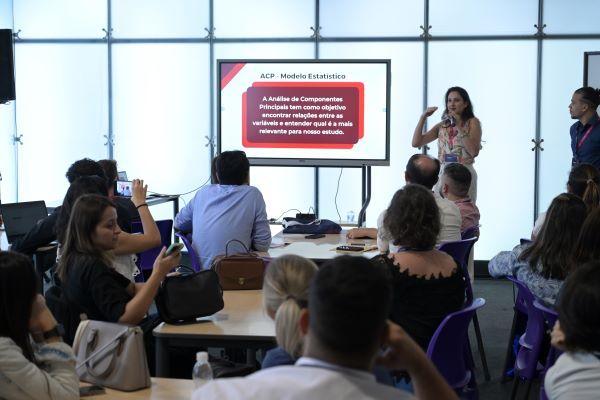
“Data visualization plays a key role. Conveying this information in an accessible way is very important for evidence-based decision-making,” Leomar emphasized.
For Larissa, the presentation at Bett Brasil increased the visibility of the Chair’s projects among various audiences in the education sector. “The recognition and feedback we received for our work were gratifying. In addition, exchanging ideas with the audience provided us with new insights to incorporate into the project.”
Article originally published on IEA-USP.
Share on social media:
Categories
- The Future of Education